I’m 23. I’m from France. I own 400 shares of IonQ .
I’m writing that upfront because it matters for what comes next. I’m not a fund manager. I’m not paid to post. Whether the stock goes up or down tomorrow, my life doesn’t change. I’m a master’s student in international business who got pulled into the quantum world a year ago and hasn’t been able to look away since.
What started as curiosity turned into something else. A year of reading, asking questions, getting things wrong, being corrected by people who knew more, and trying again. The physics didn’t come naturally. Neither did the financial side. But piece by piece, conversation by conversation, it started to connect.
And I’ve been wrong along the way. More than once. The community has corrected me, caught names I misspelled, flagged claims I couldn’t fully source. That’s not a weakness of doing this publicly it’s the point. Working in the open means your mistakes are visible, and that’s exactly what keeps the work honest.
The real craft was never about one acquisition. It was about connecting them. Oxford Ionics. SkyWater. Capella Space. Vector Atomic. Lightsynq. Qubitekk. ID Quantique. Skyloom. Seed Innovations. Nine deals in roughly twelve months, and each one reshapes a different layer computing, manufacturing, networking, sensing, space, security, software.
That’s before you count the hires behind them, the integration team under Petrina Zaraszczak, the European expansion through Lorenzo Roversi in the Nordics, Marco Pistoia in Rome with the €1B Italian commitment, Darren Strange in Oxford. Before the university partnerships Cambridge and the Cavendish Lab, the OxCam corridor, the AstraZeneca BioVentureHub in Gothenburg, MTSU’s QRISE Center in Tennessee. Before the government layer SHIELD IDIQ, Golden Dome, Katie Arrington as CIO, the GDIT partnership, Robert Cardillo at IonQ Federal. Each piece is a story. Together they tell something bigger.
And somewhere along the way, a community formed. The IonQers. Multilingual, scattered across time zones, reading the same filings, catching each other’s mistakes, crediting each other’s findings. Some of my closest conversations this past year have been with people whose real names I don’t know.
Content in English, Japanese.. because the quantum ecosystem isn’t a single-language story, and the people trying to follow it deserve to read it in their own language.
I want to be transparent about why I do this. It’s not for money. 400 shares wouldn’t change that calculation either way. I do it to help the community understand what’s actually happening to make the information accessible. Quantum is hard. The filings are dense. The physics is intimidating. Most people who could benefit from following this story give up after two paragraphs of jargon. That’s the gap I try to close. That’s why I write the deep dives. That’s why I make short videos breaking down the technology in simple terms. Not for followers. For readers who want to actually understand. Because this ecosystem shouldn’t require a PhD to follow.
And when people message me asking why the stock is up or down on a given day I don’t have that answer, and more importantly, that’s not what I’m here for. Price action is noise. The ecosystem is the signal. I’d rather explain why an acquisition matters than guess where the candle closes.
I also write this from a European seat, watching a mostly American story with European fingerprints all over it Oxford in the UK, Pistoia in Italy, QuantumBasel in Switzerland, Roversi and the Nordic corridor, Cambridge’s Cavendish Lab. France is not yet a node on this map. Maybe that changes. Either way, writing from here means I see the European side of the ecosystem with a different kind of attention than someone based in Maryland or California would.
Two things keep me going. First, the medical side.
1/2 $IONQ
$IONQ
Reaction Engines spent 35 years building Britain’s hypersonic engine. It collapsed in 2024.
Its people didn’t disappear.
At least five now work at Oxford Ionics, IonQ’s UK subsidiary including Barry Coulling, who ran manufacturing at Reaction Engines and just became Director of UK Manufacturing at IonQ.
Three left together in January 2025 as the company wound down. Two more arrived since.
What they’re building in Britain isn’t a lab demo.
It’s IonQ’s 256-qubit system the 6th-gen machine on the roadmap.
The trap chips come from a foundry the full system is integrated and tested at Oxford.
On the May earnings call, IonQ said it had moved to “system-level testing of the full 256-qubit quantum computer.”
Integration, assembly, test at scale exactly what these people did on a rocket engine.
A portion of the talented people. His at IonQ.
Full scoop👇
$IONQ #IonQ #Quantum
$IONQ
Looks like a routine field-engineering hire. It isn't. The title is Field CTO.
The background: BCG Partner.
Zheng Cui (Stanford PhD, 6.5 yrs at BCG) just joined to help take IonQ commercial.
The argument under the hire is sharper than the headline. In 1937, Shannon showed how to build digital switches.
The first real use, phone networks, became a ~$100B business. That was only 2% of the value. Everything built on top (computers, the internet, AI) grew into a $5T economy no one saw coming.
Cui's bet: quantum runs the same curve.
"The pattern re-emerges," he writes.
The one thing quantum is proven to do today, break encryption, is the visible 2%. The 98% no one can name yet is what IonQ is building for.
@Rick101284 who caught it 👇
#IonQ #QuantumComputing
$IONQ
IonQ just hired Oracle’s Air Force account director.
Meet Scott Nahrgang - now Account Executive, U.S. Federal (Intel).
Before Oracle, two decades inside US national security:
→ 548th ISR Group commander (1,500 people, Beale AFB)
→ Air Staff A8 panel chair - $25.9B FY20 program portfolio
→ defense-intelligence advisor, US Mission to NATO
→ Special Assistant, OSD Legislative Affairs
He thanks Mike Lawson and Steve Harris on the way in - the ex-Dell duo who joined IonQ’s federal team in February. Lawson posted two AE reqs the same hour on Apr 7, one of them IC-facing. Nahrgang lands on the IC side.
Not a quota-carrier filling the IC seat. Someone who spent 20 years inside the agencies.
$IONQ #IonQ #QuantumDefense
$IONQ
“It’s probably what keeps me up at night the most.” That’s IonQ’s head of R&D and he isn’t naming China’s algorithms or qubit counts.
He’s naming the supply chain.
On AFCEA’s “Disruptive by Design” intelligence series, episode 1, hosted by former DIA director Ret. Lt. Gen. Bob Ashley: Mihir Bhaskar, SVP Global R&D @IonQ_Inc (with CNAS’s Dr. Costanza Vidal Bustamante).
His argument is blunt. The supply chain doesn’t decide the physics in a lab it decides whether you can ever commercialize. You produce quantum computers on 12-, 18-, 24-month cycles, and that only works if your sources are reliable enough to keep cadence.
Three chokepoints:
→ Chips. Volume demands standard CMOS fabrication non-standard processes can’t deliver the quantity. IonQ’s answer is its planned @SkyWaterFoundry acquisition: a quantum-chip fab on US soil.
→ Lasers and photonics. US labs have sourced theirs from China for years “cheap and honestly quite reliable,” in his words. Scaling commercially means abandoning that for domestic or trusted-ally supply.
→ Cryogenics. When it takes “a year to get a cryostat every time you need one,” every development cycle stalls behind the wait. The delay compounds.
The contrast should sting: China has treated quantum hardware like a Manhattan Project for years. A decade ago it imported its cryostats, same as the West. Today it builds every one in-house. The US and Europe still run on a fragmented chain most lasers, cryogenics and photonics bought abroad, almost no local alternatives.
Here’s why quantum is still stuck in R&D:
A fragmented, foreign-dependent supply chain means you can’t build machines in volume. Too few real machines means researchers national labs, universities, companies can’t get enough time on hardware to find tomorrow’s useful algorithms.
So the field keeps proving concepts instead of shipping them.
It’s not the math holding quantum in the lab. It’s the materials.
That’s why massive investment in the hardware supply chain isn’t optional now. It’s the whole race.
His full remarks below 👇
@Rick101284 he keeps surfacing the signals that actually matter.
$IONQ #IonQ #QuantumComputing #SupplyChain
$IONQ
“It’s probably what keeps me up at night the most.” That’s IonQ’s head of R&D and he isn’t naming China’s algorithms or qubit counts.
He’s naming the supply chain.
On AFCEA’s “Disruptive by Design” intelligence series, episode 1, hosted by former DIA director Ret. Lt. Gen. Bob Ashley: Mihir Bhaskar, SVP Global R&D @IonQ_Inc (with CNAS’s Dr. Costanza Vidal Bustamante).
His argument is blunt. The supply chain doesn’t decide the physics in a lab it decides whether you can ever commercialize. You produce quantum computers on 12-, 18-, 24-month cycles, and that only works if your sources are reliable enough to keep cadence.
Three chokepoints:
→ Chips. Volume demands standard CMOS fabrication non-standard processes can’t deliver the quantity. IonQ’s answer is its planned @SkyWaterFoundry acquisition: a quantum-chip fab on US soil.
→ Lasers and photonics. US labs have sourced theirs from China for years “cheap and honestly quite reliable,” in his words. Scaling commercially means abandoning that for domestic or trusted-ally supply.
→ Cryogenics. When it takes “a year to get a cryostat every time you need one,” every development cycle stalls behind the wait. The delay compounds.
The contrast should sting: China has treated quantum hardware like a Manhattan Project for years. A decade ago it imported its cryostats, same as the West. Today it builds every one in-house. The US and Europe still run on a fragmented chain most lasers, cryogenics and photonics bought abroad, almost no local alternatives.
Here’s why quantum is still stuck in R&D:
A fragmented, foreign-dependent supply chain means you can’t build machines in volume. Too few real machines means researchers national labs, universities, companies can’t get enough time on hardware to find tomorrow’s useful algorithms.
So the field keeps proving concepts instead of shipping them.
It’s not the math holding quantum in the lab. It’s the materials.
That’s why massive investment in the hardware supply chain isn’t optional now. It’s the whole race.
His full remarks below 👇
@Rick101284 he keeps surfacing the signals that actually matter.
$IONQ #IonQ #QuantumComputing #SupplyChain
$IONQ
“It’s probably what keeps me up at night the most.” That’s IonQ’s head of R&D and he isn’t naming China’s algorithms or qubit counts.
He’s naming the supply chain.
On AFCEA’s “Disruptive by Design” intelligence series, episode 1, hosted by former DIA director Ret. Lt. Gen. Bob Ashley: Mihir Bhaskar, SVP Global R&D @IonQ_Inc (with CNAS’s Dr. Costanza Vidal Bustamante).
His argument is blunt. The supply chain doesn’t decide the physics in a lab it decides whether you can ever commercialize. You produce quantum computers on 12-, 18-, 24-month cycles, and that only works if your sources are reliable enough to keep cadence.
Three chokepoints:
→ Chips. Volume demands standard CMOS fabrication non-standard processes can’t deliver the quantity. IonQ’s answer is its planned @SkyWaterFoundry acquisition: a quantum-chip fab on US soil.
→ Lasers and photonics. US labs have sourced theirs from China for years “cheap and honestly quite reliable,” in his words. Scaling commercially means abandoning that for domestic or trusted-ally supply.
→ Cryogenics. When it takes “a year to get a cryostat every time you need one,” every development cycle stalls behind the wait. The delay compounds.
The contrast should sting: China has treated quantum hardware like a Manhattan Project for years. A decade ago it imported its cryostats, same as the West. Today it builds every one in-house. The US and Europe still run on a fragmented chain most lasers, cryogenics and photonics bought abroad, almost no local alternatives.
Here’s why quantum is still stuck in R&D:
A fragmented, foreign-dependent supply chain means you can’t build machines in volume. Too few real machines means researchers national labs, universities, companies can’t get enough time on hardware to find tomorrow’s useful algorithms.
So the field keeps proving concepts instead of shipping them.
It’s not the math holding quantum in the lab. It’s the materials.
That’s why massive investment in the hardware supply chain isn’t optional now. It’s the whole race.
His full remarks below 👇
@Rick101284 he keeps surfacing the signals that actually matter.
$IONQ #IonQ #QuantumComputing #SupplyChain
@Rick101284 And there many more than this. I bet @TechInnovationz could make a great list, including those from other Big Tech too. Now that would be a great post! 😉
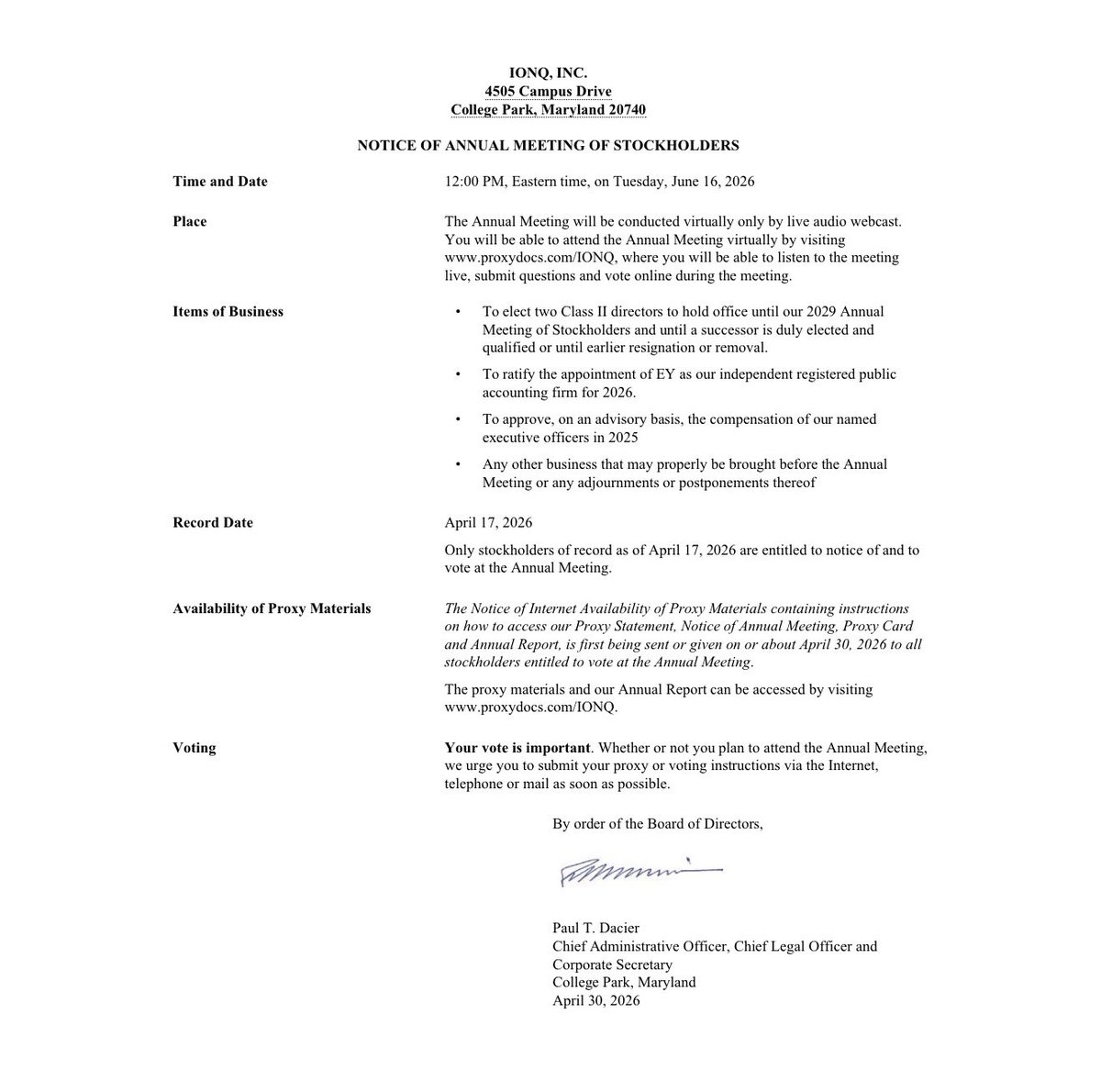
@KouziTsuru Three votes:
→ electing two directors, terms through 2029
→ approving Ernst & Young (EY) to audit the 2026 books
→ a non-binding vote on 2025 executive pay
#IonQ#Quantum