...the significance of thought processes in science, stating, "What matters is the thinking process that led to the discovery of those formulas. It's sort of critical thinking, first principles, analysis, trying to understand what is true at the most fundamental level, then reasoning up from there and testing your conclusions against the most fundamental truths in any given arena."
👍👍👍
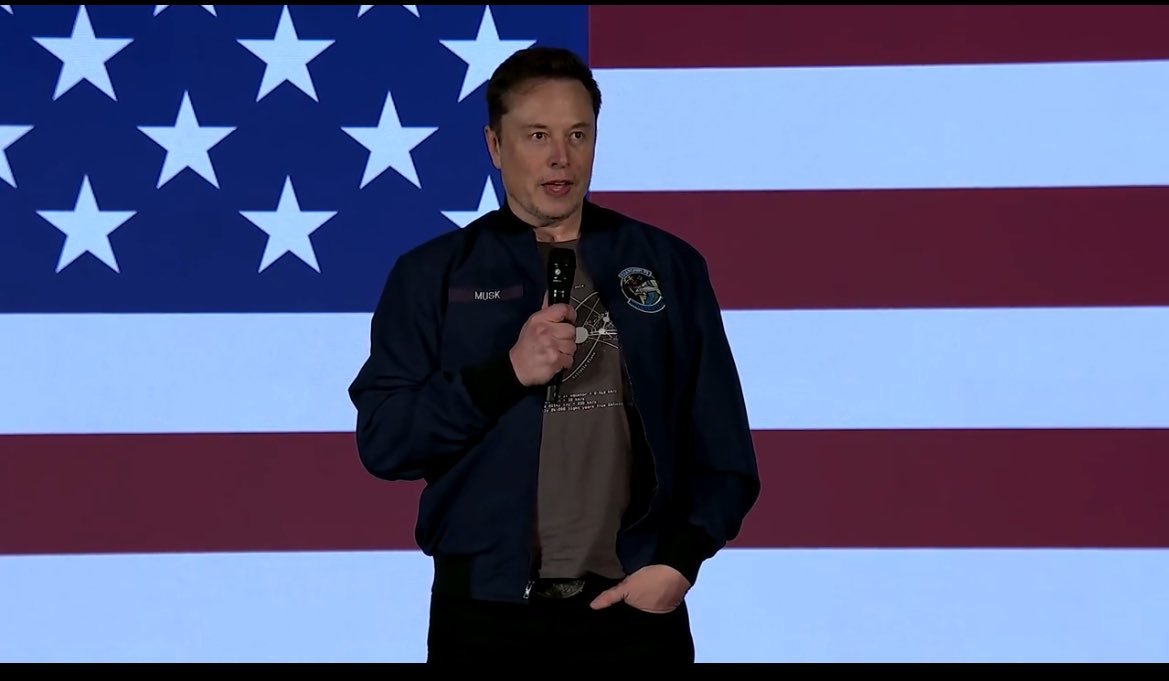
ELON MUSK ON LIFE AND PHYSICS
(Oct 26, Lancaster, PA)
Elon was asked, "Do you have an answer to life, the universe, and everything?"
Elon's Response on Life's Answer
Elon replied, "Well, the classic answer is 42, and 420 is just ten 42s!" -- This response refers to a well-known answer from Douglas Adams' The Hitchhiker's Guide to the Galaxy.
Discussion on Physics Education
Elon Musk discussed the importance of studying physics.
He shared his advice, starting with,
"I recommend studying physics, and the tools of physics, the thinking tools of physics. What matters is NOT remembering a bunch of formulas."
Importance of Critical Thinking
He further elaborated on the significance of thought processes in science, stating,
"What matters is the thinking process that led to the discovery of those formulas. It's sort of critical thinking, first principles, analysis, trying to understand what is true at the most fundamental level, then reasoning up from there and testing your conclusions against the most fundamental truths in any given arena."
Probabilistic Thinking in Physics
Elon explained the probabilistic nature of physics, saying,
"This is how you can figure out whether something is likely to be true or not. And I think it's good to think in terms of probabilities. So you receive information about a subject; that should change the probability of your conclusion, but not the certainty of your conclusion."
He continued,
"So, in Physics, you should not be 100% certain about any given prediction. Now, there are some things that are highly likely, but Physics teaches you that you've got to assign a probability to something being true, and then as you learn more information, your original conclusion may be wrong. Then you can change your mind based on the new information."
Intelligence as Predictive Ability
Elon discussed the nature of intelligence, offering his insight,
"How you can think of intelligence is just the ability to predict the future. The right metric for intelligence is the ability to predict the future. If you can predict the future well, then you are as intelligent as you can predict the future well."
He elaborated,
"Because if somebody claims that this person or this AI is very intelligent... well, how good are its predictions? If its predictions are not very good, it's not very smart. So that is the key nature of intelligence. And if you are trying to decide what to do in the future, it really just comes down to predicting the future, and to predict the future, you have to think critically about the past, and constantly try to be less wrong."
Final Advice
Elon concluded his discussion with his final piece of advice, "So maybe that would be right up there in terms of best advice. Aspire to be less wrong."
Thanks for reading. This short piece is an excerpt from my extensive articles on Elon Musk's Town Halls. You are here on X, right where the world's discussion takes place. Thanks for being part of it!
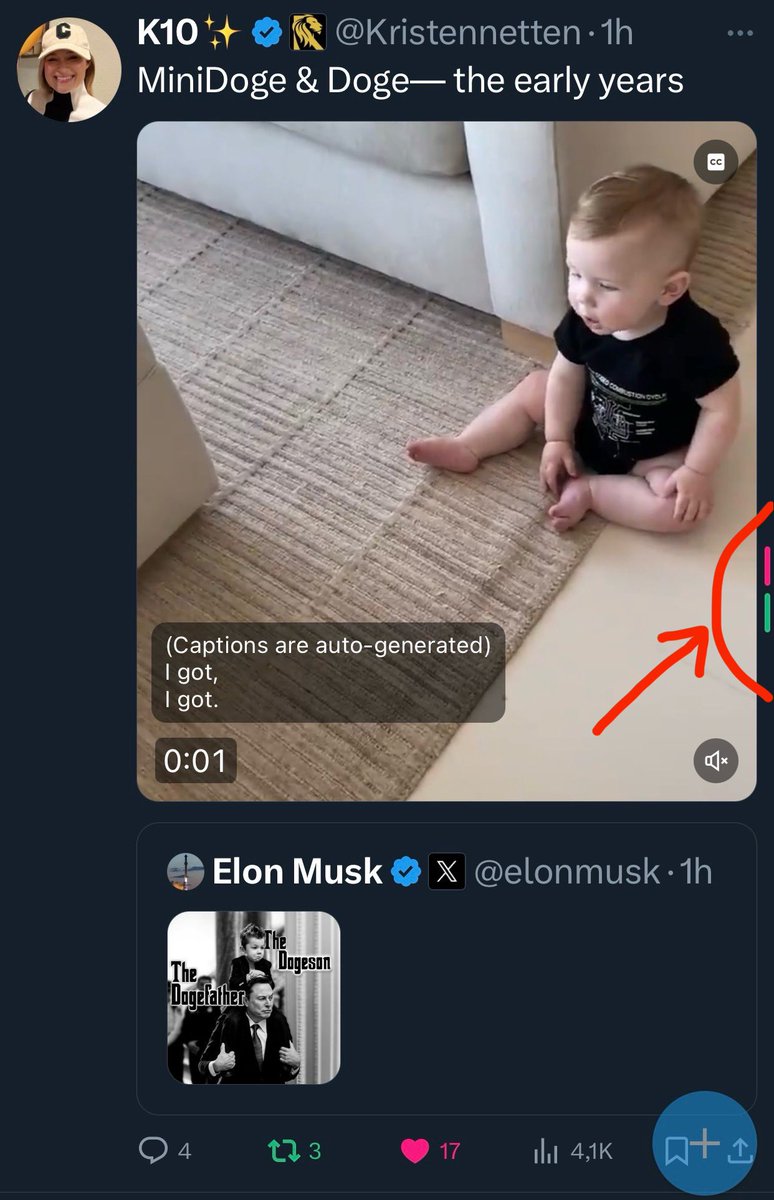
The new X update not only expanded the gesture control capabilities, but also updated the visualization. Now, when you like a post, a red indicator appears on the right side of the post, when you retweet a post, a green indicator appears. I like it! 🙌🏻
@stephen_wolfram, @coecke, @ConexusAI, @johnbaez09,
Interested in your thoughts on this as it relates to ML, Deep Neural Networks, LLM Training, and ACT. Miles Stoudenmire presentation via YouTube at the Institute for Advanced Study about reducing the complexity for solving very complex problems, typically thought to require Quantum Computers O(N^Y) and higher-dimensional problems, to simpler problems O(N*X) using tensors via splitting and adding matrices. Thought you would be interested. Link: https://t.co/tmsYN1ojSX (or easily found in the Institute for Advanced Study YouTube channel).
@stephen_wolfram I saw this from the Institute for Advanced Study on where Miles Stoudenmire talks about reducing the complexity for solving very complex problems, typically thought to require Quantum Computers O(N^Y), to simpler problems O(N*X) using tensors via addition. Thought you would be very interested in this and it's application to deep neural networks, complex mathematical problems and LLM training. Interested in hearing your thoughts. Link: https://t.co/tmsYN1oRIv (or easily found in the Institute for Advanced Study YouTube channel). @coecke - Bob, @ConexusAI - Ryan, @johnbaez09 - John
Dear @ditigalocean abuse support team,
The following IP address attempted to connect to my WIFI network from an IP address you own:
147.185.133.22
There is no valid purpose for this and was considered a hacking, ransomware, DDOS or other abuse attempt.
Similar attempts were made from IP addresses at 3 other major cloud providers.
Please investigate and follow-up as needed.
Sincerely,
Note: Tried to send via email, but since you have decided to refuse emails from your publicly posted abuse email address, I posted here
@ditigalocean, #DigitalOcean, $DOCN
@mattturck, in path to AGI have you considered updated Expert systems like Cycorp (https://t.co/G6Tqd6l1xC) attempts at context reasoning with their higher order logic Knowledge Database, data connections and Heuristic Engines (similar to Category Theory) as a faster approach to AGI, especially within some business domains?