Thanks to @vanshnook and Transit Talk NYC for helping us with our proposals. Please give this a read, as we have created a new proposal for a better 7 train extension and a better Northeastern Queens transit system.
@DanielG67128715@lizkimtweets@WNYC Oh, I absolutely care about these issues. But my question to you is why do you think Queenslink is "unwanted" and "unneeded."
@BRamkaran@The_Solo_Mans And if that is not good enough, the translation is that every 5th to 6th train through this interlocking gets delayed. When there was a train every 2 mins on average through that junction, that is equivalent to one delay every 10-12 mins.
@BRamkaran@The_Solo_Mans Because the MTA still tries to run the same number of trains and that junction still exists prior to 12/8.
Not the own you think it is.
@BRamkaran@The_Solo_Mans Monday: Switch Problem
Tuesday: Mechanical Problems on the E
Wednesday: Broken Rail
Thursday: Signal Problem
How are these related to the swap again?
@asgoodgets@FLYINGCHOPSTIK@NYCTSubway Yeah because those are delays unrelated to swap. Like you put everything back and there are still going to be problems with how service delivered.
@BRamkaran Paris Metro is completely deinterlined, Rome is as well, and Singapore is too. We are trying to bring the system in line with operational standards with other countries, and part of the reason why they are able to operate good frequencies is because of less choke points.
@BRamkaran Yeah and London has way less interlining than NYC. Not to mention newer lines built around the world (including in London) has done away with the interlining concept.
@BRamkaran Likely because of how bad the merging conflicts is and how the MTA left weird gaps to account for that. Let's see if that gets solved when the swap occurs.
@BRamkaran Because why should they? The are hundreds of merging conflicts and hundreds of trains in the system. If the MTA starts to report on, how your E train is held because of a F train ahead, every train minus the non interlined ones would have an alert.
@BRamkaran Now let's take one source of delays away, called merging conflicts. That is what the swap achieves and the majority of the delays comes from merging conflicts.
That is why the variability graph used an IQR, not a range, as that eliminates outliers via those other factors.
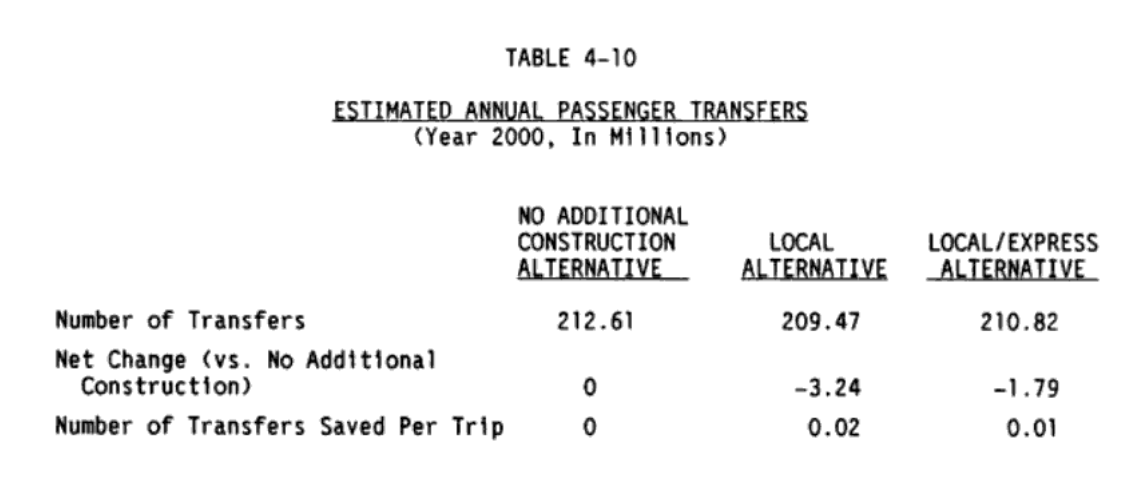
@BRamkaran I do not. But the aggregate data says that the swap saves twice the number of one seat rides than the status quo. All the while removing one of the worst choke points and increasing reliability for one of the most unreliable stretches of the E/F trains.
@BRamkaran@NYCTSubway And the swap advantages people who want 53rd St services. And piling up every story, the aggregate says that the swap saves a net twice as many transfers than the status quo.