Technical and scientific facts, step by step explained by an engineer.
Every day, an interesting fact here on TechTranslate!
Please visit my YouTube channel.
TechTranslate
The purpose of this account is to share my passion for explaining interesting technical and scientific facts that are not intuitive, often misunderstood, or simply odd.
I'm always eager to learn, particularly when others provide context, correct me, or even prove me wrong.
For unknown reasons, I have the urge to add the correct context to posts that state common misunderstandings or conspiracies.
I primarily engage in this because conspiracy theorists are very active on social media and create a false sense of balance.
Unfortunately, in recent years, I've encountered people in real life who were influenced by social media and believe in these theories, proving that this is becoming a real issue.
This fact truly saddens me.
I am realistic; I know I cannot convince the extremists or hardcore conspiracy theorists. However, I hope the context I provide will assist the undecided and vulnerable in making an informed decision.
It's encouraging to receive so much positive feedback in recent weeks and to see that many people here are fed up with these conspiracy theorists.
Happy Anti-Conspiracizing! 😉
Best regards ❤️
Geee from TechTranslate
Technical and scientific facts explained step by step. 😃👍
Dear Flat Earthers,
claiming that someone said something they never said is called lying.
NASA never claimed there is no “air” on Mars. Mars has an atmosphere, though near the surface it is only about 1% as dense as Earth’s.
In this thin atmosphere, parachutes work only for initial deceleration after atmospheric entry. Additional systems, such as retrorockets, airbags, or a sky crane (as in this case), are required for final deceleration and touchdown.
@Guardians_Bane 👍
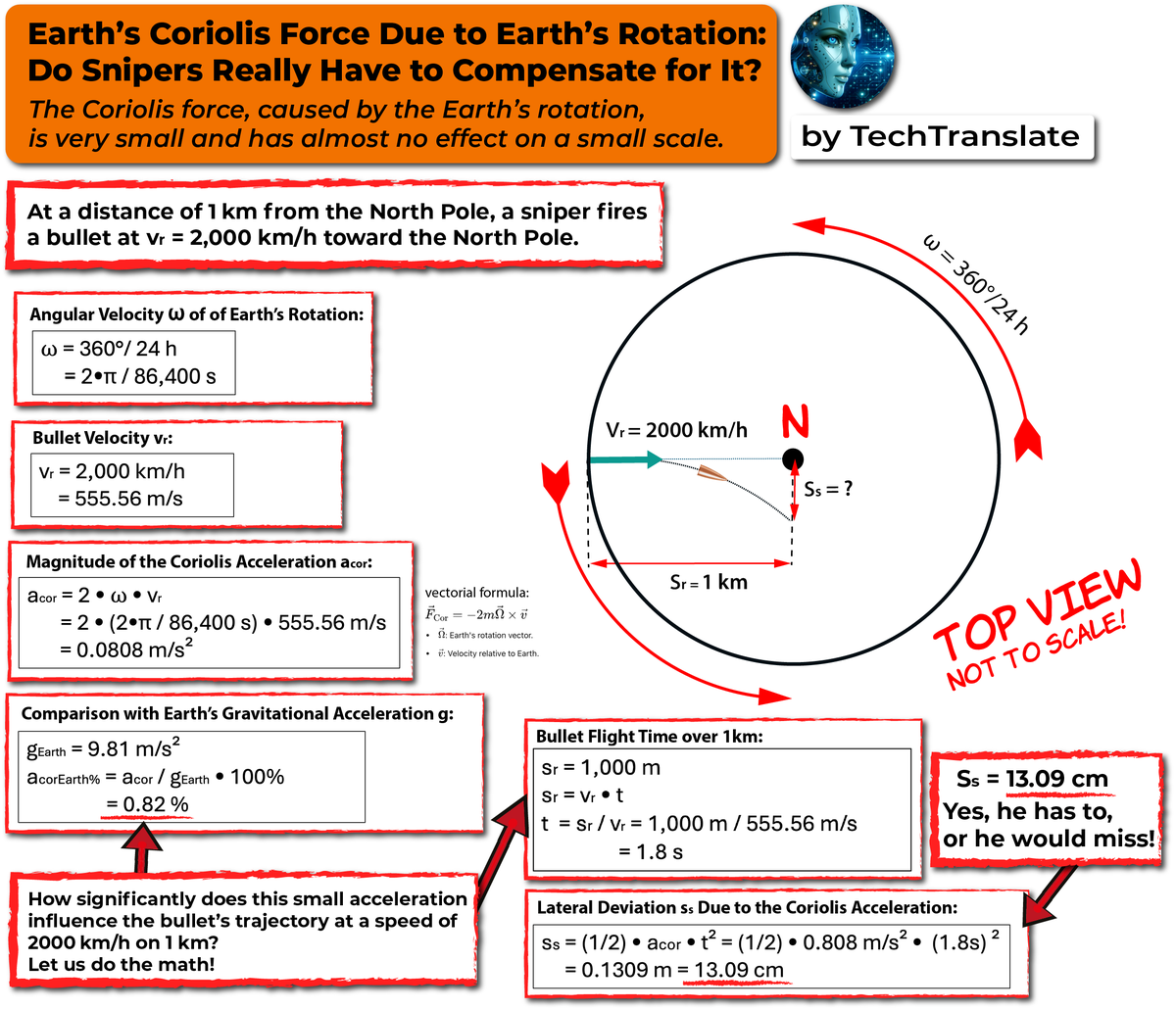
Yep, there are even sniper-training materials online explaining how to calculate and compensate for the Coriolis effect.
Furthermore, there are demonstration videos online showing the difference between compensating and not compensating for the Coriolis effect.
Dear Flat Earthers,
no matter how often you repeat your misunderstanding of the Coriolis force, it will never change the fact that this inertial force acts only on objects moving within a rotating reference frame. If the object is not moving, the Coriolis force is zero.
In case you have confused it with the centrifugal force: Due to Earth’s low rotation rate, one revolution in ~24 hours, it is very small (upper-right image)
Active Region 14455 just produced several major M- and X-class flares and eruptions! ☀️💥This video shows solar activity during this period as observed by the NSF-NOAA GONG station in El Teide, Canary Islands. 🧵 (1/3)
Incoming! The X1.0 flare produced a CME, evident in EUV dimming data - a faint, but distinct (and quite fast) coronal wave is visible. Based on the propagation of the coronal wave this will likely be a halo CME. Awaiting coronagraph images!
@bucciarolo@benpalsusaj@TheGlobeIsDead 👍
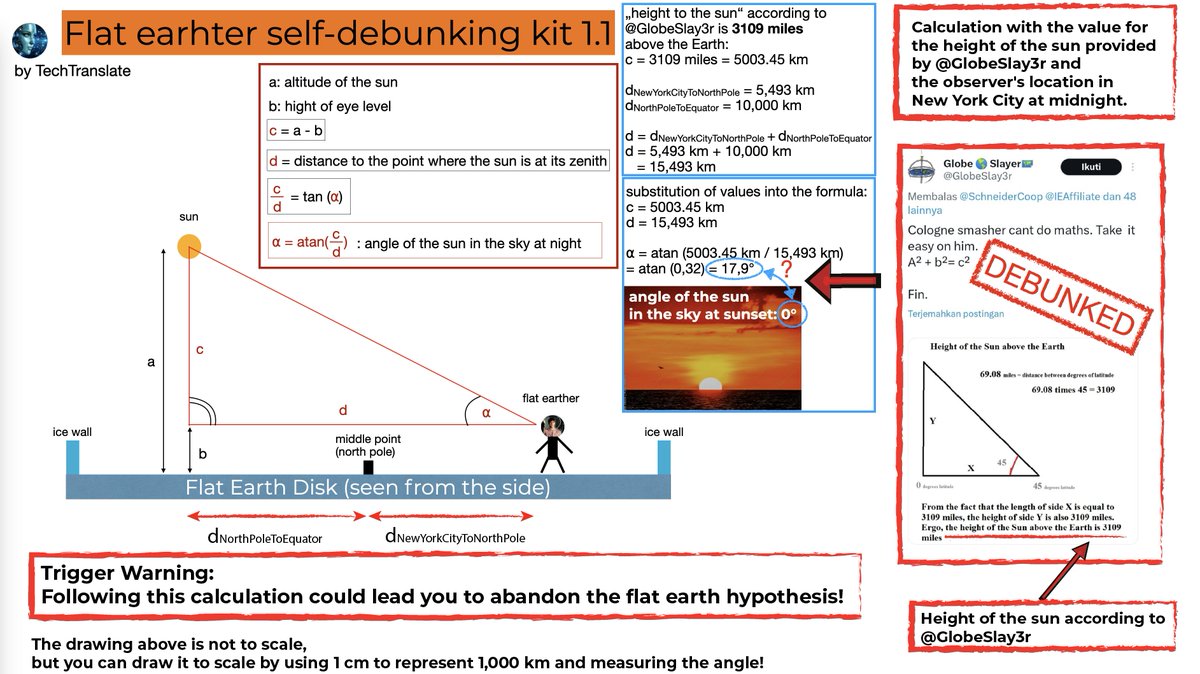
I calculated the angle of the Sun in the sky at midnight on equinox in New York.😉
But the value for the Sun's altitude varies from Flat Earther to Flat Earther, most have no idea... just it is local.🤪
Please put under mathematical scrutiny how "the nature of light and its transmission through gases" would change the angle α in the upper-right image to zero.
Hints:
Below, you will find the geometric calculation of α on the upper right, the Sun’s changing angular size on the lower right, and a geometric calculation of light intensity on the left, all as a function of the distance.
Further a link explaining Rayleigh scattering in the atmosphere, which affects light intensity, which has to be integrated as well.
Please show a calculating when α becomes zero.
This would be the first "baby step" toward proving that, on a hypothetical Flat Earth, the Sun approaches the horizon at Sunset until an angle of α = 0°.
https://t.co/ujIVCj3gGF
Dear Flat Earthers,
it is not advantageous for your Flat Earth narrative to brag that the heliocentric model withstands mathematical scrutiny.
Please put under mathematical scrutiny, why we shouldn't see the Sun at night on Flat Earth.
Basic school-level math/trigonometry is sufficient.
60 years ago today, Surveyor I made a three-point soft landing on the Moon—the first soft landing for America's space program—AND accomplished on its first try. Over the next 6 weeks it returned more than 11,000 images of the lunar surface including this one featuring its shadow.
The mission was one of the great successes of NASA's early lunar program.
Flerfs: "Things fall because of density & buoyancy, not gravity!"
Buoyancy IS a gravitational effect. No gravity = no downward pressure gradient in air/water = no buoyancy.
Density alone doesn't make shit sink or float.
Your own argument requires the gravity you deny
Boom! AR 4455 just blasted an M3.3 eruptive flare. A CME has launched, though it seems quite lopsided to SE. There was likely another, *far more eruptive* flare just behind the E limb, firing off a massive and fast CME. More shortly!
Below are two images taken with different setups. Both are stacked images without further post-processing. The image on the left was captured yesterday, while the image on the right was captured two days earlier. As you can see, the image on the left has significantly more contrast, although both images were captured with the histogram filled to a maximum of about 70%.
For the image on the right, I used the Baader SunDancer II in a single-stack configuration. My telescope is only f/5, and with the 4x telecentric system I currently use, I reach an effective focal ratio of about f/20. Baader recommends f/30 for the SunDancer II, so my setup is not yet ideal for getting the best possible performance from this filter.
I already posted the image on the right a few days ago. After post-processing, it produced quite a good result, but I had to increase the contrast and sharpening very strongly. In the end, the processed image looked somewhat oversharpened.
For the image on the left, I changed my setup by adding an additional 40 mm tilt-tuned etalon behind the SunDancer II, effectively creating a double-stack configuration. The resulting stacked image has much more contrast, even though both captures reached approximately the same histogram level. Despite the worse seeing conditions yesterday, the image on the left appears to have much more potential, especially for post-processing. The processed image in the original post required much less aggressive enhancement and looks more natural.
I had previously tried using the additional etalon with my DayStar Quark, but the results were not very convincing. The contrast improved, but the Quark produces a much darker image. With the additional etalon, I had to significantly increase both the exposure time and the gain. This made the image noisier and less sharp. Although the overall contrast was better, the fine filament structure, especially in the penumbra around the sunspot, was less visible. For that reason, I went back to using the Quark in a single-stack configuration.
The SunDancer II produces a much brighter image, which allows me to use the additional etalon without sacrificing too much light. I only had to increase the exposure time and gain slightly, while remaining within an acceptable range and still capturing plenty of fine detail.
The seeing conditions were not ideal yesterday because of a varying, very thin layer of cirrus clouds. Therefore, the fine structure around the penumbra is not as clearly visible as it was a few days ago. Nevertheless, the first result with this setup is very promising, and I will definitely try it again under better conditions.
One important remark: this combination is not recommended by either manufacturer. It is a DIY setup that I think works surprisingly well.
Tuning the additional tilt etalon into its sweet spot is quite difficult. When I change the tilt angle, the brightness of the image also changes. This makes it hard to judge which position provides the best contrast, because the exposure time or gain would have to be adjusted constantly in order to compare the images properly.
My approach was based on the following idea: the SunDancer II already pre-filters the light around the H-alpha emission line with a bandwidth of about 0.6 Å. The additional tilt-tuned etalon also has a narrow transmission band, and tilting it shifts this band toward either the blue or red side of the H-alpha line. Since the light has already been filtered by the SunDancer II, shifting the second etalon away from the overlapping transmission peak should make the image darker. Therefore, the best overlap — and thus the best tuning position — should be close to the point where the image is brightest.
Based on this idea, I tuned the additional etalon while watching the histogram and adjusted the tilt until the image reached its maximum brightness. Afterwards, I returned the exposure time and gain to the settings I use for capturing. I also tried several other approaches, but so far this method has given me the best result.
I chose this approach because it is very difficult to judge the effect of tilting the Lunt etalon directly. When the tilter is adjusted, the image becomes significantly brighter or darker. Even when using auto gain, it is difficult to evaluate the actual change in contrast, because the changing gain alters the appearance of the image at the same time. This makes it hard to determine by eye whether the tilt adjustment really increases or decreases the contrast.
Therefore, I used the brightness of the image as an indicator for the best overlap between the transmission bands of the two etalons. I adjusted the tilt while watching the histogram and looked for the position where the image became brightest. So far, this approach has produced the best results for me.
The most significant improvement with my current setup - the Baader SunDancer II combined with the additional Lunt etalon - is its thermal stability throughout the entire observing session. This will make capturing time-lapses much easier for me, because I no longer have to constantly adjust the focus.
With the DayStar Quark, I had to stay at the telescope and refocus every few minutes. With the Baader SunDancer II, this is no longer necessary. After about half an hour, once the telescope, the filter, and the entire optical train have reached a stable temperature, I set the focus once and may only need a very small adjustment afterwards. From then on, the focus remains stable.
This means I can leave the telescope almost unattended during a time-lapse sequence instead of constantly babysitting the focus.
A short time-lapse of the Sun’s chromosphere, captured on 30 May 2026:
The prominent sunspot in the lower left is active region AR 4446.
I had already shared a still image of this region, and now I finally had time to turn the captured frames into a short time-lapse. Although I recorded for 1.5 hours, thin cirrus clouds meant that only the final ~40 minutes were usable.
The conditions were challenging, so this is not among my sharpest results. Still, the session was mainly intended as a test of my new setup.
What impressed me most was the thermal stability of the new H-alpha filter: after the optical train had reached thermal equilibrium during the first half hour, no further refocusing was needed. I even managed to trim the hedge while the capture was running. 😅
I will link a description of the new setup and my double stack workflow in the thread below for anyone who is interested.
@PatByron2 It is not advantageous for the Flat Earth narrative to brag that the heliocentric model withstands mathematical scrutiny.
Please put under mathematical scrutiny, why we shouldn't see the Sun at night on Flat Earth.
Basic school-level math/trigonometry is sufficient.
Dear Flat Earthers,
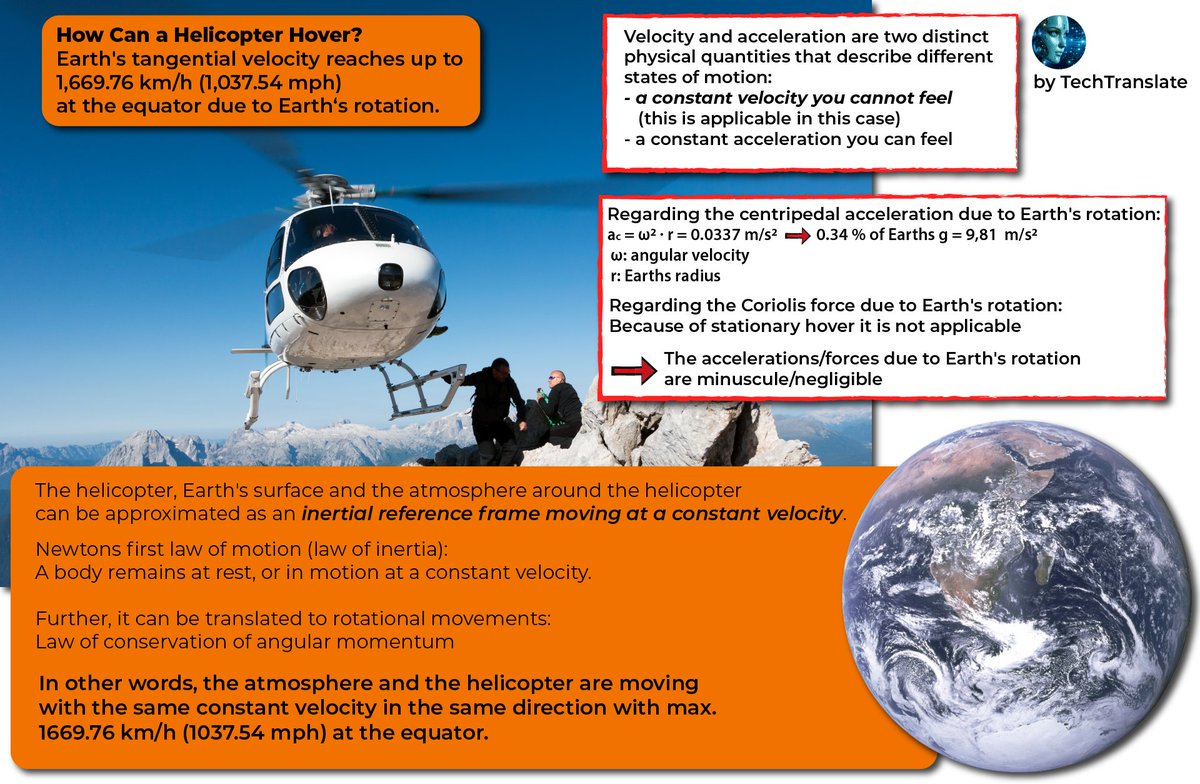
tangential velocity of a rotation alone says nothing about the centrifugal effect, to which you are referring to, unless the radius is known.
It increases linearly with the radius, but with the square of the rotation rate.
Therefore the very low rotation rates are decisive in the ones you are questioning:
→ Earth’s rotation: 1 in ~24h
→ Earth’s orbit around the Sun: 1 in ~1 year
→ The Solar System’s orbit around the Milky Way:
1 in ~230 mio. years
A large tangential velocity does not automatically imply a large centrifugal effect. With such extremely low rotation rates even at large radius, the resulting centripetal/centrifugal acceleration can still be very small.
Fun fact:
Orbits in a gravitational field are free-fall trajectories. In an inertial frame of reference, there is no real centrifugal force acting on the orbiting object.
The object is continuously falling toward the center of gravity/center of rotation, while its tangential velocity carries it sideways fast enough that it keeps missing it. Instead of falling straight down, it follows a curved path around the center of gravity.
Gravity is not being balanced by an outward force. Gravity is the inward force that continuously bends the object’s trajectory and keeps it in orbit.
Thus the calculations on the right regarding the centripetal force, except the one of Earth's rotation, are just of academically purpose.
Thank!👍
Yep, cirrus is really annoying ... first I was happy that the Sun was shining... then I looked up ... cirrus...
I made a DIY-double stack and previously changing from Quark Chromosphere to the Baader Sundancer II, here it is described in more detail:
https://t.co/8S2X4kvOxH
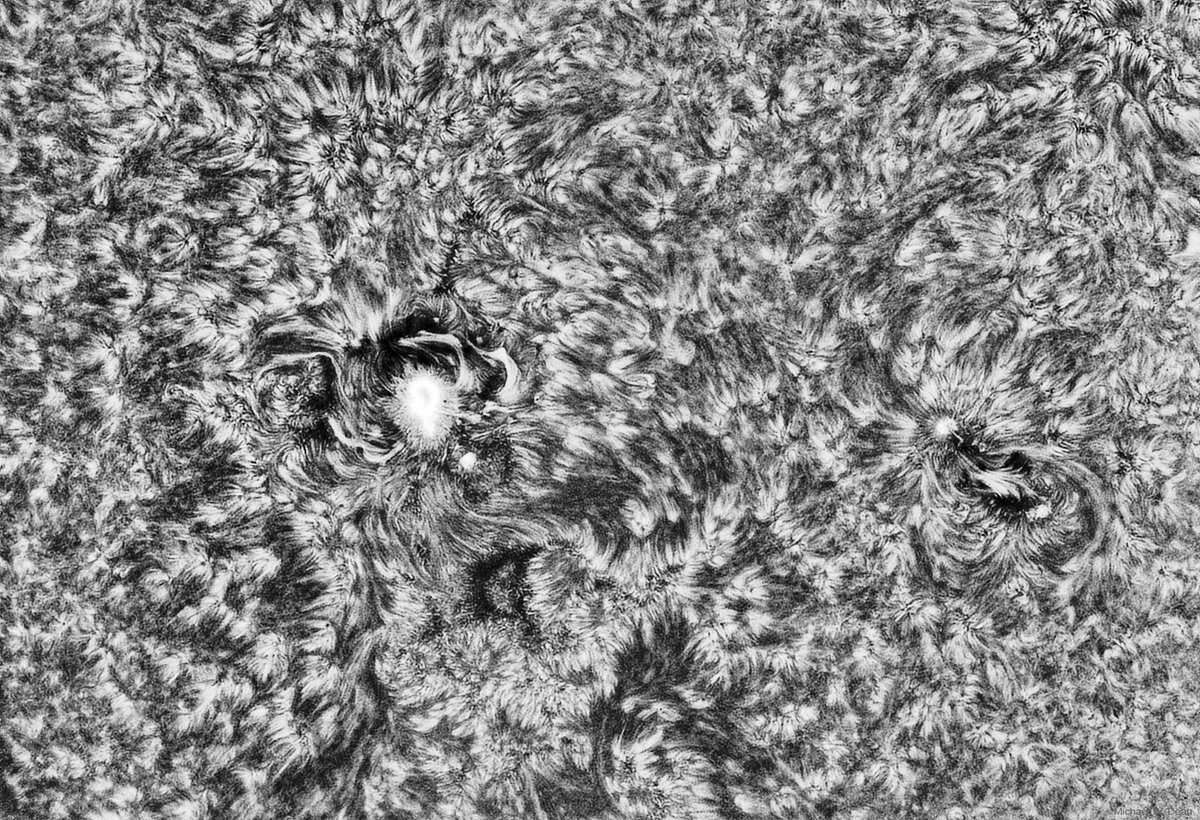
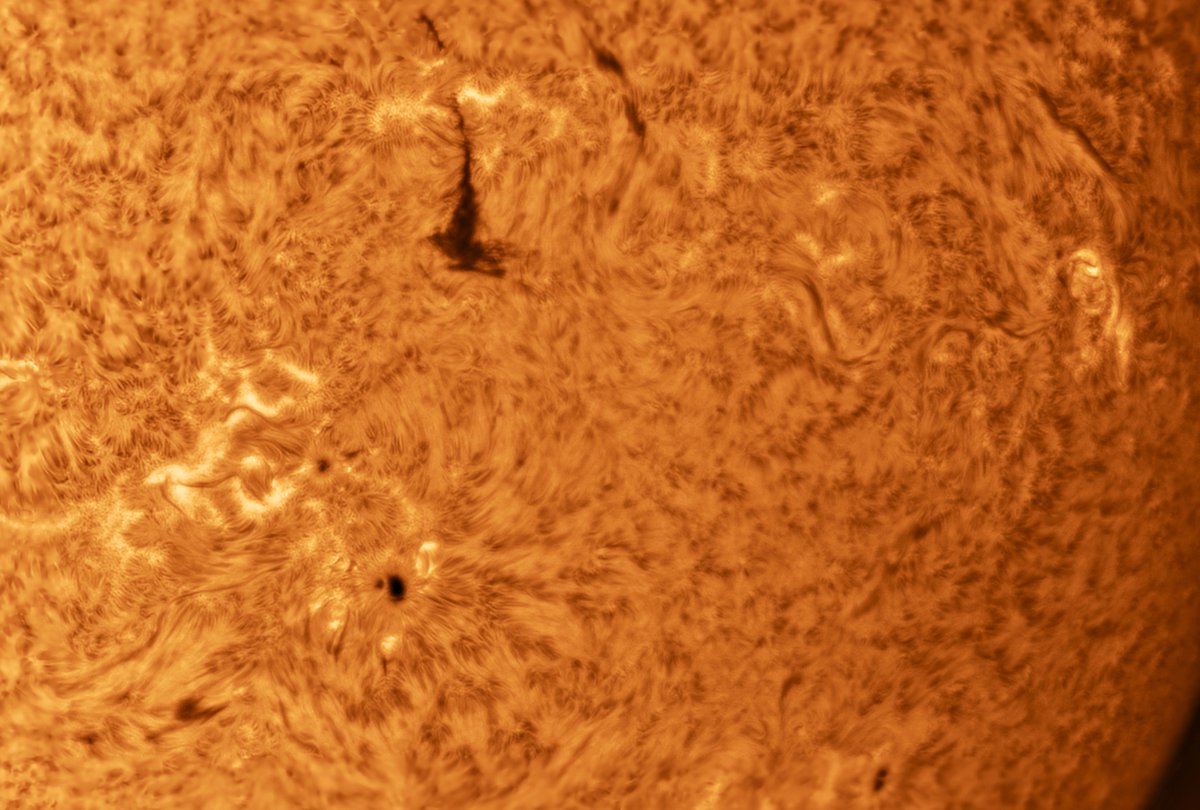
The Sun’s chromosphere yesterday:
Active region AR 4446 - the large sunspot.
The seeing wasn’t ideal due to a varying, very thin layer of cirrus clouds, but I’m quite satisfied with the result.
I made a significant change to my setup, which I’ll explain in the thread below for anyone interested.
This video is made from 47 images captured by Cassini during a flyby of Hyperion on May 31, 2015. Changing spectral filters result in slightly different exposures and contrasts. (Images sourced through SETI's OPUS3 online server.)