🚨 𝗕𝗥𝗘𝗔𝗞𝗜𝗡𝗚: Claude can now build your entire mobile app from a screenshot like a $350K senior developer at Apple. (for free)
Here are 8 insane Claude prompts replacing your entire mobile development team before they finish estimating the project cost:👇
(Save this 🔖 thread before it blows up.)
🚨 The AI apps you use every day are training on your chats by default.
ChatGPT. Gemini. LinkedIn. X. Copilot.
The off switches are buried, and each one is different.
Here are 6 settings to change today (takes 15 min) 🧵
A Costco bakery, deli, and meat department employee worked across all three departments for 5 years.
She told me the same thing frustrated her every single shift:
Customers spending $300 in the aisles, grabbing pre-packaged stuff off the shelf, and never knowing a custom shop exists 10 feet behind the display case.
No sign says "We custom-decorate half-sheet cakes for $24.99 that feed 48 people."
No sign says "We build party platters that feed 20+ guests."
She gave me a list of 9 things we're all doing wrong. Save this for your next run:
Earn up to $3,000 monthly with Google, but not many are aware of this opportunity.
Ready to jump in? All you need is:
→ Internet access
→ A smartphone or computer
→ Time (2-3 hours)
Want the free guide? Here’s how:
1. Like
2. Comment "Google"
(Follow, So I'll DM you)
🚨 HOW TO STOP HITTING CLAUDE’S USAGE LIMIT SO FAST
If you use Claude for coding, writing, research, or building projects, you’ve probably seen this problem:
You’re in the middle of important work, everything is going well… and suddenly, you hit your usage limit. 😩
But the solution isn’t always upgrading your plan.
Sometimes, you’re simply using Claude inefficiently.
Here are 9 practical ways to make your Claude usage last longer. 👇
Stop using ChatGPT like a basic chatbot. 🔥
Here are 35 powerful ChatGPT prompts for professionals & businesses to help you:
✅ Write better emails & documents
✅ Summarize meetings and extract action items
✅ Make smarter business decisions
✅ Analyze data, Excel & SQL
✅ Improve marketing and sales
✅ Challenge ideas and prioritize tasks
✅ Build better prompts with proven frameworks
Save this cheat sheet. 📌
Your next productivity upgrade might be just one prompt away.
Follow @Arzu_with_Ai for more AI tools, tips & tutorials. 🚀
#ChatGPT #AITools #Productivity
THE 22 THINGS THAT MADE ME COME HOME TWICE AS OFTEN AS MY FRIENDS DID, FROM THE KID'S SIDE.
My mother did most of them on purpose. I found out at 22 :
1. Nobody asked about grades in the first hour. Someone handed me a plate.
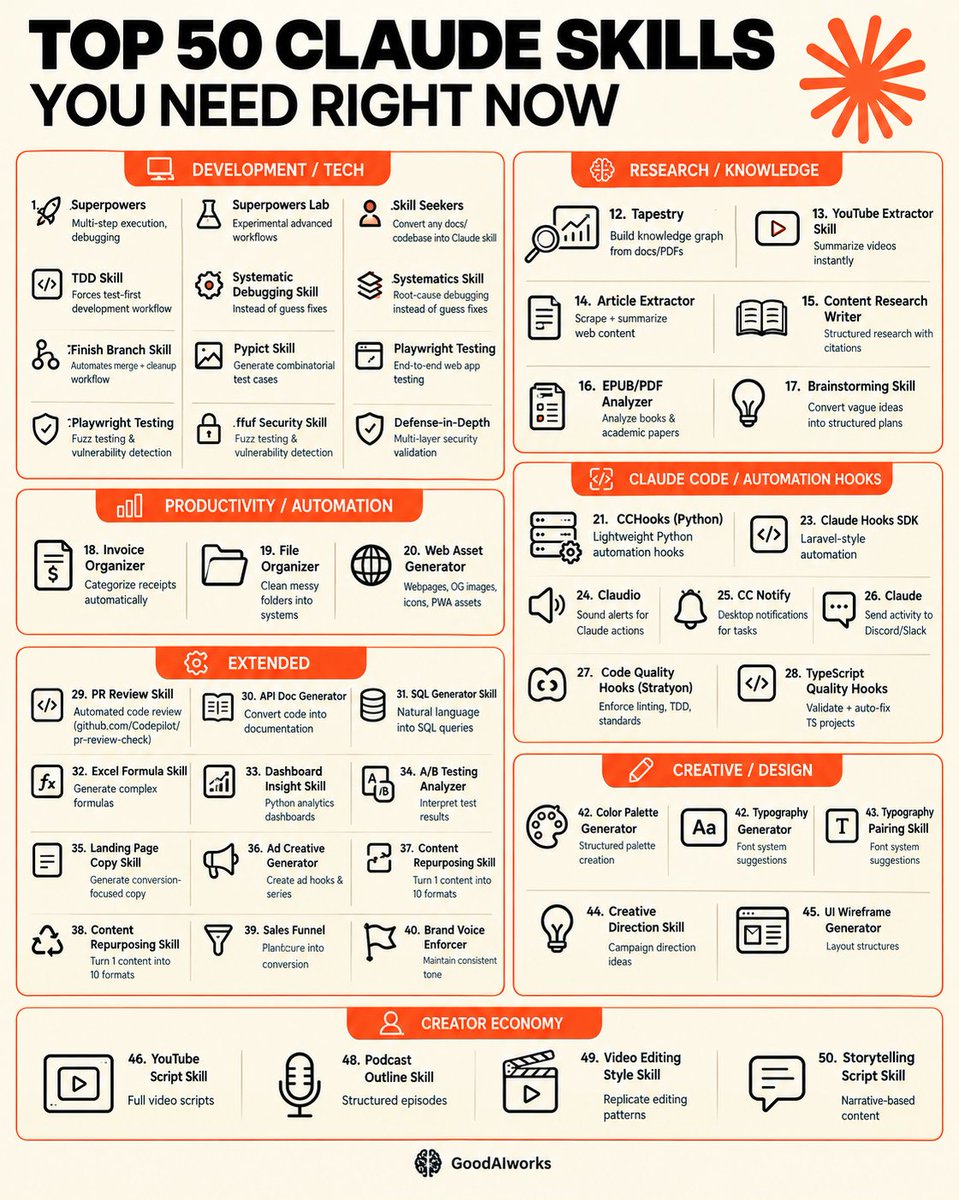
Ki 🚨 50 Claude Skills That Can Turn You Into a Productivity Powerhouse
Most people use Claude for basic questions, writing, and coding.
But Claude can do SO much more. 👀
With the right skills, you can turn Claude into a powerful assistant for development, research, automation, content creation, and business workflows.
Here are 50 Claude skills worth exploring:
💻 Development & Tech
1. Superpowers
2. Superpowers Lab
3. Skill Seekers
4. TDD Skill
5. Systematic Debugging
6. Systematics Skill
7. Finish Branch Skill
8. Pypict Skill
9. Playwright Testing
10. ffuf Security Skill
11. Defense-in-Depth
🔎 Research & Knowledge
12. Tapestry
13. YouTube Extractor Skill
14. Article Extractor
15. Citation Research
16. EPUB/PDF Analyzer
17. Brainstorming Skill
⚡ Productivity & Automation
18. Invoice Organizer
19. File Organizer
20. Web Asset Generator
🛠️ Claude Code & Automation Hooks
21. CCHooks (Python)
22. Claude Hooks SDK
23. Claudio
24. CC Notify
25. Claude activity notifications
26. Code Quality Hooks
27. TypeScript Quality Hooks
📊 Extended Skills
28. PR Review Skill
29. API Doc Generator
30. SQL Generator Skill
31. Excel Formula Skill
32. Dashboard Insight Skill
33. A/B Testing Analyzer
34. Landing Page Copy Skill
35. Ad Creative Generator
36. Content Repurposing Skill
37. Sales Funnel Planner
38. Brand Voice Enforcer
🎨 Creative & Design
39. Color Palette Generator
40. Typography Generator
41. Typography Pairing Skill
42. Creative Direction Skill
43. UI Wireframe Generator
🎬 Creator Economy
44. YouTube Script Skill
45. Podcast Outline Skill
46. Video Editing Style Skill
47. Storytelling Script Skill
Why does this matter?
Because the real power of AI isn't just asking better questions. It's building repeatable workflows that save time, reduce manual work, and help you create more with less effort.
📌 Save this list for your next Claude project.
♻️ Repost it for someone exploring Claude Code.
Comment " CLAUDE"
Follow me @samcoderx for more AI tools, workflows, and productivity tips.