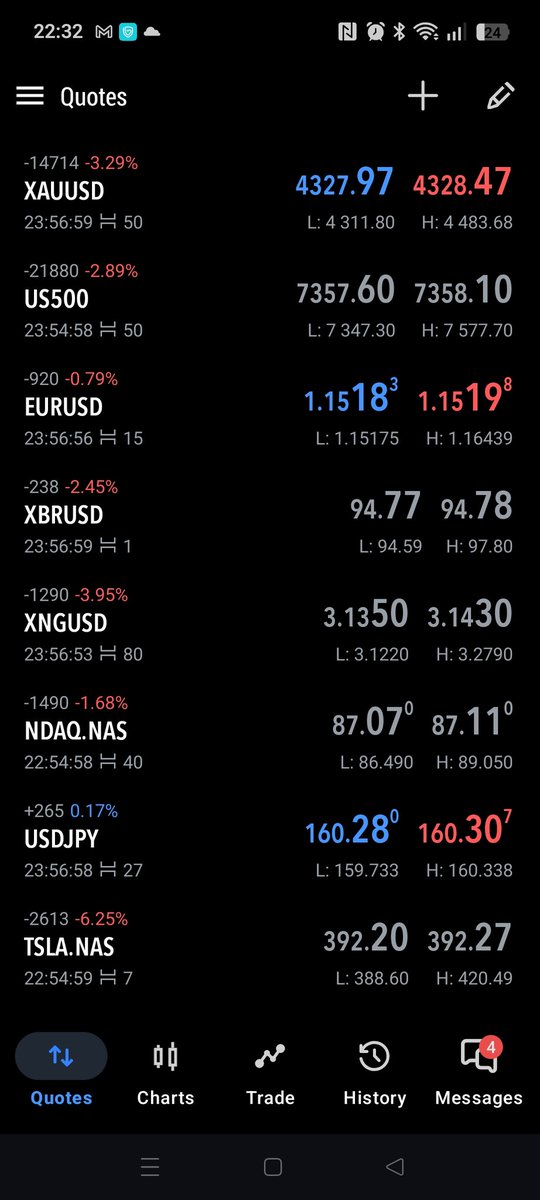
GOLD WILL BREAK 4,000 SUPPORT
4,800 → 3,940 → 4,200 → 3,850 (next) → 4,000
This is a liquidity grab in a downtrend
Nobody wants to believe it
But that's how the market works and the bull rally is over
This could continue all the way down to 3,450
I told you about this before
🔥Central bank demand for gold is accelerating:
World central banks acquired 41 tonnes of gold in May, following ~20 tonnes in the prior month.
Year-to-date, Poland has been the biggest buyer, adding 64 tonnes and bringing its total gold reserves to a record 614 tonnes, on track to reach its 700-tonne target.
This is followed by Uzbekistan, which added 33 tonnes. Notably, the country's gold reserves now stand at 87% of its total FX reserves.
Meanwhile, China has bought gold for 20 consecutive months, adding 25 tonnes year-to-date and increasing its gold reserves to a record 2,331 tonnes, or 9% of total FX reserves.
Central banks are aggressively buying every dip in gold.
Central Banks CONTINUE to BUY GOLD. Goldman Sachs now declares that "gold is not done." Goldman projects a rebound to $4,900/oz by end-2026.
BUY GOLD, WEAR DIAMONDS.
🚨US MARGIN DEBT IS EXPLODING HIGHER:
US margin debt spiked another $112 BILLION last month to $1.4 TRILLION, an all-time high.
Since 2023, the amount of debt used for trading has more than DOUBLED.
TAP IMAGE TO SEE FULL INSIGHT👇
https://t.co/Skv9BRwKk2
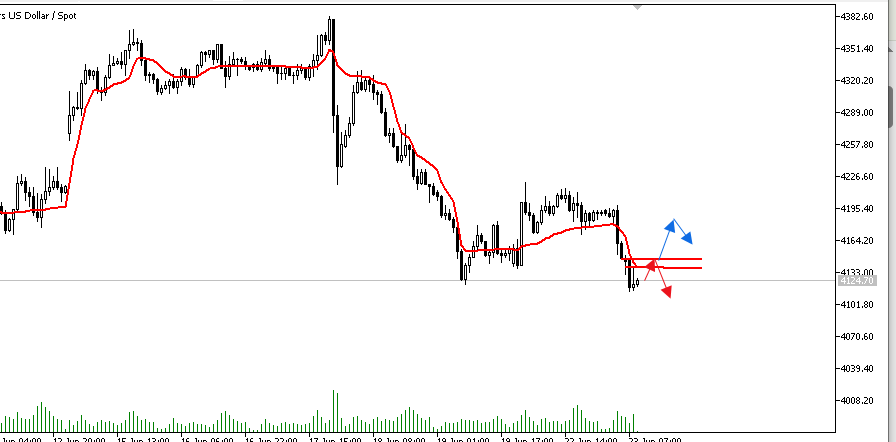
Technical Analysis: As expected, after a brief consolidation period, gold plummeted on heavy volume, officially breaking below its previous sideways trading range and signaling a full-scale technical bearish breakout. Currently, a clean and decisive bearish candlestick has forcefully pierced through the horizontal support level at 4120.66 (currently trading at 4118.10), marking the complete failure of the previous low-level support zone. The red moving average exhibits an extremely steep downward slope, forming a classic “perfect bearish alignment” that exerts downward pressure. With no obvious dense consolidation zone below, the downside potential is now fully open. Given the latest price action following this “breakout from the consolidation range,” the previous strategy of testing long positions at lower levels must be completely abandoned. Trading should now fully shift to “trading with the trend by selling on rallies” or “chasing shorts on breakouts.” Sell on any rebound (the conservative choice)! Key resistance lies in the 4135–42 range! Strategy: Sell: 4135–38 TP: 4105 SL: 4150
#XAUUSD
BREAKING: $SPCX is down -10% today, wiping out $242 billion from its market cap.
In the last 4 trading sessions, it has now crashed more than 25%, wiping out $725 billion from its market cap.
That is more than the entire combined market cap of #SanDisk and #CocaCola.
The market is being driven by just 2 sectors:
The S&P 500 has added over +$5 trillion in market cap so far in 2026.
Meanwhile, AI stocks have added +$6 trillion in value, followed by +$200 billion added by the energy sector.
🚨 EVERYTHING THAT COULD GO WRONG FOR MARKETS WENT WRONG TODAY.
S&P 500 down -1.65%, wiping out $1.14 trillion.
Nasdaq down -2.60%, wiping out $1.11 trillion.
Gold down -3.38%, wiping out $1 trillion.
Silver down -6.9%, wiping out $280 billion.
Bitcoin down -6.31%, wiping out $80 billion.
In total $2.5 TRILLION wiped out in a single session. These were not isolated moves. Everything started breaking at the same time.
It started with the jobs report this morning.
The US economy added 172,000 jobs in May. Wall Street expected 88,000. That is almost double.
On any normal day, strong jobs is good news. But inflation is already at 3.8% and oil is sitting at $90. A labor market this strong tells the Fed it cannot cut interest rates and may actually need to raise them.
The probability of a rate hike this year went from 40% to 57% in a single day. That spooked every investor holding tech and growth stocks because higher rates mean those stocks are worth less today.
Then the AI trade started cracking.
Yesterday Broadcom reported record earnings: revenue up 48%, AI chip sales up 143% and the stock still crashed 12.6%. The reason was simple.
Broadcom did not raise its AI revenue targets for the year. Investors had expected it to. That single miss made people ask a question they had been avoiding for months: are we paying too much for AI stocks?
That question got louder today when a research firm called SemiAnalysis revealed that Nvidia's next-generation AI chips will need significantly less memory than everyone assumed, roughly half of what the market was pricing in.
Memory chips are what companies like SK Hynix and Samsung make. SK Hynix fell nearly 10% today. Samsung fell over 6%.
South Korea's entire stock market crashed 5.5% in a single session. Japan's semiconductor stocks did the same.
And then Anthropic added fuel to the fire by publishing a report warning that AI is getting close to the point where it can improve itself without human help and calling for a global pause in AI development.
Coming on the same day as the memory demand news and Broadcom's miss, it fed a single growing fear across the market: what if the AI boom is moving faster than the business models can keep up with?
Underneath all of this, there is a liquidity problem nobody is talking about.
SpaceX goes public next week at a $1.75 trillion valuation. Anthropic just filed to go public. OpenAI is next.
These three companies together are worth $4 to $5 trillion. Fund managers need cash to buy into these listings.
But cash levels are already at their lowest since early 2024. The only way to raise cash is to sell what they already own. That selling is happening right now.
The new Fed Chair Kevin Warsh will also hold his very first policy meeting in 11 days. He was appointed by Trump with the expectation of cutting rates.
He is now walking into a situation where inflation is high, oil is high, and the job market is running hot. Investors do not know what he will do.
When nobody knows what the most powerful central banker in the world will decide in less than two weeks, the safest move is to reduce risk today.
Everything that could go wrong, went wrong at the same time. A hot jobs report, a collapsing ceasefire, a crack in the AI trade, a trillion dollar liquidity drain, and a Fed meeting with no clear outcome.