This paper is f*cking insane.
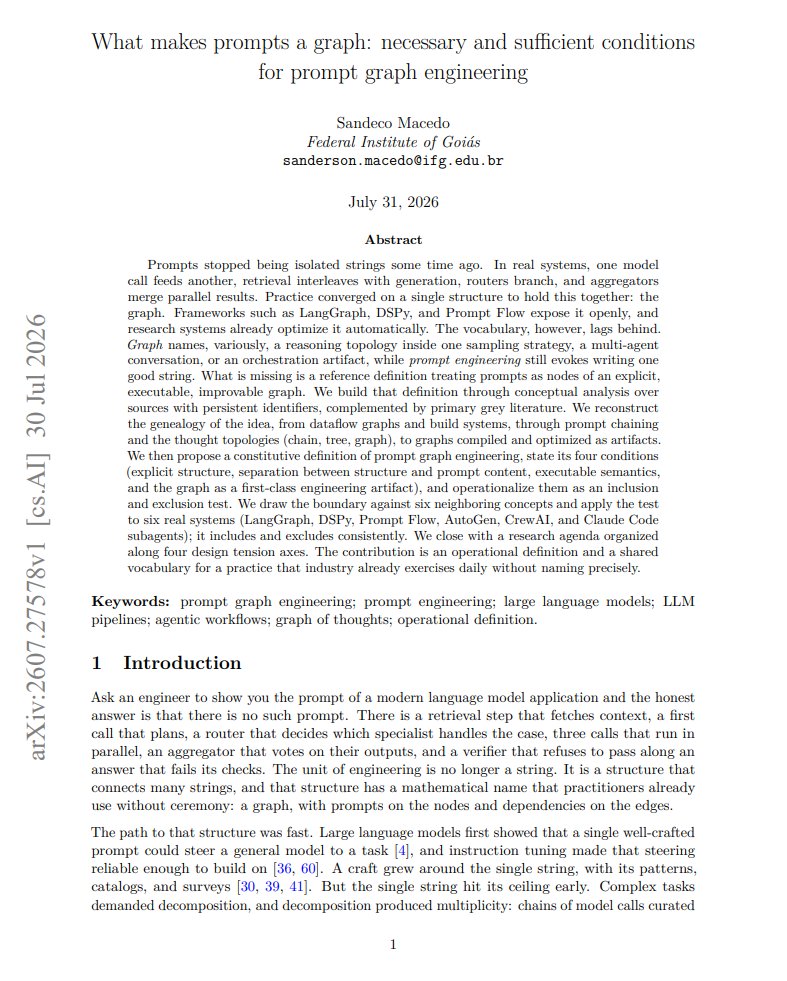
Prompt Engineering just got replaced by Graph Engineering.
A new 20-page paper formalized what the best AI builders are already doing:
Stop writing one giant prompt.
Build a graph of agents instead.
Planner → specialists → verifier → feedback loop.
The authors test this definition against LangGraph, DSPy, AutoGen, CrewAI, Prompt Flow, and Claude Code subagents.
The prompt is no longer the system.
The graph around it is.
Bookmark this, then read the full Graph Engineering guide below.
Caught up with @karpathy for a new @NoPriorsPod: on the phase shift in engineering, AI psychosis, claws, AutoResearch, the opportunity for a SETI-at-Home like movement in AI, the model landscape, and second order effects
02:55 - What Capability Limits Remain?
06:15 - What Mastery of Coding Agents Looks Like
11:16 - Second Order Effects of Coding Agents
15:51 - Why AutoResearch
22:45 - Relevant Skills in the AI Era
28:25 - Model Speciation
32:30 - Collaboration Surfaces for Humans and AI
37:28 - Analysis of Jobs Market Data
48:25 - Open vs. Closed Source Models
53:51 - Autonomous Robotics and Atoms
1:00:59 - MicroGPT and Agentic Education
1:05:40 - End Thoughts
Dario Amodei just revealed that the AI training bottleneck everyone is worried about doesn’t exist anymore.
The industry spent years obsessed with scraping the open web. More data. More text. More human output to feed the models.
Amodei: “I don’t think data is quite the most central thing anymore.”
The shift is fundamental.
Amodei: “Static data is becoming less important. A lot of the data we use today is RL environments that we train on. Dynamic data that the model creates itself.”
Not scraped. Not licensed. Not written by humans.
Generated by the model through pure trial and error.
When you train on complex math or agentic coding, you don’t feed it a textbook. You give it an environment.
The model experiments. Fails. Adjusts. Tries again.
Amodei: “You’re getting some math problems and the model experiments with trying the math problems.”
It generates its own experience. Millions of iterations. Each one building on the last.
No human required.
This destroys the entire narrative around AI hitting a data wall.
You cannot throttle a competitor by locking down copyright. Cannot slow the race by putting up a paywall.
When a model learns through its own synthetic experience, the open web becomes irrelevant.
The only true bottleneck left is compute.
And this is where the geopolitical stakes become impossible to overstate.
The nation that wins the compute race doesn’t just build smarter models.
It builds models that generate their own intelligence, compounding on themselves, iterating past every limit human knowledge ever imposed.
We are no longer training AI on the past.
We are letting it simulate the future.
The machine has stopped reading the dictionary.
It’s doing the math itself now.
one of the biggest realizations I've had working on Claude Code is that you fundamentally have to design agents for prompt caching first, almost every feature touches on it somehow
I wrote this in a day but it's the culmination of months of learnings, hope you enjoy it
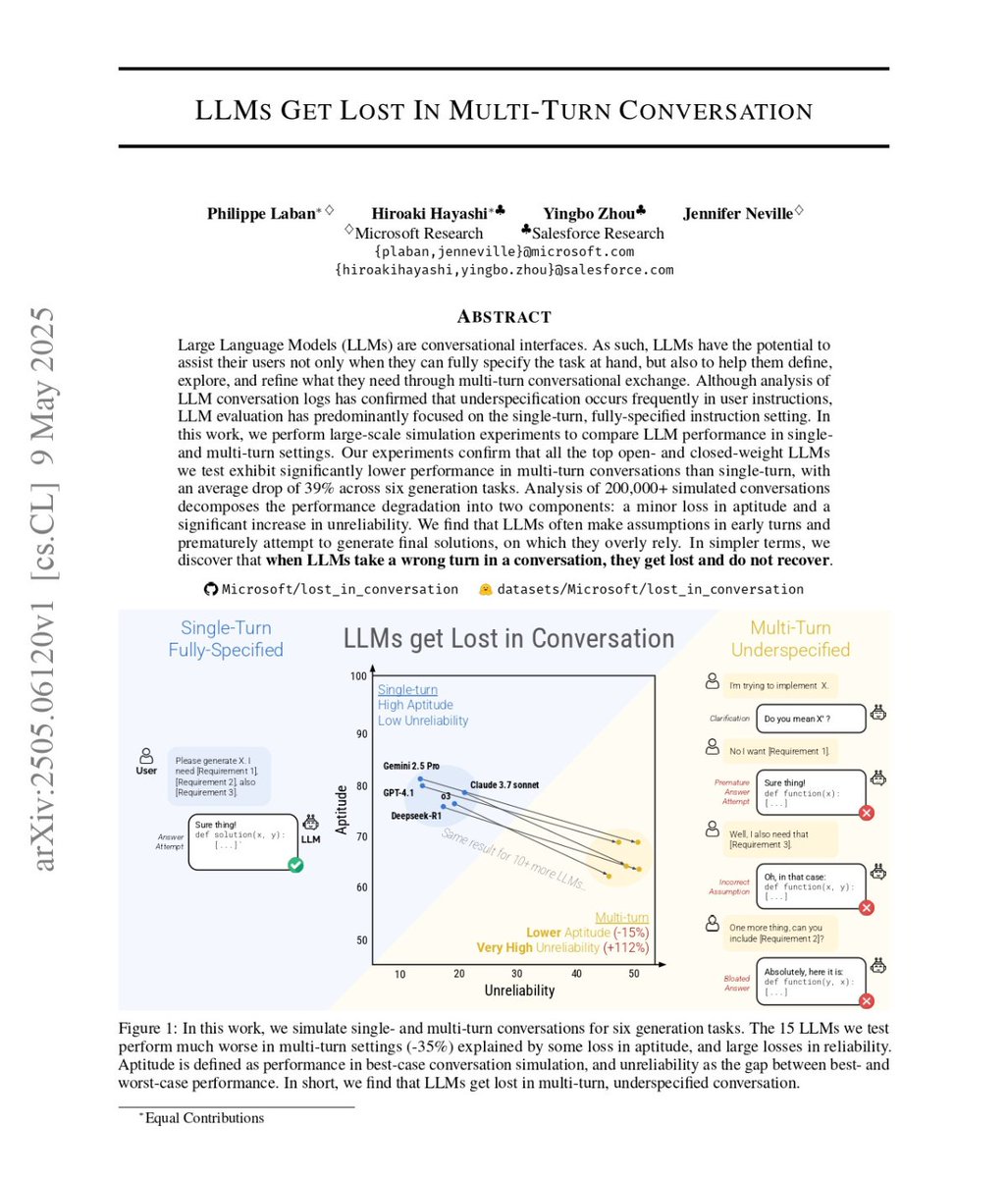
🚨BREAKING: Microsoft Research + Salesforce just dropped a paper that should scare every AI builder.
They tested 15 top LLMs GPT-4.1, Gemini 2.5 Pro, Claude 3.7 Sonnet, o3, DeepSeek R1, Llama 4 across 200,000+ simulated conversations.
Single-turn prompt: 90% performance.
Multi-turn conversation: 65% performance.
Same model. Same task. Just... talking normally.
The culprit isn't intelligence. Aptitude only dropped 15%.
Unreliability EXPLODED by 112%.
→ LLMs answer before you finish explaining (wrong assumptions get baked in permanently)
→ They fall in love with their first wrong answer and build on it
→ They forget the middle of your conversation entirely
→ Longer responses introduce more assumptions = more errors
Even reasoning models failed. o3 and DeepSeek R1 performed just as badly.
Extra thinking tokens did nothing.
Setting temperature to 0? Still broken.
The fix right now: give your AI everything upfront in one message instead of back-and-forth.
Every benchmark you've seen was tested on single-turn prompts in perfect lab conditions.
Real conversations break every model on the market and nobody's talking about it.
Google and Microsoft just co-authored the spec that turns every website into an API for AI agents. The second-order effects here are massive.
Right now, browser agents work by taking screenshots, parsing the DOM, and guessing which buttons to click. It works about as well as you’d expect. Fragile, expensive, slow. WebMCP replaces all of that with a single browser API: navigator.modelContext. Websites register structured tools directly in client-side JavaScript. The agent reads a menu of available actions, calls them, gets structured data back. No scraping. No backend MCP server in Python or Node. The tools run inside the browser tab and share the user’s existing auth session.
Early benchmarks show ~67% reduction in computational overhead compared to visual agent-browser interactions. Task accuracy around 98%.
The second-order effect is where this gets wild. Today, when a browser agent visits two competing airline sites, it’s guessing at both interfaces equally. Once WebMCP adoption spreads, the site that exposes structured tools gives the agent a clean, reliable path to complete the task. The site that doesn’t forces the agent to fumble through the UI. Agents will prefer the cheaper path. Every time.
This means “Agent Experience Optimization” becomes a real discipline. Tool naming, schema design, description quality. Sound familiar? It’s the same shift that happened when meta descriptions and structured data became optimization surfaces for search engines. Except this time, the traffic source isn’t Google’s crawler. It’s every AI agent on the internet.
Bots already make up 51% of web traffic. Google just gave them a front door.
Vercel just shipped a context engineering strategy for the post-agent codebase.
It all compiles into a single https://t.co/znr9rhfkAe file. That file format now appears in 60,000+ open-source projects and the OpenAI repo alone has 88 of them.
This matters because AI coding agents face a fundamental constraint. Context windows are limited and effective capacity runs around 50-60% of stated limits. An agent looking at your 400,000-file monorepo can only “see” a few thousand tokens at once. Understanding the codebase becomes like reading a novel one paragraph at a time.
So what happens when you need consistent performance decisions across a large codebase? You can’t brief an agent on 10 years of accumulated knowledge every time it opens a file.
Vercel’s answer: encode the tribal knowledge in a machine-queryable format. The rules are prioritized by impact (CRITICAL to LOW) so agents know what to fix first. The code examples show what breaks and how to fix it. Everything a senior engineer carries in their head, now available to every agent session.
“Eliminate waterfalls before optimizing useMemo” isn’t novel advice. What’s novel is packaging it so Cursor, Claude Code, and Codex can apply it autonomously.
The shift changes documentation itself. README files stay for humans. https://t.co/znr9rhfkAe becomes the briefing packet for your AI teammates. One describes what the project does. The other tells agents how to work on it without breaking things.
This also reveals where competitive advantage is moving. Model quality keeps improving. The moat is becoming context: who can give agents the right knowledge at the right time. You can train a better model in six months. You cannot rebuild 10 years of institutional knowledge in six months.
Watch for every major framework to ship something similar. The performance guide is table stakes. The agent-optimized format is the actual product.
@CometMessa70661@GavinSBaker For most problems, there’s a surprisingly small piece of code that solves them - the hard part is finding it.
Program synthesis turns intelligence into a scalable search for that solution, instead of hard-coding expertise.
See:
https://t.co/EHA2L9FO46
I'm Boris and I created Claude Code. Lots of people have asked how I use Claude Code, so I wanted to show off my setup a bit.
My setup might be surprisingly vanilla! Claude Code works great out of the box, so I personally don't customize it much. There is no one correct way to use Claude Code: we intentionally build it in a way that you can use it, customize it, and hack it however you like. Each person on the Claude Code team uses it very differently.
So, here goes.
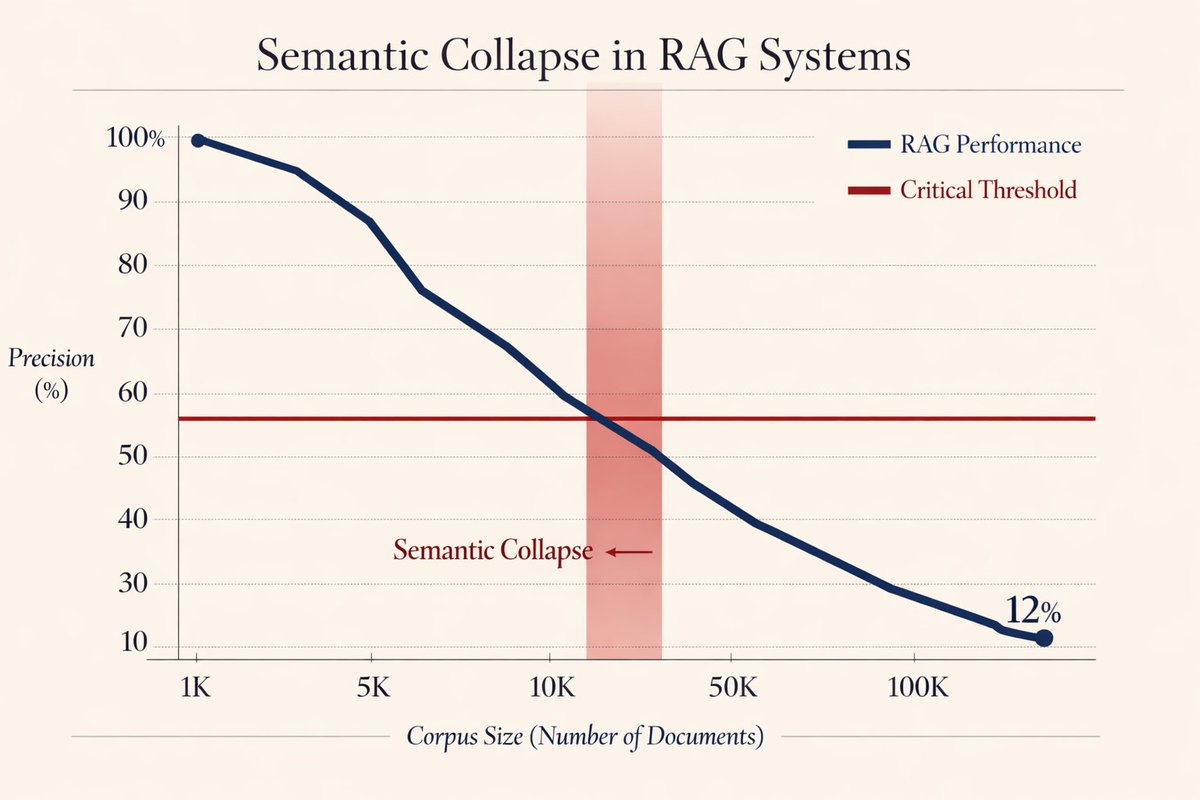
🚨 RAG is broken and nobody's talking about it.
Stanford just exposed the fatal flaw killing every "AI that reads your docs" product.
It's called "Semantic Collapse", and it happens the moment your knowledge base hits critical mass.
Here's the brutal math (and why your RAG system is already dying):
If you still don’t get tool calls, start here:
AWS open-sourced a full AgentCore samples repo. It’s one of the more clear and value-driven agents on AWS walkthroughs I’ve seen (linked below, not sponsored).
AgentCore = production layer for agents: serverless runtime, safe tool access (Gateway/MCP), identity, memory, and full tracing/observability.
Clone it in Cursor and spend 24 hours actually building and learning by playing around with it.
Then I’m telling @eyad_khrais to drop a playbook. Follow him + turn on post notifications to make sure you don't miss it.
Get to building.
I've never felt this much behind as a programmer. The profession is being dramatically refactored as the bits contributed by the programmer are increasingly sparse and between. I have a sense that I could be 10X more powerful if I just properly string together what has become available over the last ~year and a failure to claim the boost feels decidedly like skill issue. There's a new programmable layer of abstraction to master (in addition to the usual layers below) involving agents, subagents, their prompts, contexts, memory, modes, permissions, tools, plugins, skills, hooks, MCP, LSP, slash commands, workflows, IDE integrations, and a need to build an all-encompassing mental model for strengths and pitfalls of fundamentally stochastic, fallible, unintelligible and changing entities suddenly intermingled with what used to be good old fashioned engineering. Clearly some powerful alien tool was handed around except it comes with no manual and everyone has to figure out how to hold it and operate it, while the resulting magnitude 9 earthquake is rocking the profession. Roll up your sleeves to not fall behind.
"The trouble is, you think you have time."
— Buddha.
In our pursuit of legacy, we often overlook the present. Reflect on the wisdom of Yudhishthira from the Mahabharata and the delusion of immortality.
#Wisdom#Mindfulness#Legacy#Buddha#Leadership#Spirituality#Mahabharata #Time #Reflection
https://t.co/cT3MXvkEAo
For any theory that claims conscious experience emerges from physical processes ask: "What specific conscious experience does your theory explain? The taste of mint? The smell of garlic? No hand waves. Give a mathematically precise account." None so far.
https://t.co/ISEjtOuWqD
Moving beyond AI's capabilities to its boundaries: It's time to shift the focus from what AI can do, to what it can't (yet). 🤖 From the hard problem of consciousness to revolutionizing organizational design, let's explore these frontiers! Join the conversation and reshape the future of AI in business. #AI #Leadership #Innovation #OrgDesign https://t.co/Bd2vvyKsqU