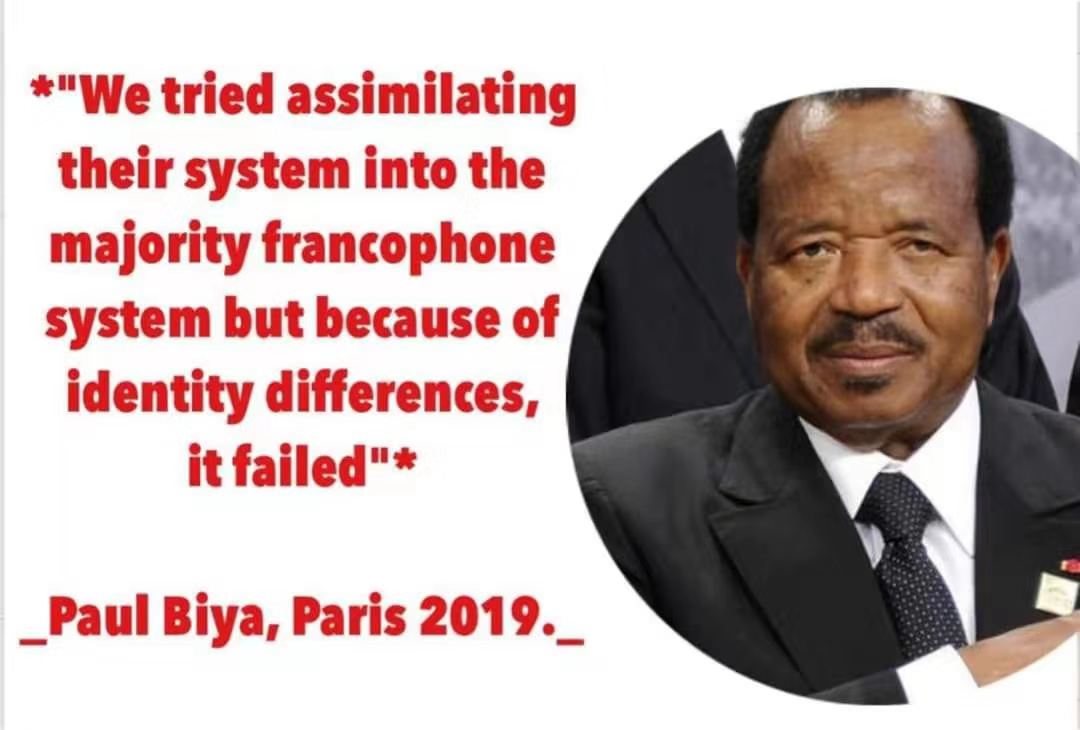
A picture of Anglophone marginalisation vividly explained on @GinaSondo's timeline.
Follow twitter thread below. It tells just half of the story of the people's outcry in the past decades.
👇👇👇
@GinaSondo That is the irony of the so called bilingualism in the so called one Cameroons. the situation has not changed and it can no longer change because Ambazonia has cut off that unholy marriage.
@GinaSondo After reading this write-up i just love you dear. You are are truly beautiful in and out. Please accept my appreciation for well tendering out what has been the S.Cameroonians story for donkey years. Thanks a lot
Why are some companies and ministries still sharing communiques only in French? Why aren’t things changing ‘gradually’ as promised?
To whom it may concern
Gina Sondo.
Why don’t you recruit professional translators? Where is the commission for the promotion of Bilingualism and Multiculturalism in Cameroon? Where is the committee set up during the national dialogue in Cameroon on Bilingualism and Multiculturalism?
I also did this write up because ever since the coronavirus crisis started, I have been receiving messages from the ministry of public health only in French. What has happened to the English Language?
Where are our translators in Cameroon?
I decided to do this write up because at times information sent out to Cameroonians is poorly translated, even during this health crisis. Some do not bother about sending out information in the English Language at all.
others. Some trained translators are ‘jobless’, some have left the country. I say professionally because English Speaking Cameroonians deserve to get information in the English Language the same way it is sent out from the government in the French Language.
are not done professionally. Yes, I say professionally because Cameroon has a reputable school of Translators, Advanced School of Translation and Interpreters (ASTI). I say professionally because that is not the only school where translation is taught in the country, there are..
During my 4 yrs of practicing as a journalist in Cameroon, I have learned that when I receive a communique from an official in French and English, most of the time, I do not use what is shared in English to write an article, I use the French document, because most translations..
So years passed, I completed studies in IRIC, and then I started practicing as a journalist in July 2016. I got into Digital Journalism in 2017, the same year the Bilingualism Commission was created.
Again, while I studied in IRIC an effort was made to translate French questions to English, but if you didn’t have a clue of what was set in French, believe me you would go Off Topic.
Thanks to my very good friends Anorld Dzeben and Che Azeh Cedric, before the second semester of the first year, I was good. Then I had to study statistics in French, believe me I don’t know how I passed that course (wait… DETERMINATION).
Development (CA2D), & I got into IRIC. So, this was actually my 1st time studying in French, in the Uni. of Buea, where I had my Bsc. in Journalism & Mass Comm., I studied in English. It is an Anglo-Saxon University.
Believe me it was difficult, after my first lecture I cried.
Luckily for me, a member of the jury during the orals is a very bilingual person; Prof. Jean Emmanuel Pondi. Well… I did not actually succeed to get into CAPI that year.
That same year another concour was launched International Cooperation, Humanitarian Action and Sustainable..
The question in French (I cannot remember, getting old lol, had something to do with the FIFA) was slightly different from what was set in English. I had to read the French version to understand the question. I passed the written part of the exam and went for the orals.
My story…
In 2012, I wrote an entrance exam into the department of International Communication and Public Action (CAPI) in IRIC, a section of the exam (the essay) was set in French and translated to English.
In January 2017, President Paul Biya created a commission for the promotion of Bilingualism and Multiculturalism in Cameroon. In April 2017, members of the commission were installed. Peter Mafany Musonge, former Cameroon Prime Minister was made head of the commission.