A new look for TensorCash.
The website and documentation now explain the whole protocol, from proof of inference to the financial layer.
Welcome to the verification and settlement layer for global AI inference.
https://t.co/FoKRA1A9nS
Mining should produce something people actually need.
That is the first principle behind the TensorCash protocol.
The work that secures the chain is AI inference, so the electricity spent on mining produces answers people can use, each with a proof of the model that wrote it.
TensorCash v1.2.4b is now available.
It introduces ruleset 6, with dense error checking, historical content non-reuse checks and repetitive entropy filters, to reward higher quality blocks and reduce fork risk.
It activates at mainnet block 35,300 (~Tue 10 Nov, 12:00 UTC). Block producers need to upgrade before then, and verifiers should update to support ruleset 6. Until that height, v1.2.4 keeps working.
A miner on the TensorCash network wrote a website for a coding agent on Qwen3.8-27B, and received 0.01136 TSC for this inference.
Inference and a shot at the block reward, from the same unit of electricity.
A live run by @boblabs_eu, an independent team building on the network.
Every miner on the network creates inference like this while competing for the block reward, whether it gets sold or not.
Platforms such as @boblabs_eu, @AskTillyAI and @inferenceFI are bringing that supply together with demand.
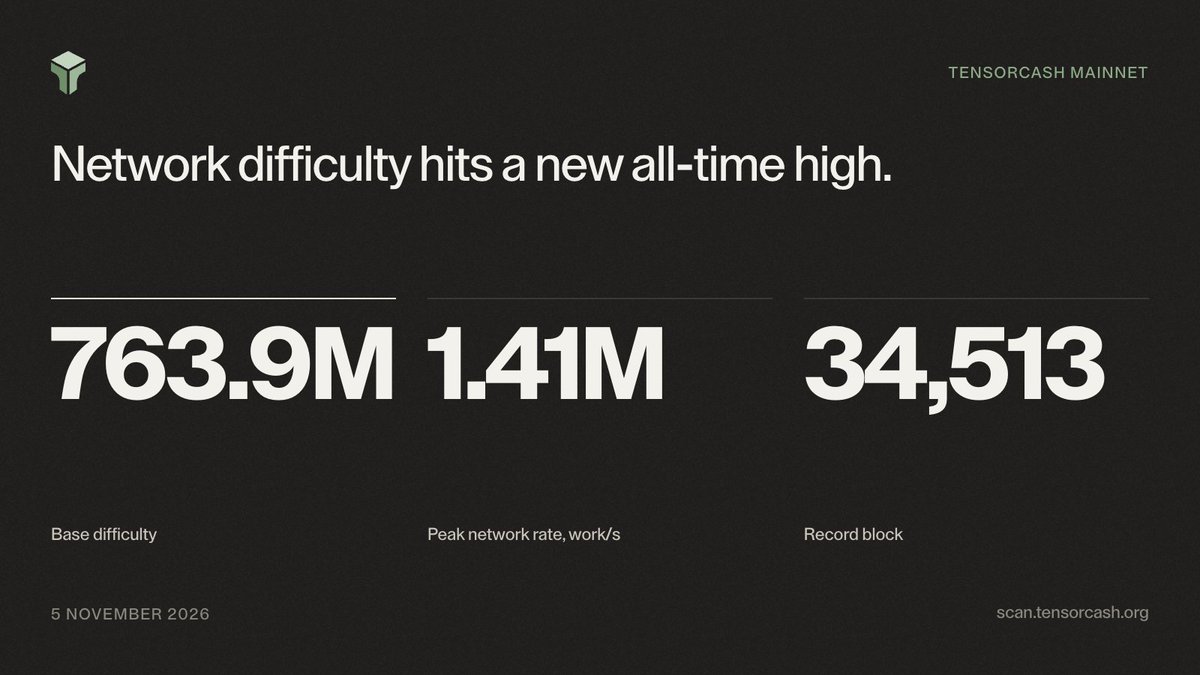
Network difficulty on TensorCash reached a new all-time high today.
More AI inference is running to secure the chain than ever before, and every block still comes with a proof of the model that produced it.
Anthropic is releasing an open source library, FlashProve, for provable inference. It was measured on Llama 4 Maverick, a 400B-parameter mixture of experts model.
Code:
https://t.co/1ILw5Zf8Lh
Blog post:
https://t.co/YROBN2PThF
On TensorCash, the work that secures the chain is AI inference.
Miners run AI models, and every answer they write is also an attempt at the next block.
One computation, two outputs: a secured chain and inference that someone actually uses.
@drwconvexity On the issue of sequencing @Tensorcash’s DEX (in development) addresses this in a very innovative way. Validators operate in a distributed network topology, and speed of light + order info cryptographic fragmentation guarantee stochastically fair sequencing.
On TensorCash, two people can trade directly, with no one else in between. The funds stay in their own wallets until the trade settles, removing the risk of an exchange losing or freezing them.
This video follows one of those trades, from the offer to the block it settled in.
One unit of a call option on the network’s difficulty was traded for 0.9 TSC. The option and the TSC moved in one transaction, straight from one wallet to the other.
Each trade on the protocol is trustless, and neither side can end up paying without receiving. All in an ordinary transaction, with no escrow, no multisig and no trace of the negotiation, which keeps it cheap and private.
TensorCash v1.2.4 activates today at block 33,378, expected between 09:00 and 11:00 UTC.
From that height, nodes run their own validity check on proof-of-inference blocks. Verifiers and bcore block producers who haven’t upgraded yet: the upgrade is mandatory, so do it before then.
Pool verifiers: download both pool-verify-pack archives, verify them against SHA256SUMS and extract them into the same directory.
Improved verifier performance for larger models and longer context windows, reviewed together with several miners.
TensorCash v1.2.4 activates on Wednesday 28 October at block 33,378, expected around midday UTC.
Verifiers and bcore block producers: the upgrade is mandatory, so upgrade before that height.
An independent benchmark by @boblabs_eu showed that mining on TensorCash adds at most 0.3% GPU time to inference.
Qwen3.8-27B ran on three GPUs over a full agentic session, once without mining and once with every request mined.
GPU time changed by −1.1% to +0.3%.
At close to zero overhead cost, a miner can serve inference together with a proof of the model that wrote it, and compete for the block reward at the same time.