I photograph historic art & architecture. Prints, posters, mugs, T-shirts etc. at Terence Kerr on Fine Art America (link below) + license my images on Alamy.
#TuesdayTowers#Lucca
Medieval battlemented bell tower of Basilica di San Frediano in Lucca, Tuscany, Italy, begun 1147. Romanesque mullioned windows with one, two and three mullions were added 13th century. Number of mullions increases as windows ascend to summit. https://t.co/PKVIvznQQy
The complex coat of arms of Richard Neville, 16th Earl of Warwick, was a visual map of his immense wealth and power. Its four grand quadrants reflect the strategic marriages and inheritances that made the “Kingmaker” one of England’s most formidable magnates.
St Catherine, Ledsham, Yorkshire West Riding
She wears a white mantle over a dress with yellow flowers, holds a sword & steadies a large wheel, against a blue ground of seaweed pattern
A highlight from last week's new entries in the Parish Churches app: https://t.co/MQzIEy8ku7
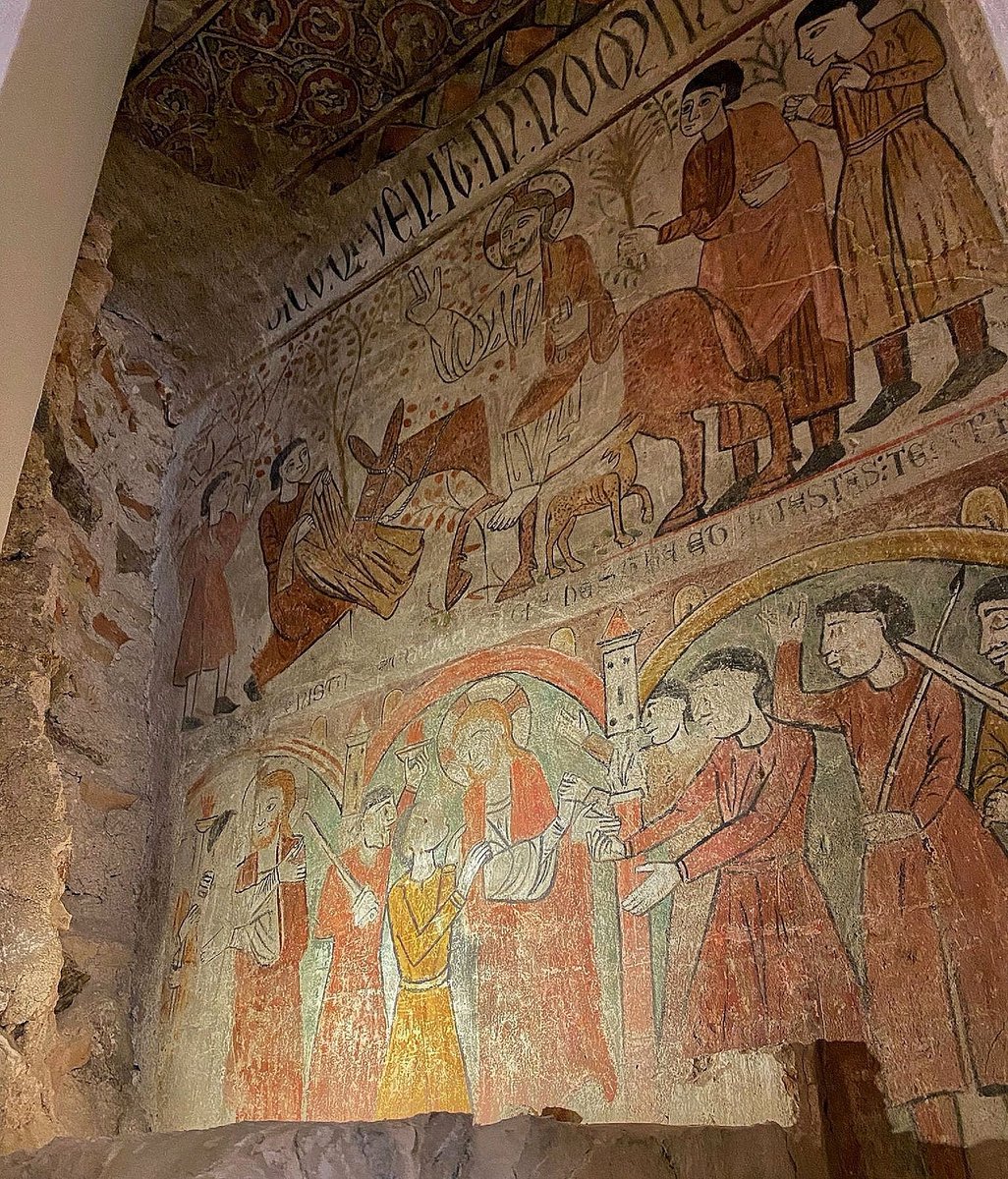
Aprovechando la solemnidad de San Clemente Papa que celebramos hoy vuelvo a traer por aquí las pinturas murales de la sala capitular del convento a él advocado en Toledo, aparecidas en 2006 en un recoveco de su sala capitular
A 15,000-year-old snapshot of an Ice Age feast.
Found at Abri de Raymonden in France, this Magdalenian bone pendant shows a row of humans gathered around the head, stripped spine, and detached hooves of a Steppe bison.
In Paleolithic art, animals are everywhere—but scenes of humans acting together as a community are almost unheard of.
(Bottom: archaeological tracing by Abbé Henri Breuil)
In the early 1900s, a French illustration imagined a classroom in the year 2000 where machines could transfer knowledge directly from books into students' minds.
The teacher places books into a machine while a boy turns a crank to operate it. Wires connect the machine to headsets worn by the students, suggesting that information could be delivered to them without having to read the books themselves.
Titled At School (À l'école), the illustration was part of En l'an 2000, a French series depicting how people imagined everyday life in the future.
Illustration: En l'an 2000, early 1900s. Public domain.
No podía faltar en este día de San Clemente una vista nocturna de la más famosa de todas las iglesias románicas dedicadas al considerado cuarto Papa de la Iglesia Católica:
Sant Climent de Taüll, recordad que a final de este mes cierra durante aproximadamente medio año por obras
Dante and Beatrice among the stars (Paradiso, Canto XXII).
Venetian edition from 1544, designed by Alessandro Vellutello, executed in woodcut print by Giovanni Britto, painted after publication in watercolor by an anonymous illuminator.
The craftsmanship on this French Renaissance armor is incredible. Dating back to around 1575–80, even the embossed backplate is covered in details that make it feel more like a work of art than a piece of armor. It's amazing how much attention to detail went into objects like this centuries ago.
Self-taught California glass artist Loren Stump builds a "loaf" of glass, called murrine, from hundreds of tiny colored glass rods. Slice it, and a full painting appears inside: here, Leonardo da Vinci's Virgin of the Rocks.
Stump says the image could be stretched as thin as a hair and still be seen.
Each slice sold for $5,000 in 2014.
The craftsmanship on this 17th-century Maratha helmet is incredible. The intricate golden metalwork, delicate patterns and turquoise stones make it look almost like a piece of jewellery rather than a piece of armour. It’s amazing how beauty and protection were brought together in such a unique way.
At first glance, you might think these are real hands holding up a piece of fabric. But it's actually a bronze bench sculpture by Iris Le Rütte. I love how unusual yet simple the idea is. It's not just a place to sit, it's a piece of art that makes you stop and look twice.