@LifeNetwork_AI Rosuvastatin and clopidogrel differences appeared only after broad approval; building Asian cardiometabolic evidence before Phase II could move those dosing insights from post-market labels into the pivotal trial design itself.
This mirrors precision agriculture: general satellite models give broad insight, yet the decisive yield gains come from farm-level soil, weather, and outcome data that no horizontal platform fully owns.
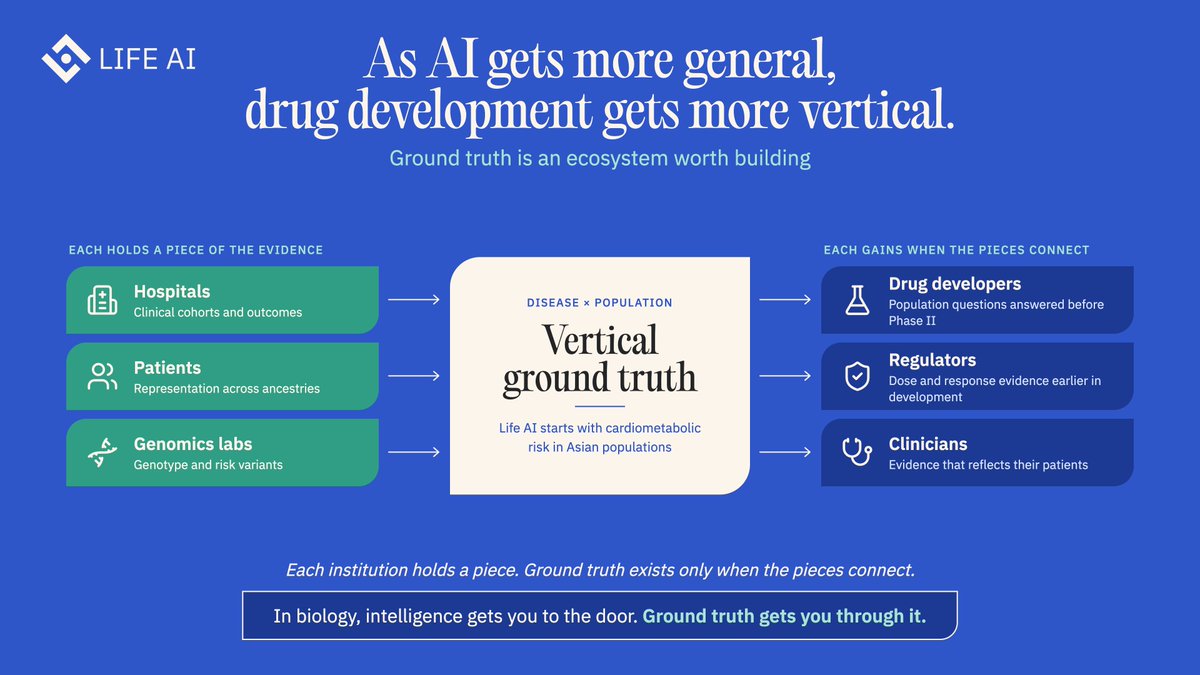
As AI Gets More General, Drug Development Gets More Vertical
The question for AI in drug development is shifting from speed to probability of success. IQVIA’s 2026 R&D report shows the gains are uneven: in its latest three-year window, AI-enabled programs at emerging biopharmas posted a 75% Phase I success rate, yet only matched non-AI programs in Phase II.
The reasoning starts with where value is decided. Phase II proof of concept, where asset value inflects, turns not only on the molecule but on its match with the patients receiving it.
AI has made hypotheses cheaper. It has not made proof cheaper. One lever is well established: in BIO’s 2011–2020 analysis, programs using biomarkers to select patients reached approval about twice as often.
That match also shifts with the population, and in cardiology some differences surfaced on drug labels only after approval. Asian patients show about twice the exposure to rosuvastatin, prompting a lower starting dose on its FDA label in 2005. Since 2010, clopidogrel has carried a boxed warning for CYP2C19 poor metabolizers, about one in seven Chinese patients but one in fifty Caucasians. Yet as of 2025, fewer than one in fifteen GWAS Catalog participants were of Asian ancestry.
Intelligence is portable; ground truth is not.
Today’s approaches each solve for a different variable: general-purpose models for breadth, AI-native discovery firms for the molecule, platforms such as Epic’s Cosmos for volume, mostly from U.S. health systems.
Phase II depends on one more, and no single player holds it: depth of evidence in a specific population. It sits across hospitals, genomics labs, sponsors and regulators, and becomes ground truth only when connected around one disease and one population.
If ground truth is population-specific and distributed, advantage is vertical, and vertical depth is built as an ecosystem.
That is Life AI’s premise. As Dr. Tuan Cao, Co-Founder and CEO of Life AI, has put it: “Many AI companies go horizontal and spread very wide. We go vertical, deep into the diseases that still weigh most on Asian patients, like diabetes and cardiovascular disease.”
Life AI works disease by disease, population by population: starting with cardiometabolic genetic risk in Asian populations, bringing intelligence into partner hospitals, where care happens, and extending it toward drug R&D through a purpose-built world model on connected infrastructure.
When models become a shared input, advantage increasingly moves to the evidence beneath them: which patients respond, at what dose and why, established before approval.
That evidence cannot simply be licensed. It is built institution by institution, cohort by cohort, and each institution that contributes can make it more valuable to the rest.
In biology, intelligence gets you to the door. Ground truth gets you through it.
A launchpad should explain more than how to create something. It should also make its operating rules understandable.
This is an important part of evaluating the product direction behind @onlystreetsfun.
Its photo-first concept introduces a different approach to memecoin creation. But a complete product experience requires more than an interesting creation process.
There are three areas worth examining:
1. Cost Transparency
Users should be able to understand the costs associated with using the platform before confirming an action.
2. Token Configuration
The platform should clearly explain the important settings associated with creating a token, including the permissions and responsibilities involved.
3. Transaction Transparency
Users should understand when an action is submitted, whether it has been completed and where they can verify its status.
Why does this matter?
Because an attractive interface does not automatically make a product transparent.
People need to understand what happens behind the interface, especially when blockchain transactions are involved.
There is an important distinction here:
OnlyStreets has publicly introduced its photo-first creation concept, but its complete fee structure, token configuration rules and transaction-handling details have not yet been established in the public information we reviewed.
These are important areas to examine as the product develops.
A strong launchpad should make its creative process simple and its technical rules clear.
That is how a good concept can develop into a product people understand.
@onlystreetsfun@rarelistio
@LifeNetwork_AI Addressing these two issues simultaneously can reverse the condition. Current understanding is that diabetes cannot be cured, only controlled, but miraculously, my family member persisted with eight months of traditional Chinese medicine treatment and has now fully recovered.🍀🙏
@LifeNetwork_AI Traditional Chinese medicine believes that the root cause of diabetes complications, like other cardiovascular diseases, is arteriosclerosis, with the core pathogenic factors being inflammatory responses in the vascular endothelium and changes in blood lipids and hemorheology.