For my kids I started DCAing into $TSLA 3 years ago in a separate account. Average cost basis +- $210. Genius or reckless? Time will tell.
Anyone doing the same?
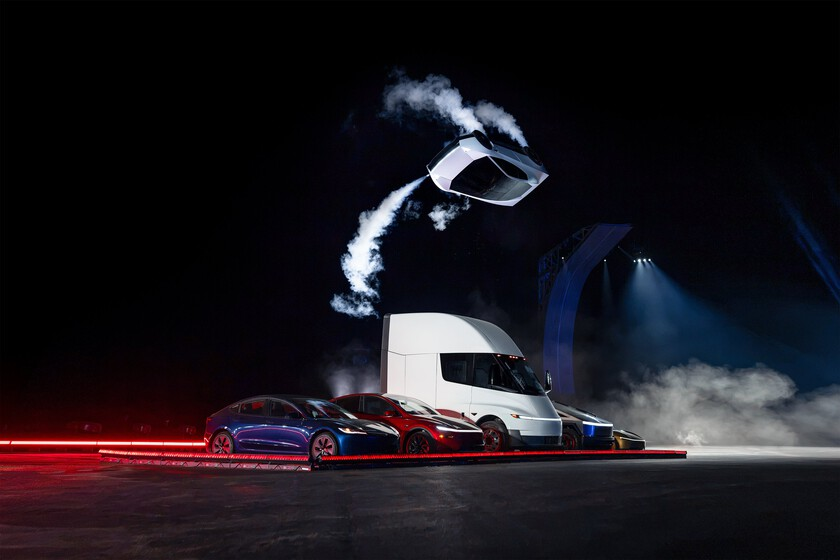
I’ve spent a few days thinking about the Tesla Roadster reveal and landed somewhere I haven’t seen much discussion. I’m neither a Tesla fanboy nor a Tesla hater. And I couldn’t care less whether what we saw technically qualifies as a flying car. Three takeaways: (1) The risk of that live demonstration going horribly wrong was real. Almost no CEO would willingly expose their company to that kind of public humiliation for a product with so little financial upside. Elon did. (2) That willingness to attempt the seemingly impossible is what makes Tesla special. It’s also arguably Elon’s greatest contribution to America. He’s helped bring back something we’ve lost. The American spirit of chasing big scary ideas that most people think are impossible. That mindset is spreading across a new generation of founders and its long term impact on America’s future could dwarf anything Tesla ever sells. I think this is deeply underappreciated. (3) Can we just acknowledge how insanely cool that moment was? We’ve reached a strange place culturally where even extraordinary feats of human ingenuity immediately become arguments about why they don’t count. Not everything needs to be a debate. Sometimes we should just be able to stand back together and marvel at what humans are capable of. I’ve been both bullish and critical of Tesla’s ambitions over the years. But watching Elon and his team push the boundaries of what’s possible reminds me why I’m glad we have him. Whether the Roadster ever makes Tesla a dollar or impacts $TSLA stock price is almost beside the point. We need more people willing to risk failure in pursuit of things the rest of us think are impossible. Because when they succeed we all win.
J'ai vu une Tesla décoller. Et j'ai entendu beaucoup de bêtises.
« Ça ne sert à rien. » « Gadget de milliardaire. » « Qui a besoin d'une voiture qui vole ? »
Personne. Et c'est exactement pour ça que c'est important.
En 1978, Brabham a aligné en Formule 1 une voiture équipée d'un ventilateur géant à l'arrière. Il aspirait l'air sous le châssis et plaquait la voiture au sol. Elle a gagné sa première course avec une avance insolente. Elle a été interdite immédiatement.
Quarante-huit ans plus tard, on y revient. Un système de succion qui colle la voiture à la route et lui permet de passer sous la seconde au 0 à 100.
Personne n'a « besoin » de faire le 0 à 100 en moins d'une seconde. Comme personne n'a besoin d'une Formule 1. Et pourtant : les freins carbone de votre berline, l'hybridation de votre moteur, l'aérodynamique de votre SUV, les palettes au volant — tout ça vient de voitures de course que personne n'utilisera jamais pour aller au travail.
La Formule 1 ne sert à rien. Pourtant elle sert à tout.
En 1973, quand la France a lancé Ariane, l'Europe sortait de onze échecs consécutifs du programme Europa. La presse parlait d'argent jeté dans l'espace. Vingt ans plus tard, Ariane détenait la moitié du marché mondial des lancements commerciaux, et chaque satellite de télévision, de météo ou de GPS que vous utilisez a bénéficié de cette obstination.
Le progrès a toujours la même tête au début : un truc inutile, cher, ridicule, construit par des gens qu'on prend pour des fous.
Ce que j'ai vu à Dallas, ce n'est pas une voiture volante. C'est un châssis, une gestion de l'énergie et une maîtrise des flux d'air que l'industrie automobile mettra dix ans à digérer.
Les applications viendront : sécurité, freinage, stabilité, consommation. Elles finiront dans des voitures ordinaires conduites par des gens qui expliqueront, en 2036, que tout ça était évident.
La question n'est jamais « à quoi ça sert ».
La question est : qui ose encore construire des choses qui ne servent à rien ?
Il y a cinquante ans, c'était nous. La fusée, le TGV, le Concorde, le Minitel.
L'Europe construisait des choses absurdes et magnifiques.
Aujourd'hui, on commente depuis le siège arrière car nous sommes hors course.
Merci @elonmusk de nous faire rêver
*Un auto chino saca un dron del techo para que puedas mirar el tráfico* (ya lo hace Google Maps).
El público: "Es lo más impresionante que vi en la vida. Se terminó todo, China va a dominar el planeta y está 70 años adelantada. No hay fuerza del universo que pueda competir."
*Tesla presenta el Roadster que acelera a la mitad de la velocidad del sonido (617.5 km/h), hace backflips y se puede sostener en una superficie vertical o de cabeza*.
El público: "No me impresiona, no leo veo utilidad. Puro marketing y mucho humo."
Greta Thunberg se dit « extrêmement fière » des lycéens français.
Gardez ce signal en tête, parce qu'il résume tout.
En quelques années, la militante du climat est devenue militante de la Palestine, puis supportrice de n'importe quel mouvement de rue en Europe. Le sujet change, mais la posture ne bouge jamais.
Ce n'est pas un hasard. C'est une méthode.
Une cause peut être réelle. Le réchauffement existe, Gaza est un drame, et la colère de certains lycéens est sincère. Mais dans ce logiciel, la cause n'est jamais une fin, c'est un véhicule. On la charge d'émotion, on la vide de toute nuance, et on s'en sert pour faire avancer le même agenda : délégitimer l'Occident, ses frontières, ses institutions, sa culture. Quand une cause s'essouffle, on passe à la suivante. Le climat hier, la Palestine aujourd'hui, les lycées demain. Les drapeaux changent mais l'ennemi désigné reste le même.
Un projet politique se juge à ses résultats, pas à ses slogans. Après trente ans de ce récit, le bilan est clair. On a eu une immigration massive qu'il était interdit de questionner, et une insécurité que les gens vivent dans leur rue pendant qu'on leur explique que c'est un « sentiment ». Des territoires entiers ont décroché de la République. Les classes moyennes paient tout et se font traiter de racistes dès qu'elles le disent. Ceux qui portent ce discours n'en subissent jamais les conséquences. Ce sont toujours les autres qui paient l'addition.
Il faut appeler ce projet par son nom : c'est la continuation du communisme par d'autres moyens. Gramsci l'avait théorisé depuis sa cellule dans les années 30. En Occident, on ne prend pas le pouvoir par la révolution, on le prend par la culture. On conquiert l'école, l'université, les médias, le monde associatif, et le jour où ces idées sont devenues le « bon sens », le pouvoir politique tombe tout seul. C'est l'hégémonie culturelle. La lutte des classes est devenue lutte des identités, et le prolétaire a été remplacé par le « dominé » du moment. Mais la mécanique est identique : diviser, culpabiliser, déconstruire.
Le problème pour eux, c'est que ça ne marche plus.
Cet écosystème d'ONG, de fondations comme l'Open Society de George Soros, d'institutions internationales et de médias qui financent et amplifient ces causes depuis des décennies est en train de perdre partout. Les peuples ont vu les résultats et ils votent contre, en Europe comme en Amérique. Le récit ne prend plus. Quand on en est réduit à envoyer Greta Thunberg applaudir des lycéens français, ce n'est plus une stratégie, c'est un aveu de faiblesse.
Greta peut être fière. Elle assiste à la fin d'une époque.
Waymo took a year and a half to get 300 robotaxis on the road in Austin. Tesla just did it in 5 weeks.
The whole difference is a car factory in Texas.
Every Waymo starts out as somebody else's car. A Jaguar I-Pace gets built in Austria, shipped across the ocean, then hand-fitted with lidar, radar, and computers that analysts peg at over $100,000 per vehicle. After 15 years of doing it that way, Waymo's entire worldwide fleet is around 4,000 cars.
The Cybercab just rolls off a line at Giga Texas.
Two seats, no steering wheel or pedals, not even side mirrors. People look at that and see a bold design. A factory sees fewer parts, and fewer parts means the line moves faster and each car costs less to build.
Tesla designed the whole thing around its unboxed assembly process, where chunks of the car get built in parallel and come together at the end. Elon says the target is 2 million Cybercabs a year out of one factory. You can't get anywhere near that retrofitting luxury SUVs by hand.
The sticker price is the wild part. Tesla's target is under $30,000 per Cybercab. That's Toyota Camry money. So for what Waymo spends putting one car on the road, Tesla can put out four or five.
To be fair, Tesla ran Model Ys around Austin for 15 months before the first Cybercab picked anyone up, and 300 cars in one city doesn't prove the business works yet.
But look at the growth rates. For ten years the hard part of robotaxis was teaching a car to drive itself. Once that's solved, the hard part becomes building cars fast and cheap. And one company in this race spent the last 20 years getting good at exactly that.
Waymo builds robotaxis the way NASA builds satellites, one at a time, by hand. Tesla builds them the way it builds cars. Because they are cars.
Dear @Tesla
👉 Toyota hates you because you are far more reliable.
👉 VW hates you because of your superior software infrastructure.
👉 Mercedes hates you because they can no longer claim the luxury title.
👉 BMW hates you because they are no longer the ultimate driving machine.
👉 Waymo hates you because you outperform them in safety, cost-per-mile, and aesthetics.
👉 Gas stations hate you because you don’t need gas.
👉 Dealerships hate you because they can’t charge a markup.
👉 Unions hate you because you take away their power and return it to the workers through meritocracy and incentives.
👉 Big government hates you because you show all of us how incompetent, outdated, and inefficient they are.
But with all that said, you do you, Tesla. Because you are changing the world.
Bonnie Blue can suck 1,000 guys off on camera and not a word from “progressives”.
Only fans has countless young girls entering porn. Not a word from progressives
Tons of fat and not very conventionally attractive people naked in woke adds for 5 year. Not a word from progressives
Body positivity, body autonomy and protecting sex workers were all celebrated by progressives.
Then, an attractive white women with big boobs they don’t like decided to make a sexy naked commercial and “progressives” lost their minds
I guess I should be saying “thank you” because everyday “progressives” prove they are dishonest, hypocritical spoiled crybullies who project their misery onto everything they touch.
This whole Macklemore situation is so spiritually Palestinian.
Ed Sheeran became one of the biggest musicians in the world by writing good music, he built an audience, and people spend hundreds of dollars to come hear his music.
Macklemore gets invited onto that stage and decides to hijack Ed Sheeran’s concert for his political rally. Ed built the stage and brought the audience, and Macklemore decided he was entitled to commandeer it for his demented cause.
And when Ed Sheeran tells him this is a concert, not a political rally, and he doesn’t want to take sides, he becomes the villain.
This is Palestinianism. You build nothing. You bite the hand that feeds you. You leech onto things other people built and destroy them.
These parasites have hijacked every institution, every cultural event, everything other people built, and feel entitled to selfishly destroy it for their tribal clan politics.
The EU is seriously celebrating 15 Mbps internet as a massive connectivity breakthrough 😂
East Greenland’s current OneWeb-backed service includes:
15/5 Mbps — 799 DKK/month (~$124)
Freaking 15 Mbps for $124
In 2026 lmfao
Now compare that with what Starlink already offers in Denmark:
100 Mbps — 235 DKK/month (~$37)
200 Mbps — 370 DKK/month (~$57)
Max, up to 400+ Mbps — 530 DKK/month (~$82)
Read that again
Starlink’s 200 Mbps plan costs LESS THAN HALF as much while offering over 13× the download speed
Even Starlink’s highest-performance residential plan costs less than that 15 Mbps OneWeb plan
SpaceX already built Starlink at global scale: high-speed, low-latency internet through a terminal you can literally set up yourself in minutes
Meanwhile, Europe keeps spending billions building its own “strategic autonomy” satellite architecture instead of simply embracing the technology that already works at a massive scale: faster, better, reliable, and cheaper
And the funniest part is...
When connectivity becomes mission-critical, suddenly everyone understands exactly why Starlink matters
But when ordinary people just want good internet?
Apparently 15 Mbps for $124 deserves a freaking ribbon-cutting ceremony
Only the EU can make painfully slow internet expensive...and then celebrate it like a technological breakthrough
les gens détestent Elon pour des raisons complètement débiles
pollution, climat, net worth, individualité, etc.
alors que c’est un des types qui fait le plus pour tout
le cybercab :
- moteur sans métaux rares
- voiture plus légère, moins chère à produire
- 100% électrique, zéro CO2 à l’usage
- un seul véhicule qui sert des dizaines de personnes → moins de voitures au total
- dispo jour et nuit, pas d’indisponibilité
- facile d’accès, ultra sécurisé
- ça va faire chuter les morts sur la route de manière massive
starlink :
- internet accessible partout, pour tous
spacex :
- a cassé le prix d’accès à l’espace
- fusées réutilisables, cadences de lancement absurdes
- veut rendre l'espèce multi-planétaire
neuralink :
- déjà utile pour des gens qui ne pouvaient plus bouger / communiquer
X :
- info en temps réel, moins de filtre politique
- a open-source l’algo
énergie :
- défend le solaire au-dessus du reste, devant le nucléaire et le fossile
- pousse une énergie abondante et clean
optimus :
- un robot humanoïde qui peut faire les tâches répétitives / dangereuses
c’est objectivement l'un des plus grand entrepreneur de ce monde et certainement l'une des personnes qui a le plus d'impact positif pour l'espèce
ENGINEERING WONDER DECODED 🚖 Cybercab isn’t just an FSD story. FSD is the intelligence that makes a driverless robotaxi possible, but the other half of the equation is the vehicle Tesla has built around it 🆒
And the deeper we look at Cybercab’s hardware, the clearer it becomes that Tesla didn’t simply remove the steering wheel and pedals. It rethought some surprisingly fundamental parts of the car around autonomy, manufacturing, and operating at enormous scale.
One of the best examples is the braking system.
A conventional car uses hydraulics. When you press the brake pedal, brake fluid carries pressure through lines running around the vehicle and ultimately squeezes the pads against the rotors.
Cybercab still has physical brake discs and calipers, but each caliper instead uses its own electric actuator. According to Elon Musk, that eliminates the hydraulic system entirely: no brake fluid and no need to route brake plumbing throughout the car.
For a vehicle without a brake pedal in the first place, that makes a lot of sense. The autonomy system is already commanding the brakes electronically, so Tesla can take the next step and actuate them electrically at the wheels instead of converting that command into hydraulic pressure.
But the bigger advantage may be manufacturing.
Hydraulic brakes require lines to be routed through the vehicle, connected between different assemblies, filled with fluid, bled to remove air, and checked for leaks.
Remove the hydraulics and a surprising amount of that work disappears.
That fits extremely well with Tesla’s “unboxed” manufacturing process, where large sections of the car can be built independently and brought together much later in assembly.
Instead of having brake lines physically connecting major sections of the vehicle, those assemblies can potentially arrive with their braking hardware already installed and tested, with the final vehicle relying much more heavily on electrical connections.
For a robotaxi expected to accumulate mileage far faster than a normal privately owned car, eliminating brake fluid also removes another fluid and maintenance item from the vehicle.
That same obsession with manufacturing speed carries directly over to the Cybercab’s drive unit.
Tesla says it is 18% smaller and 25% lighter than other top-performing EV drive units while also being more efficient.
But perhaps the more interesting part is how aggressively it appears to have been designed around automated production.
The unit uses a simplified bar-wound stator and lubrication system, with an architecture reportedly designed for fully automated production and sub-10-second cycle times.
To put that in perspective, a sub-10-second cycle time means a single production line could theoretically churn out over three million drive units a year.
The stator is essentially the stationary part of the motor containing the copper conductors that create the rotating magnetic field.
A bar-wound design uses precisely formed copper conductors that machines can insert and assemble very consistently. The concept itself isn’t unique to Tesla, but what matters here is how Tesla appears to have simplified the entire motor around automation, packaging, and that blistering production speed.
In other words, Tesla isn’t only designing the motor. It is designing the motor and the factory that builds it as one system.
And then Elon revealed perhaps the most intriguing detail of all: the Cybercab motor uses no rare-earth metals while maintaining the same range.
That is much harder than it sounds, and it solves a massive scale problem.
High-performance EV motors commonly use extremely powerful rare-earth permanent magnets because they can produce a very strong magnetic field from a relatively small and lightweight package.
You can build motors without rare earths. The difficult part is doing it without giving up the efficiency, size, weight, or performance advantages that made rare-earth magnets attractive in the first place.
That is why Elon described achieving this while maintaining Cybercab’s range as “extremely hard.”
Beyond the engineering feat, this removes massive supply chain bottlenecks and volatile material costs. It drives the unit cost down to the absolute floor required to deploy a global fleet.
Tesla hasn’t publicly explained every detail of how the Cybercab motor accomplishes it yet, which makes this one of the most interesting pieces of engineering still waiting to be unpacked.
And this wasn’t completely out of nowhere.
At Investor Day in 2023, Tesla showed a next-generation permanent-magnet motor requiring zero rare earths as part of a broader next-generation drive unit program.
Tesla was already talking about dramatically reducing powertrain manufacturing space, cutting expensive materials, and designing the system around much higher production efficiency.
Cybercab increasingly looks like the production realization of that roadmap.
Put all of this together and Cybercab starts to look less like a conventional EV adapted for autonomy and more like a vehicle engineered from the beginning around it.
FSD provides the intelligence. The hardware is being redesigned to remove components, plumbing, manufacturing steps, maintenance requirements, and constrained materials that make conventional cars harder and more expensive to build and operate at enormous scale.
That may be the real Cybercab equation: automate the driver with FSD, then redesign the car itself for a world where nobody needs to drive it.
Jason Arday shouldn’t be dead.
But he is dead - because he didn’t tell the truth.
And Cambridge University didn’t look for the truth - because he’s black.
And fellow black professors didn’t ask for the truth - because he is black.
Jason lied repeatedly.
And he told the exact lies that allow one to excel in the system that elite universities have adopted.
A system that factors in race, hardship, and lived experience under the banner of equity, instead of pure performance.
Nearly everyone in these institutions ignored Jason’s lies, to try and protect black people.
They called the people seeking the truth racists.
Of course there were some racists.
But the majority of people just wanted the truth.
Avoiding the truth didn’t help black people.
Double standards in academia aren’t helping black people.
They hurt the perception of black people who are truly the best, and would have held prestigious positions at elite schools, solely off the merits of their performance.
Double standards always backfire.
Even when well intentioned.
Even when intended to correct for past oppression.
Race-conscious hiring and admissions have created a situation where it is rational to wonder whether a black person has achieved their position because they were simply the best, or because they were good enough, and black.
This is not a racist thought.
It’s a rational thing to wonder when a system promotes people based on race.
It’s a thing I’ve wondered about myself, as someone who graduated from Harvard - which had race-conscious admissions.
No amount of insistence that it’s racist will make it racist.
It’s no more racist than it would be to wonder whether a white player got into the NBA off of just performance, if the NBA decided to focus on “fixing” the underrepresentation of white people.
This is the logical downside of race-conscious hiring and admissions.
You can think the downside is worth the upside.
But the downside remains.
Calling people with legitimate concerns racist didn’t protect black people.
It didn’t protect Jason.
It hurt black people who have earned their positions.
And it allowed a troubled man who built his career on lies to rise to a height so great that his fall from grace killed him.
We could have just had the truth.
Instead, we have a tragedy.
@ChadAppDev@ads4apps After I had a leecher cancelling right after subscribing and still enjoying their trial for the full 7 days, I removed the trial for new purchases!
I do offer a one-time in-app experience of 'pro' features for any specific game of their choice in the app.