Your coding agent can run all night. It still can't tell if what it built actually works.
Today we're open-sourcing the TestSprite CLl
(Apache-2.0)
A tool your agent calls on its own to test your app end-to-end like a real user, fix what broke, and re-check everything it ever got right. It's the same engine 100,000+ teams already use.
https://t.co/Yh6TkXOr6u
We proved it in public, on a public leaderboard:
Most correct app on the board:89% Built by the cheapest model in the field At half the cost of the priciest one
You no longer need the biggest, most expensive model to ship software you can trust.
Setup is 2 commands:
npm install -g @testsprite/testsprite-cli
testsprite init
That's the last command you'll ever type - from there, your agent runs the tests itself.
Shipping with Claude Code, Codex, or Antigravity? Season 4 is for you.
One loop. Every PR.
Week one: wire TestSprite into your repo so every pull request gets tested. Your proof is a PR that caught something and went green.
Bonus: make our open-source CLI better. Open an issue, ship the fix.
$4,000 pool. $3,000 for the 5 best projects, $1,500 to first. $1,000 for CLI fixes, $50+ per merged PR that's a genuine improvement.
Plus five creators picking their favorite builds.
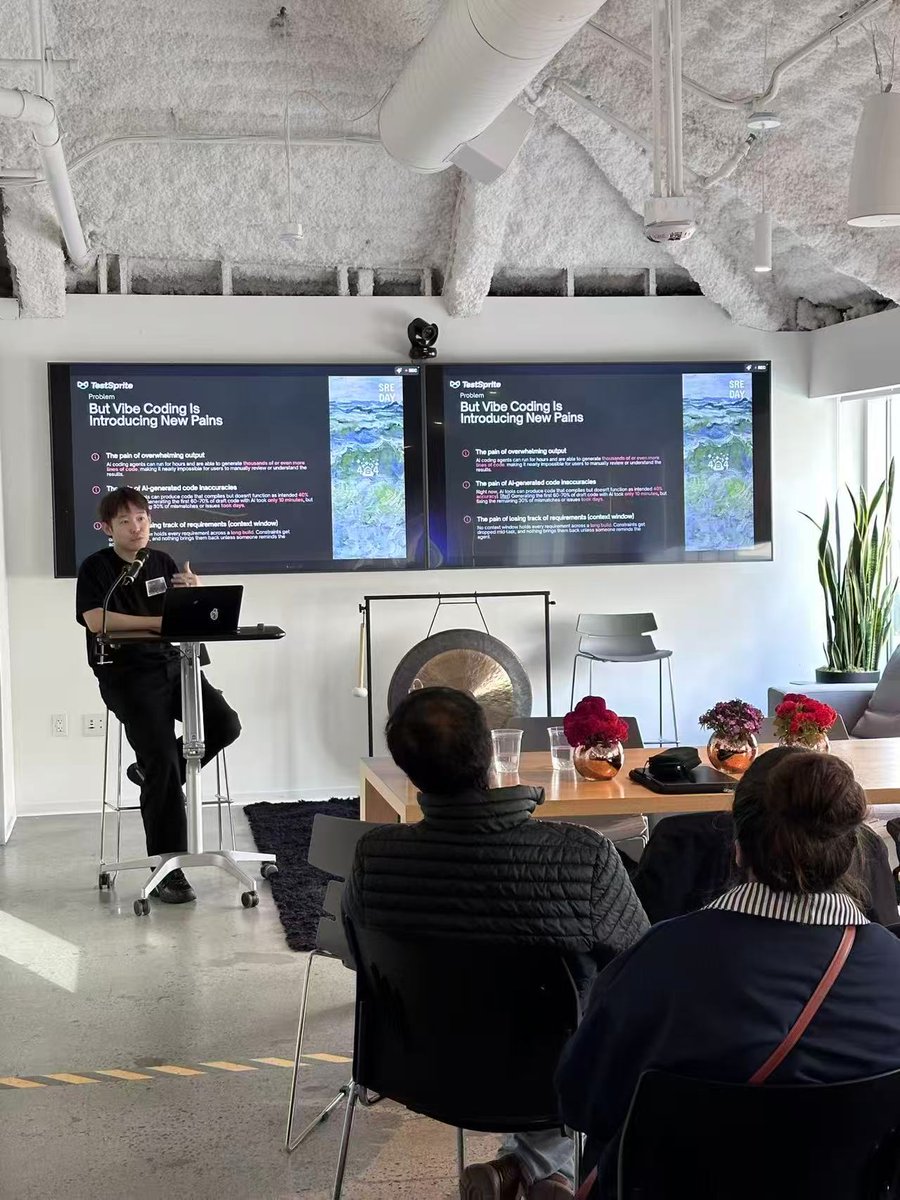
Thanks to the @sreday_com team for hosting us in SF last Friday!
@yunhaojiao , our CEO, talked about what breaks when AI writes the code, and how TestSprite catches it by testing the running app end to end.
Great meeting so many engineers who care about reliability.
Great to connect with AI founders at AWS Startup Day SF! The agenda ran from the agentic stack to security as a day-one choice. Agents keep changing apps. TestSprite makes sure those apps still work after every deploy.
Thanks @AWSstartups for hosting 🤝
TestSprite CLI v0.12 just shipped. Two things you can use right away:
Test your local app: Hook a project straight to the app running on your machine by port, no deploying or building a URL first.
Environments: Manage your staging, dev, and prod setups from the CLI, then point any run at one with --env <name>. No more accidentally testing against the wrong place.
npm i -g @testsprite/testsprite-cli to grab it.
TestSprite CLI v0.11 just shipped. This one's all about keeping your local runs safe and honest:
No more zombie runs: if a tunnel can't be reached, we stop the run and cancel it instead of leaving it executing and billing against a machine it can't reach.
Honest refunds: cancel a frontend run early and test cancel now shows the credits you got back, instead of the old help text that wrongly claimed there was no refund.
npm i -g @testsprite/testsprite-cli to grab it.
We shipped v0.9 with a bunch of fixes, then shipped v0.10 just to add one more thing. Three things that make your day easier:
-test-id-attributes (v0.10): Tell TestSprite about your own test hooks (data-element, data-cy, whatever you use), so exported tests stop relying on brittle text or xpath and survive UI changes.
setup: It now detects the agents you actually use and installs for all of them, instead of quietly setting up just one and letting the rest fail silently.
test get: See a test's real steps from the CLI now, numbered, not just a step count.
npm i -g @testsprite/testsprite-cli to grab it. Tell us what breaks!
TestSprite CLI v0.8.0 is out. Three things you'll actually feel:
>test plan generate: No tests yet? It explores your live app, maps the features, and writes the first ones for you. Review and accept, done.
>test run --local: Test the app running on your own machine. It opens a tunnel, runs against localhost, and closes it after. No deploy step needed.
>ci init github: Scaffold a full GitHub Actions gate in one command. Version pinned, least privilege, and it won't fake a green when a run is only partial.
npm i -g @testsprite/testsprite-cli to grab it. Tell us what breaks.
TestSprite CLI v0.7.0 just shipped. Three things that make your day easier:
schedule: Set tests to run on a schedule, and see the monthly cost before you commit, so no surprise bills.
testlist: Bundle your tests across projects and run them as one batch, straight into CI.
--target-url: Point at a dead URL or a dead tunnel? We stop the run before it costs you anything.
npm i -g @testsprite/testsprite-cli to grab it. Tell us what breaks.
And finally, our Hackathon Season 3🏆
Nora by @resquedzn05: a cozy pixel study app built on real learning science, with a companion that grows as you learn.
The builder ran TestSprite 55 times against the live app in a week. The catch that stuck: they always tested on their own data-rich account, so everything looked fine, until TestSprite signed up as a fresh user and found every new signup was landing on a blank white screen. One line to fix, invisible to anyone testing as themselves.
Full honest writeup 👇
One of the clearest breakdowns we've seen on agent systems that survive production. The whole thing is worth reading, from cutting fake dependencies to designing failure as a local event.
The part closest to our world is verification on the edge: "Do not ask the same agent to generate, approve, and publish its own work in one context. Separate the roles." That's independent verification in a sentence. A checker earns its place by producing nothing new, its only job is to stop weak work from reaching the user.
Climbing to 2nd Place in our Hackathon Season 3 🏆
Mantiz by @mawa22Q: a lie detector for AI coding agents, built to catch them when they cheat a test suite by skipping tests, disabling assertions, or hallucinating matchers to fake a green build.
Then TestSprite went to work.
Mantiz and TestSprite are chasing the same lie, an agent claiming a success it never earned. So they built it inside the loop and pointed TestSprite at their own honesty detector, making sure the thing that catches cheaters wasn't quietly passing itself.
A build this on the nose about verification is our kind of winner. Repo below 👇