The all-new CURERING iOS app is here.
Built from the ground up, the new app delivers a faster, smoother, more intuitive experience from the moment you connect your Ring.
Existing CURERING owners can now join the beta, explore the new experience first, and help shape what launches next.
Join the beta: https://t.co/7EQEai1IEN
5 Health Signals Hidden in Your Voice
Your voice may be tracking things your words never say.
The pause before a word, the subtle drop in energy, the flatter tone when you are tired, and the small shifts in pitch, rhythm, breath, and volume.
Researchers are studying these patterns over time because they can reflect changes in the nervous system, cognition, mood, stress, and fatigue.
Here are 5 health signals hidden in your voice:
1. Neurological health
Your voice is partly controlled by your nervous system. Changes in vocal stability, loudness, pitch, articulation, and speech rhythm are being studied in conditions like Parkinson’s as possible markers of disease state or progression.
2. Cognitive load
You can sometimes hear cognitive effort in speech. When your brain is working harder, your pauses may get longer, your responses may slow down, and word-finding can become more difficult.
3. Emotional state
Your mood can change how you sound. Pitch, pace, rhythm, vocal energy, and variation can shift with emotional state. Researchers have studied these patterns in relation to depression, anxiety, and other mental health signals.
4. Stress and recovery
Stress affects your body, and your voice can reflect that. Breathing, muscle tension, vocal effort, and nervous system activity can influence tone, stability, energy, and voice quality.
5. Fatigue
When you are tired, your speech may become slower, quieter, flatter, or less precise. That is why voice is being explored as a signal for fatigue monitoring, workplace health, and clinical research.
The important part is not one recording.
It is the pattern over time.
Voice data can carry health, emotional, identity, and behavioral signals. It should not be collected casually or studied without clear consent.
That is why AxonVoice is being built as privacy-first research infrastructure for voice biomarkers.
A consent-first way to study voice as a health signal while giving participants control over how their data is collected, shared, and used.
Learn more: https://t.co/e5CPcEzNfs
High performers don't just work harder. They recover better.
Recovery is a skill, not a passive event. You build it into your day.
The five pillars:
Breath, Mindfulness, Movement, Quality Sleep & Nature
Training recovery is the same as training productivity.
Start today.
Published today: a first-of-its-kind case series examining clinical improvements following an integrative iboga microdosing protocol for chronic brain injury symptoms.
https://t.co/ddhhR6kcUP
Day 3 burn is complete 🔥
4.5M / 4.5M AXGT has now been permanently removed from circulation.
This is part of the infrastructure work we’re building around Axon’s protocol. For us, the point isn’t just the burn itself. It’s the loop behind it:
- GPU demand leads to compute usage.
- Compute usage supports real research.
- More infrastructure enables us to expand capacity.
- More capacity gives research workflows more space to run.
Compute, research, infrastructure, repeat.
Burn tx: 0xaa56820ac2425d05c89e1110cb34e1c8cec999c58a7306bb5a55df5434fbafd7
He spent weeks sifting through the wreckage of 9/11 for survivors.
Only to wake up one night with an ice pick in his eye. Except...
𝘵𝘩𝘦𝘳𝘦 𝘸𝘢𝘴 𝘯𝘰 𝘪𝘤𝘦 𝘱𝘪𝘤𝘬.
Joe McKay had developed Cluster Headaches. Also known as:
𝗦𝘂𝗶𝗰𝗶𝗱𝗲 𝗛𝗲𝗮𝗱𝗮𝗰𝗵𝗲𝘀.
Described by doctors as "the worst pain humans can experience."
And for a year, nothing gave him relief.
No prescription helped.
No treatment worked.
He was hooked on prescription painkillers, contemplating death
𝘦𝘷𝘦𝘳𝘺. 𝘴𝘪𝘯𝘨𝘭𝘦. 𝘥𝘢𝘺.
Until a friend who used to go to Grateful Dead concerts handed him a chocolate.
𝗧𝗵𝗮𝘁 𝗵𝗮𝗱 𝟮𝗴 𝗼𝗳 𝗣𝘀𝗶𝗹𝗼𝗰𝘆𝗯𝗶𝗻 𝗶𝗻 𝗶𝘁.
The next day...
He felt the shadow of a headache.
𝘉𝘶𝘵 𝘪𝘵 𝘯𝘦𝘷𝘦𝘳 𝘤𝘢𝘮𝘦.
Day after that. Same thing.
No headaches for over a year.
Now he advocates for first responders.
"For people in my community, a lot of us,"
"𝙄𝙩'𝙨 𝙥𝙨𝙞𝙡𝙤𝙘𝙮𝙗𝙞𝙣 𝙤𝙧 𝙨𝙪𝙞𝙘𝙞𝙙𝙚."
AxonOS private beta is here.
We’re opening the first cohort to selected researchers, and AxonDAO is providing free initial compute for those joining early.
If you want early access, apply here:
https://t.co/cDCtH66hXu
AxonOS is now in private beta.
We are inviting qualified researchers to join the first test cohort and early grant pipeline.
Selected researchers may receive free initial compute grants on the first V100-backed stack as part of the initial rollout.
Apply here: https://t.co/kjKuVSMLq1
This is part of what we think about a lot at AxonDAO.
If science is becoming computational, then scientific infrastructure has to be built for verification, reuse, and access, not just raw performance.
Follow us for more
Source:
https://t.co/dplyfSSXik
Australian tech entrepreneur Paul Conyngham explains how he used ChatGPT/AlphaFold (spent $3,000 with no biology background) to create a custom MRNA vaccine to treat his dog’s cancer tumors. Unreal.
Very soon there are going to be more AI agents than humans making transactions.
They can’t open a bank account, but they can own a crypto wallet. Think about it.
It’s live.
AxonDAO’s GPU fleet is installed and will soon be rentable on the open market via @vast_ai.
Premium GPU capacity - 8x NVIDIA B200 and 8x RTX Pro 6000 - built for large-scale AI training, inference, rendering, and research workloads. 🧵
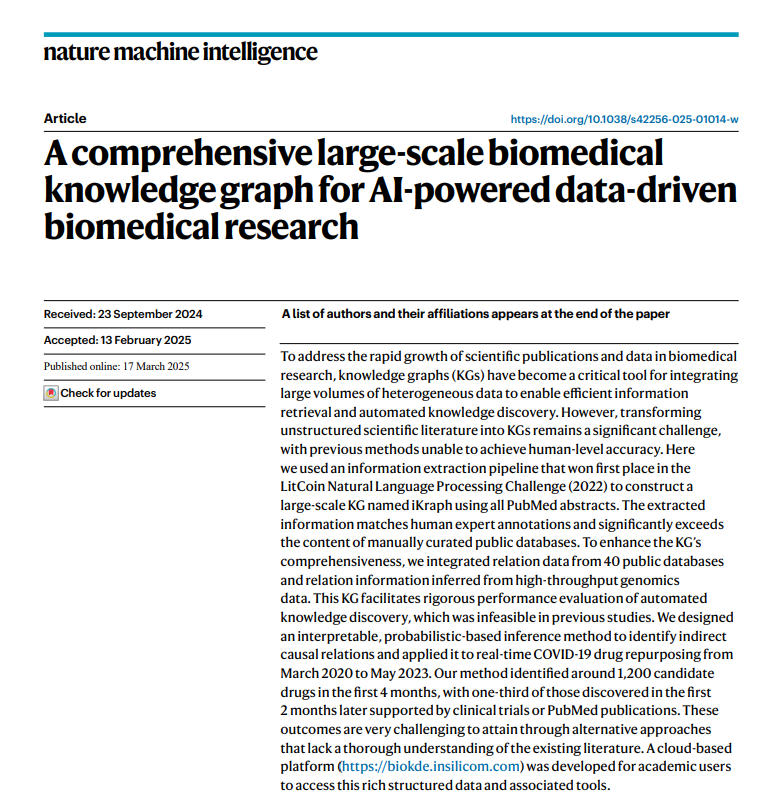
A comprehensive large-scale biomedical knowledge graph for AI-powered data-driven biomedical research
https://t.co/PmwLyvT3mx
#iKraph#AI_for_science
Summary: In this study, authors built a large biomedical knowledge graph called iKraph using all PubMed abstracts. It extracts information with human-level accuracy and integrates data from 40 public databases.
The system can discover indirect causal relationships and predict new drug candidates. Overall, the study demonstrates that large-scale, literature-integrated knowledge graphs combined with interpretable inference methods can enable powerful, real-time biomedical discovery. The authors also released a cloud-based platform for academic users to access the structured data and analytical tools.