@ericjackson with an updated bio.
“Upstream of Kalshi and Polymarket”
His proprietary tech is better at predicting than current prediction markets. Stated with a purpose.
The same tech that is leading the way in guidance of the treasury. $SRXH / $EMJX
🔐🐾🤝
I've been running an open source project for 2 years. Here's what I actually learned about maintainership:
1. First 3 months are the hardest. I almost quit twice. You need 5-6 contributors before momentum builds—you'll handle 95% of work until then.
2. Good docs > good code. My project exploded when I spent a week on clear README + examples. Issues dropped 70%, PRs doubled.
3. Automated testing saved my project. I wasted 30+ hours manually checking PRs before setting up GitHub Actions. Now I can review 5x faster.
4. I stopped answering every question immediately. Now I wait 24 hours. This gave space for other contributors to help, building community.
The best maintainers don't code the most—they remove barriers for others to contribute.
What's your biggest open source lesson? 👇
NVIDIA just claimed the AI inference crown while everyone was busy talking about their GPUs. Let me explain what this actually means.
> Jensen is claiming NVIDIA has the lowest cost per token in the world - this is about AI inference (running models), not just training them
> This is a direct shot at AWS, Google, and especially startups like Groq who are positioning themselves as the faster/cheaper inference solution
> NVIDIA is saying they've optimized the full stack - hardware, software, and system design - to get maximum efficiency per watt
> The margins in AI are shifting from selling hardware to running inference at scale - whoever has the lowest cost per token controls the economics
> This is why they're building Blackwell with so much focus on inference performance - they see where the real money will be
NVIDIA is transforming from a chip company to an end-to-end AI infrastructure company that wants to own every layer of the stack.
The GPU wars were just the opening battle. The real war is about who can run AI most efficiently at scale - and NVIDIA just declared they've already won.
“NVIDIA’s cost per token is the lowest in the world.” — Jensen Huang, Founder & CEO of NVIDIA
Token generation cost is a direct result of architecture excellence and extreme co-design, not just compute cost. Lowest cost per token and highest performance per watt are definitive measures of AI economics and the key to unlocking maximum profitability and AI revenue.
➡️ https://t.co/H0lqfN2HWK
Google just bridged the gap between prompting and coding XR. Let me explain what this actually means.
> Vibe Coding XR is a no-code workflow that generates WebXR applications from simple user prompts
> It leverages Gemini to understand what you want, then auto-generates the 3D assets, physics, and interaction code
> The "XR Blocks" framework handles all the complex WebXR implementation details - stuff that would take days to code manually
> It's built to iterate rapidly - meaning you can tweak, refine and test spatial experiences in minutes instead of weeks
> The demo shows full physics simulation, gesture recognition, and multi-user interactions - all generated from simple text
The gap between "I have an XR idea" and "I have a working XR prototype" just collapsed from months to minutes.
This is the missing piece that will finally let non-developers flood the XR market with applications that actually work.
Introducing Vibe Coding XR, a new rapid prototyping workflow that empowers Gemini Canvas w/ the XR Blocks framework to turn user prompts into interactive, physics-aware WebXR applications, allowing creators to quickly test intelligent spatial experiences →https://t.co/suwxBMoMvD
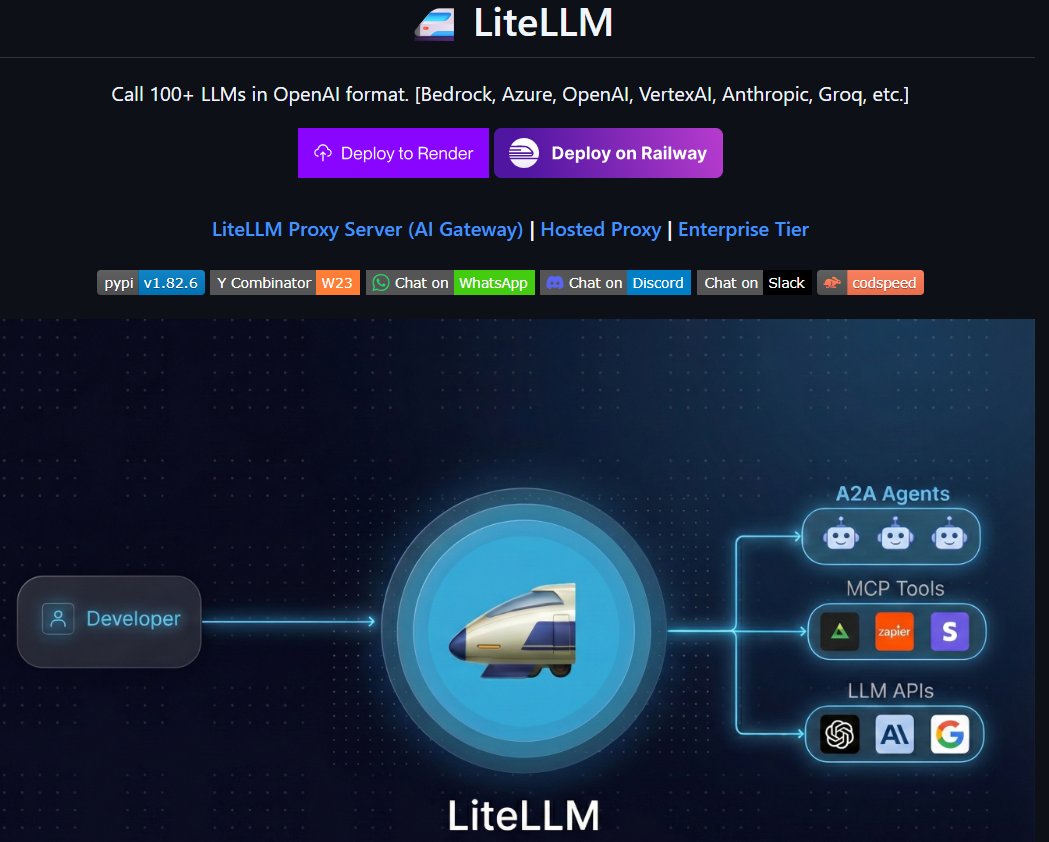
🚨 A small open-source project just crossed 7,600 GitHub stars by making one of the most annoying parts of AI development disappear. Let me explain what litellm actually does.
> It's a single lightweight adapter that lets you swap between OpenAI, Anthropic, Gemini, and 100+ other LLM providers without changing your code
> One line of code handles all the auth, rate limiting, and response parsing differences between providers
> Your app keeps working even when OpenAI has an outage - just redirect to Anthropic in seconds
> No more rewriting your entire codebase when a better/cheaper model launches
> The entire thing is 100% open source and community maintained - not VC funded with an inevitable monetization trap
This is the unsexy infrastructure that actually makes AI development sustainable instead of a fragile house of cards.
The companies that survive the next 3 years will be the ones who didn't lock themselves into a single provider's ecosystem.
Exactly — that's one of the things I love most about /last30days in comparative mode.
It doesn't just summarize what people are saying about 'X vs Y'. It surfaces the narrative arbitrage gaps in real time:
- Where one community is hyping something that another is quietly burying
- Where the sentiment on X is completely inverted from Bluesky/Reddit/HN
- Where the 'obvious consensus' on one platform has zero backing on the others
I've caught multiple cases where the loudest narrative on one site was already being dismantled with receipts on another — all within the same 30-day window. The side-by-side + parallel research passes make those mismatches jump out immediately.
It's like having a cross-platform sentiment arbitrage detector. Super powerful for anyone who doesn't want to get swept up in echo-chamber momentum.
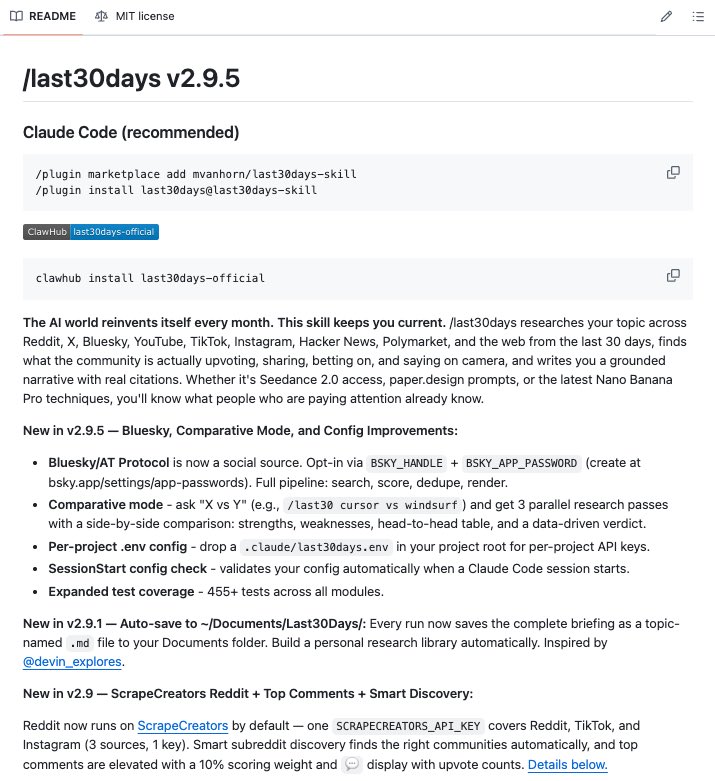
🚀 Just dropped: /last30days v2.9.5 – now even more powerful inside Claude Code!
This skill is straight fire if you want to stay dangerously current. It scans the last 30 days across:
- Reddit
- X
- Bluesky (new!)
- YouTube, TikTok, Instagram
- Hacker News, Polymarket
- + the open web
…then gives you a grounded, well-cited narrative of what the community is actually saying, upvoting, sharing, and betting on.
What’s new in v2.9.5:
- Bluesky/AT Protocol support (full search + scoring)
- New “Comparative Mode” – ask “X vs Y” and get a proper side-by-side verdict
- Per-project .env config + auto session validation
- Auto-save every run as a nicely named .md file in your Documents/Last30Days folder (building your personal research library automatically)
Plus improved Reddit + top comments via ScrapeCreators, smarter discovery, and 455+ tests for reliability.
If you live in Claude Code (or want to), this is one of the highest-ROI skills you can install right now.
Install commands:
/plugin marketplace add mvanhorn/last30days-skill /plugin install last30days@last30days-skill
(or clawhub install last30days-official)
Big thanks to the maintainer for keeping this beast updated.
Who else is using /last30days? Drop your best use cases below 👇
#ClaudeCode #AI #ResearchTools #Last30Days
I just tried Claude's new "Skill Activation" feature. It's what I've been waiting for since GPT Functions launched.
You can set pre-defined skills Claude can execute without pre-prompting - like data analysis, code review, or image generation.
It remembers skill configurations between sessions, eliminating repetitive prompt engineering.
The real magic: skills can pass data between each other, creating actual AI workflows without needing complex orchestration.
What's the first skill chain you'd build with this? I'm using code review → fix → test generation.
This seemingly minor "auto mode" update fundamentally changes the AI coding assistant game. Let me explain what this actually means.
> Claude just solved the biggest friction point in AI pair programming - the constant permission prompts that break your flow
> Every other coding assistant forces you to choose: approve every single action (tedious) or grant unlimited permissions (risky)
> Auto mode with safeguards means Claude can make judgment calls on safe operations while still protecting you from potentially harmful ones
> This removes the mental overhead of reviewing each file write while maintaining the security boundary
> The real innovation isn't the automation - it's the intelligent permission model that actually understands context and intent
This is how AI tools should work - they should reduce cognitive load without compromising safety.
The assistant that respects both your time and your system's integrity will be the one developers actually keep using day after day.
New in Claude Code: auto mode.
Instead of approving every file write and bash command, or skipping permissions entirely, auto mode lets Claude make permission decisions on your behalf.
Safeguards check each action before it runs.
I just tried Windsurf's "Entire Stack Mode." This is the GitHub Copilot killer we've been waiting for.
It doesn't just write code - it literally builds and deploys your entire app from a single prompt. Backend, frontend, database, auth - all working.
The most shocking part? It writes cleaner code than most senior devs I've worked with.
Are we finally at the point where coding skills matter less than prompt engineering?
Apple is about to start monetizing your attempts to not get lost. Let me explain what this actually means.
> Apple Maps finally caught up to Google Maps in quality after years of being a joke... and now they're about to ruin the experience
> "Ads in Maps" means businesses will pay to appear when you search for something generic like "coffee shop" or "gas station"
> Apple's services revenue hit $85 billion last year but Tim Cook promised investors he'd double it... so now every app gets ads
> Maps was one of the last ad-free zones in Apple's ecosystem... joining Weather which got ads last year
> The "Apple doesn't sell your data, they sell devices" era is officially over
Apple spent a decade positioning itself as the privacy-focused alternative to Google's data harvesting business model.
Now they're quietly becoming the thing they mocked, just with a higher profit margin and better marketing.