🚨 $DELL Bearish Options Flow 📉🐻
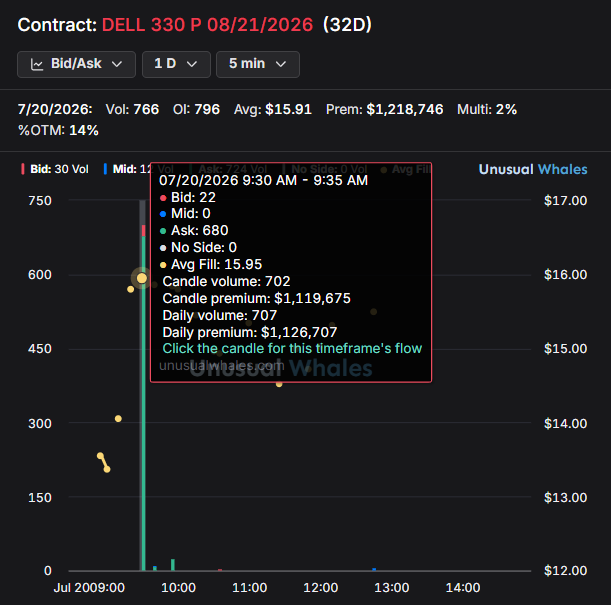
A whale just stepped into the $330 Puts (Aug. 21 Expiry) with a $1.12M+ premium trade.
🔻 Flow Highlights:
• 💰 $1.22M total premium
• 📄 766 contracts traded
• 🎯 Avg fill: $15.95
• 📅 Expiry: 08/21/2026
• 📉 Strike: $330 Put (~14% OTM)
This looks like a sizeable downside bet or hedge, with the majority of the order hitting near the ask—showing aggressive put buying.
👀 Keep an eye on $DELL if sellers start gaining momentum.
BREAKING: U.S. Immigration and Customs Enforcement has suspended vehicle stops related to immigration enforcement, after agents fatally shot two men in separate incidents six days apart following stops in Texas and Maine, per Reuters
Micron is going to $4,000 and here is why (Save this).
For 25 years, DRAM prices did one thing, they went down.
Memory makers overbuilt, supply overwhelmed demand, buyers had all the negotiating leverage and that commodity trap crushed memory stocks every single cycle.
What you are watching right now is a complete structural break from that 25 year trend.
DRAM contract prices are up 700% year over year and the reason is AI and it is not going away.
HBM3 was 12 layers, HBM4 in production and shipping now to Nvidia's latest GPUs is 16 layers.
Each generation consumes significantly more wafer to produce than the last, meaning supply structurally tightens as the technology advances.
Memory was 8% of hyperscaler capex in 2023 but is 35% in 2026 and is projected to hit 48% in 2027.
Nearly half of everything Microsoft, Amazon, Google, and Meta spend on infrastructure will go to memory by next year.
Going from the GB300 to the Vera Rubin 200 generation, GPU cost went up 57% while memory cost went up 435%.
There are three companies on earth that can make DRAM at scale, Samsung, SK Hynix, and Micron.
Both Samsung and SK Hynix are converting capacity to HBM which means conventional DRAM supply tightens further for everything else, and Micron captures pricing on both sides.
Micron guided to $33.5 billion for Q3 and they reported $41.46 billion, a $7.96 billion beat, the largest earnings beat in the company's history.
Gross margins came in at 85% above the 81% they guided.
For Q4, they are now guiding to $50 billion in revenue with ~86% gross margins and $31 EPS.
At $112 EPS in FY2027, the pre-earnings consensus and a 35x multiple, that is a $3,920 stock but with Q4 guiding to $31 EPS alone in a single quarter, FY2027 estimates will be revised meaningfully higher.
Deutsche Bank says the supply-demand gap worsens through all of 2027 and into 2028.
The market still thinks this is a cyclical bounce but this is far from it.
This is the first chapters of a multi year repricing of the most critical component in the AI economy and Micron is at the center of it.
Follow me @MelvinInvests for more AI, semis, and the next big market themes.
As you know, $MU usually experiences sell the news after ER. But this time was different 💯 Here is my detailed pre ER analysis and my post ER +8% upside forecast 🎯 Enjoy reading 👇
Comprehensive Micron Technology (MU) Fiscal Q3 2026 Earnings Report Analysis
📷
MarketMaestro
4 hours ago
Edit
The entire global market is focused on MU’s fiscal third quarter earnings report, which will be released after the market close. Micron has transformed from a highly cyclical commodity producer into an indispensable architect of cloud computing hyperscaler infrastructure, thanks to the enormous pricing power it has gained in high bandwidth memory (HBM) and dynamic random access memory (DRAM) segments. This structural transformation has pushed analyst expectations to historic levels; EPS estimates have been revised upward 19 times in the last 90 days. Consensus estimates point to normalized EPS of $20.28, GAAP EPS of $20.87, and total revenue of $35.25B.
However, this historic earnings report will be released in an unprecedented environment of technical and macroeconomic volatility. Just 24 hours before the report, a heavy macroeconomic shock centered in South Korea shook the global memory sector. The 10% collapse in the KOSPI index and the liquidation of leveraged positions in the sector caused a -13% intraday pullback in Micron shares, bringing the price down to around $1,055. But on the morning of June 24, the stock is showing signs of recovery in pre market trading. This fundamentally changed the risk reward balance before the earnings report. At the same time, options market data shows that implied volatility has jumped to 155%, the Volatility Regime is elevated at 1.51, and the expected move is being priced at 12.94%, approximately ±$134.93.
Let me examine in depth the fundamental, structural, and technical forces surrounding Microns fiscal Q3 2026 expectations.
Fundamental Financial Expectations and Consensus Analysis
The expectations set for Microns fiscal Q3 2026 represent one of the most dramatic yearly operational accelerations ever seen among large scale technology companies.
Hyper Growth in Revenue and EPS
The consensus revenue estimate for the third quarter is $35.25B. This represents approximately 301% year over year growth compared with the roughly $11.32B revenue reported in the same quarter of 2025. Even more striking, the expected normalized EPS of $20.28 and GAAP EPS of $20.87 point to an almost tenfold, approximately 1,000%, increase compared with the $1.91 EPS generated in the same quarter last year.
The sequential jump from the second quarter to the third quarter is just as deep. In Q2 2026, Micron generated $23.86B in revenue with EPS of $12.20. Revenue jumping sequentially to $35.25B shows that pricing power in the memory market has completely broken away from historical cyclicality and is now dictating terms to the broader technology sector.
Beat and Raise Paradox
Despite these extremely strong fundamentals, Micron shares face a clear historical paradox. As you know, beating earnings and revenue estimates does not always translate into positive stock price action. Micron has successfully beaten both earnings and revenue estimates in each of its last eight reports covering the full AI infrastructure buildout process. However, clearing the bar has rarely been enough to push the stock higher the next day.
In six of Microns last eight reports, the stock closed lower in the immediate session after earnings, and the average one day post earnings return has been -1.75%. One week after earnings, the average return points to a 2.7% loss. This historical pattern reveals the reality that an algorithmic sell the news bias tends to activate.
Structural AI Memory Supercycle: HBM, DRAM, and NAND Dynamics
The main engine pushing Microns valuation above the $1.2T market cap threshold is the structural shortage in global memory supply, especially the shortage of High Bandwidth Memory (HBM). The AI data center boom has transformed memory from a commoditized byproduct into the main bottleneck of AI scaling.
High Bandwidth Memory Architecture
High Bandwidth Memory (HBM) improves performance by vertically stacking traditional Dynamic Random Access Memory (DRAM) layers, while significantly reducing power consumption and exponentially increasing data transfer speeds to the graphics processing unit (GPU). As generative AI models reach trillions of parameters, the memory wall, meaning the speed at which data can be fed into logic processors, is becoming the primary limiting factor for AI inference and training.
Nvidias next generation accelerator architectures clearly show this rising requirement. The Blackwell B200 GPU uses 192GB of HBM3E memory, a 140% increase compared with the previous generation H100 GPUs 80GB capacity. Future B300 and Vera Rubin platforms demand even higher memory density and bandwidth by using specialized HBM4. Micron confirmed that HBM4 shipments designed for the Vera Rubin platform began in March 2026, are ramping at twice the speed of HBM3E, and production yield is running above expectations.
Supply Constraints and Wafer Economics
The basic math of HBM production strongly supports margin expansion for producers like Micron. HBM requires more than three times the wafer capacity per bit compared with traditional DRAM. As Micron, SK Hynix, and Samsung allocate large portions of their production capacity to HBM in order to meet massive demand from cloud computing companies, the supply of traditional DRAM and NAND flash is being artificially restricted.
As a result, both Micron and SK Hynix have reported that all of their HBM production capacity for calendar year 2026 is fully sold out and that allocations were finalized in Q4 2025. This structural shortage triggered a massive upward repricing of traditional memory. Wall Street analysts estimate that due to constrained supply, DRAM average selling prices (ASP) could rise by as much as 200% throughout 2026, while NAND ASPs could increase by 186%. This would push Microns gross margins from a historical level of around 58% toward the 81%-82.9% range by fiscal 2027.
The Hundred Year Flood in Memory Pricing
On June 17, 2026, Apple CEO Tim Cook confirmed in an exclusive interview with The Wall Street Journal that Apple would have to raise retail prices on upcoming hardware, including the iPhone 18 series and Macs, explicitly citing rising costs of memory and storage chips. Cook described the current memory shortage as a hundred year flood and said that in more than 40 years of supply chain management, he had never seen a commodity price shock of this magnitude.
This is a historic turning point. Apple has historically used memory and storage upgrades as high margin profit centers, creating a deep financial cushion against raw material volatility. However, the cost of standalone internal flash storage and LPDDR5X DRAM has risen so much that, because memory producers are redirecting production toward high profit AI chips instead of consumer electronics, Apple can no longer absorb these costs internally.
If Apple were to sell a hypothetical iPhone 18 Pro at the same $1,100 retail price as the iPhone 17 Pro, this $150 increase in memory cost would reduce the gross margin on the flagship device from 38.7% to around 25%, with profit per phone falling from $425 to $275. To preserve the standard 38.7% gross margin, Apple would need to raise the device price to $1,345, meaning a net $245 increase, or roughly 22.3%.
For Micron, the strategic implication of this is enormous. Tim Cooks public admission is indisputable macroeconomic proof that pricing power has permanently shifted away from the worlds largest consumer hardware company and toward memory producers. This dynamic effectively guarantees that forward revenue guidance for Microns traditional DRAM and NAND segments will remain at very high levels for the foreseeable future.
Strategic Transformation: Anthropic Architecture Partnership
Further strengthening the transformation from a commoditized hardware seller into a core architect of the AI economy, Micron announced a comprehensive, multilayer strategic agreement with AI developer Anthropic on June 22, 2026. This partnership represents vertical integration of the AI value chain and consists of four distinct core pillars that significantly improve Microns long term thesis.
The Four Core Pillars of the Anthropic Agreement
Memory and storage AI architecture co design
Multiyear supply agreement
Strategic investment, Series H
Enterprise AI adoption
Optimization of the Token Economy
The real value of the Anthropic partnership lies in its focus on the token economy. Every token produced by an AI model carries a measurable cost in terms of power consumption and silicon usage. By co designing memory architecture specifically for Claudes workloads, the partnership aims to significantly reduce the energy required per generated token. As data center power grids reach their physical limits, power efficiency becomes just as critical as raw processing speed for a hyperscaler. By optimizing total cost of ownership (TCO) through superior memory power efficiency, Micron ensures that its HBM products can demand a lasting premium compared with standard alternatives.
June 23 Macroeconomic Shock: KOSPI Contagion and Pre Earnings Washout
To correctly estimate how the market may react to Microns June 24 earnings report, the June 23, 2026 market action and options data must be analyzed in an integrated way. The sudden and severe macroeconomic shock that rippled through the global semiconductor sector fundamentally changed the technical structure of Micron shares before the report.
The severity of this collapse came more from mechanical liquidations, margin calls, rather than a deterioration in fundamentals. The collapse was mainly driven by three mechanical and speculative factors:
Leveraged retail debt and regulatory intervention
AI valuation concern
SK Hynix production rumors
Leverage flush
Paradoxically, this pre earnings collapse significantly reduced the risk of Microns upcoming report. Before June 23, Micron was trading in peak euphoria, priced for absolute perfection. With 13% of market value wiped out and highly leveraged retail participants pushed out of the system, the hurdle for a post earnings upside move has fundamentally dropped.
So what can we experience after ER?
In light of all the data, I think Micron will report extraordinary numbers; it will beat its own guidance by a massive margin and beat Wall Street consensus by a small margin. Management will provide strong and stable Q4 guidance and once again confirm that HBM capacity is sold out.
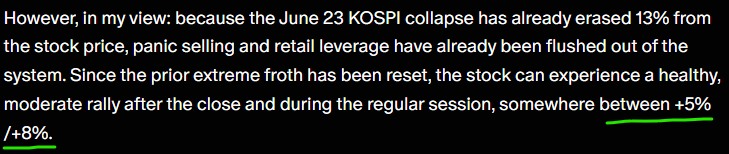
However, in my view: because the June 23 KOSPI collapse has already erased 13% from the stock price, panic selling and retail leverage have already been flushed out of the system. Since the prior extreme froth has been reset, the stock can experience a healthy, moderate rally after the close and during the regular session, somewhere between +5% /+8%.
https://t.co/k01vMZXtTV
$MU PRE-EARNINGS FLOW 🧠🔥
$MU reports Q3 2026 earnings after the close today.
**PRE-EARNINGS FLOW:**
Bearish lean into the report with heavy premium on both sides, but puts are leading as $MU sells off over 5% on the day.
**SHORT-DATED FLOW:**
Traders are active in near-term contracts, especially the 7/17 $1,000P and upside calls like the 7/2 $1,100C and 7/17 $1,500C.
**NET PREMIUM:**
Total premium: $3.14B
Net premium: -$104.5M
Net put premium: $34.5M
Net call premium: -$70.2M
**EXPECTED MOVE:**
Options market is pricing around a $100 move post-earnings, roughly 10% from current levels.
**EXPECTED REVENUE / EPS:**
Q3 2026 estimates:
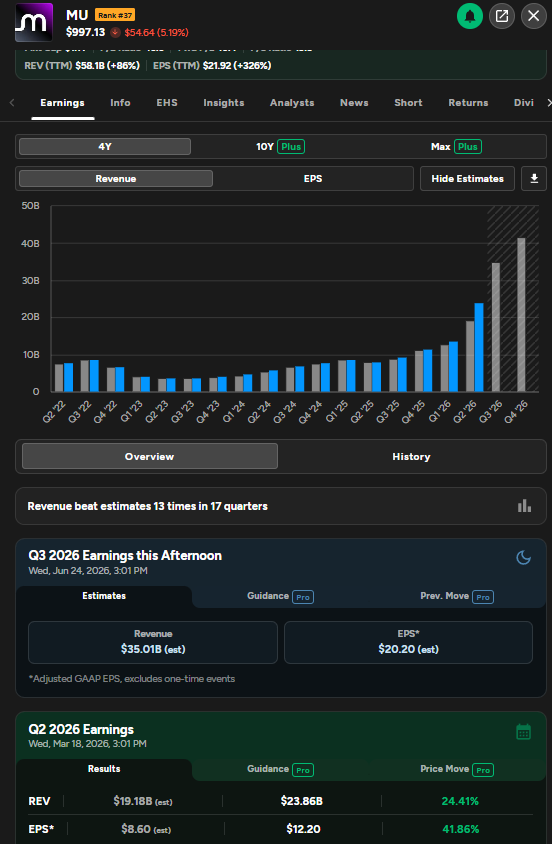
Revenue: $35.01B
EPS: $20.20
Previous quarter:
Revenue: $23.86B
EPS: $12.20
Revenue is expected to jump big from last quarter, with EPS also expected to show strong growth.
**NOTABLE FLOW:**
$4.9M into 9/18 $900C
$4.3M into 8/21 $800C
$2.9M into 7/17 $1,000P
$2.5M into 8/21 $950P
$2.3M into 8/21 $1,150C
$2.1M into 7/17 $1,000P
Overall: $MU has a massive move priced in, with bearish net premium into earnings, but large upside call buyers are still showing up. Big report ahead. $MU
There's a rule book that will improve your trading journey. Guaranteed.
This playbook helped me navigate 2015, 2018, 2020, 2022, 2025, and 2026 and other corrections.
1. When the market loses the 21EMA, your odds of winning shrink significantly.
The best looking setups will pop and drop with the indices.
2. Your position sizing has to respect the broader market.
Above 21EMA + trending up = size normal.
Below 21EMA + trending down = reduce size.
3. Reduce your trade frequency in weak markets.
If you normally take 10 trades a week, take 50% or less when indices are downtrending.
4. Tight stops in uptrends. Wider stops in downtrends.
In strong markets, dips get bought fast - tight stops work.
In weak markets, dips go deeper before reversing - tight stops trigger right before the bounce.
Different market environments require different rules.
$SNDK From $200 to $1400. +600 since this BLUE candle signal.
Stop asking what's next. I've given you thousands callouts and conviction posts on $MU $DRAM $INTC. This is it.
Choose your notifications wisely.
$DGXX
With the news, it pushed all the way up to the red resistance line of the triangle. hope the jump it made with the news remains as a breakaway gap