The 4th Estate invites quality articles on contemporary issues like, but not limited to, politics, education, economy, religion, culture, life style, health etc. Click following link to submit:
https://t.co/EBOzz8J0Bt
A $25.6 million wire fraud. Not a single line of code hacked. Every "colleague" on the video call was an AI-generated ghost. In my latest piece for *The Hindu BusinessLine*, I examine what happens when the foundational assumption of our legal and financial systems — that seeing is believing — no longer holds. We are entering the age of Synthetic Truth. Generative Adversarial Networks have made deepfakes statistically indistinguishable from reality. The forensic fightback — Error Level Analysis, sensor noise verification, Multi-Signal Forensics — is real, but it is a response to a threat that our legal architecture has not yet caught up with. The Bharatiya Sakshya Adhiniyam, 2023 was a significant step — elevating electronic records to primary evidence, mandating cryptographic hashing. But it validates how evidence was captured and stored. It says nothing about whether that evidence was AI-generated in the first place. Neither the BNS nor the BSA assigns criminal liability for creating deepfakes to deceive a court — a gap the Supreme Court itself flagged in Pune Bar Association v. Union of India (May 2026) but declined to resolve. Deepfakes are not a technology problem. They are an existential threat to the rule of law. If our legal systems cannot establish truth, they drown in a sea of doubt. We need a dedicated statutory instrument — a Digital Forensic Evidence Act or a targeted BSA amendment — with a notified National Digital Forensic Authority empowered to validate AI-generated evidence before it reaches a courtroom. The architecture of truth must be every bit as sophisticated as the machinery of illusion. Read the full piece:
https://t.co/EEIpTZYxor
#DeepfakeDetection #AIGovernance #DigitalForensics #RuleOfLaw #Cybersecurity #BharatiyaSakshyaAdhiniyam #ArtificialIntelligence #LegalTech #DataPrivacy #CorporateGovernance
@GoI_MeitY@DSCI_Connect@NFSU_Official@ugc_india@nasscom@ASSOCHAM4India@PIB_India
The maturity of blockchain infrastructure has reached a critical turning point. For financial institutions, the conversation is shifting from "if" we should engage with Decentralized Finance (DeFi) to "how" we can strategically integrate its efficiencies into a regulated framework. As we look toward the next three years, here is a pragmatic roadmap for navigating this transition from the "Wild West" of early crypto to a sophisticated, hybrid financial ecosystem.
https://t.co/pp7COWESOf
There is a number that should unsettle every policymaker in Brussels, New Delhi, and Beijing right now. It is 70.6. That is how many gigawatts of AI-capable data centre capacity the United States controls , nearly half of all known computing infrastructure on the planet. The entire rest of the world, combined, accounts for the other half. And the gap is not closing. It is accelerating. Read my article⬇️🇮🇳
https://t.co/AGgD6dR3Mj
A recent security breach involving elite naval surveillance drones has exposed a critical vulnerability in global defense procurement. A routine assessment revealed that advanced K3 Scout drones, utilized by elite commando units, were secretly transmitting "heartbeat" signals to an IP address in Beijing for months. Although the British contractor had provided assurances that the third-party cameras were secure and "NDAA-compliant," a failure in component-level origin checks allowed high-risk hardware to be embedded in the platform. This incident serves as a definitive warning: in a globalized market, "paper compliance" is no longer a substitute for technical sovereignty. My take on this issue,
Securing India’s Digital Supply Chain: The Board Room Storm https://t.co/f1q7Ekth2m
The Reserve Bank of India (RBI) recently released its draft guidance on data governance which is a welcome and necessary step toward structuring how financial institutions manage customer data, risk, and artificial intelligence. However, in an interconnected global market, domestic adequacy is only half the battle. If Indian financial institutions and fintech innovations are to seamlessly operate on the global stage, our regulatory standards must act as bridges rather than barriers to foreign markets. Here is my take on the issue @RBI@FinMinIndia@DSCI_Connect
https://t.co/RF4C9nvvGt
The landscape of global security is shifting as cyber crime evolves into a pervasive and costly international crisis. Total losses for 2023 were estimated at a staggering 8 trillion dollars. While early digital threats were primarily characterized by phishing emails and deceptive websites, the emergence of newer technologies has shifted the frontline to mobile applications. The ecosystem has transitioned from interpersonal attacks designed to compromise device privacy to sophisticated operations that target victims directly for profit.
https://t.co/dPJnnPofoP
The Invisible Pickpocket
For decades, the "common man" viewed the bank vault as the ultimate symbol of security, a heavy, steel-clad promise that their life savings were untouchable. But as we move deeper into 2026, that vault has been replaced by a "distributed mesh" of cloud servers, APIs, and AI models. The latest Digital Threat Report 2025-26 reveals a chilling reality, the walls are not just thinning; they are dissolving into a complex web that neither you nor your bank fully controls. For the average citizen, digital banking was sold as a convenience. But in reality…..? I have explored this issue in this article.
https://t.co/h91fSbb052
Artificial Intelligence is the latest Industrial Revolution. Effective risk management of AI deployment requires organizational commitment at senior levels and a willingness to cease deployment if an AI system presents unacceptable risk. Global standards would have to be weaved and coloured with DPDA for implementation in India. By anchoring it in the DPDA and using it to bridge the gaps in private international law, India can ensure that its AI revolution is not just fast, but fundamentally responsible. Check out my latest article: The Jurisdictional Shield: Leveraging Global Standards for India’s Cross-Border AI Ambitions https://t.co/Zrb3ACkDJz via @LinkedIn
मैंने वक़्त से पूछा कि मेरा क़सूर क्या था,
वक़्त ने हंस कर कहा तेरी गलती बस इतनी थी कि तूने हर किसी को अपना समझा और लोगों ने तुझे सिर्फ़ अपने मतलब समझा।
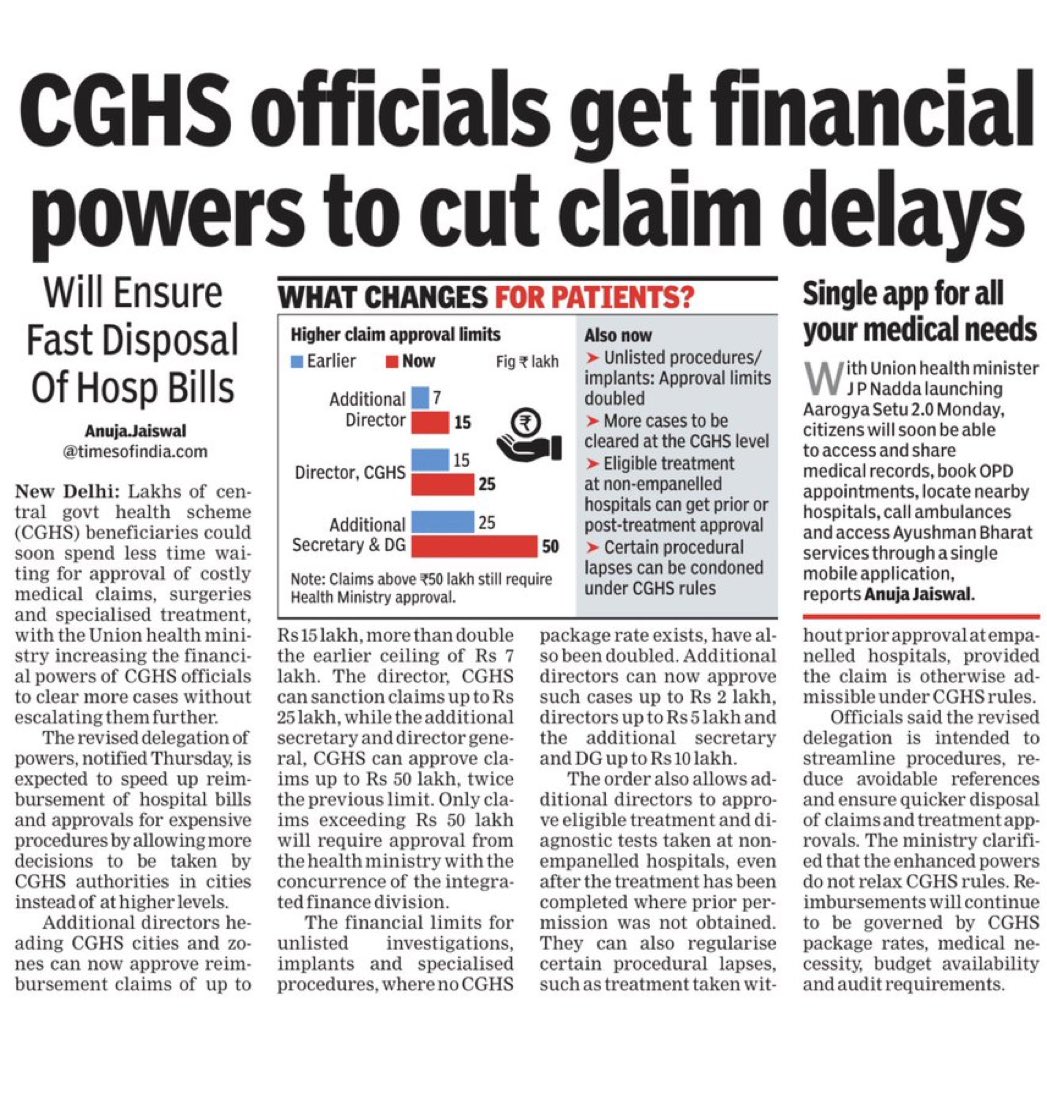
It is not lack of powers which frustrates beneficiaries rather the arrogance & lack of compassion coupled with the attitude of officials as if giving alms to beneficiaries is the main culprit. This can be improved by change in mentality of #CGHS Officials.
For decades, the cryptographic systems protecting India's banking networks, government databases, and citizen records have rested on a simple mathematical assumption: that certain arithmetic problems are too complex for any computer to crack within a useful timeframe. Quantum computing, a technology advancing with alarming speed, is now threatening to dissolve that assumption entirely. A high level Government of India Task Force, constituted by the Department of Science and Technology under India's National Quantum Mission, released a sweeping report in February 2026 laying out the country's strategy for what experts are calling "post-quantum migration", the enormous, multi-year task of replacing today's vulnerable encryption systems with ones that can withstand attacks from future quantum machines. Read my views here,
https://t.co/ND1DHB4Dua
पिताजी के साथ बिताए कुछ पल। कभी-कभी समय मिलने पर पिताजी की दाढ़ी मैं ही बनाता था । जब मैं नहीं होता था तो मेरी बिटिया उनकी दाढ़ी बना देती थी। बच्चे अपने माता-पिता को जो करते देखते हैं वैसे ही ढल जाते हैं। कार्ड वगैरह तो हमने कभी दिया नहीं कुछ यादें ही हैं। कुछ बुद्धिजीवी इसे दिखावा कहते हैं पर जो तथ्य है वह है 😇 #पितृ_दिवस
#FathersDayCelebration