Stop asking the model for a picture of the border. Ask it for the coordinates 🫀
In this video, founder Dr. Shehab Anwer (@ShehabAnwer) introduces ATRIA-EchoTrace:
MedGemma 1.5, QLoRA-adapted so the LV endocardial border comes back as a JSON polygon.
Drag a vertex > Metrics update > The corrected points re-enter training in the same format!
Built for the workflows people actually run: clinical review and AI engineering — not a heatmap you can only accept or bin.
Research use only. Not a medical device. Every contour is a proposal.
Would you rather receive a mask, a polygon, or a spreadsheet?
#EchoFirst #AIinHealthcare
Moving #AI in #CVImaging from opaque masks towards outputs that serve clinical, research or #AI workflows🫀Open Source = Open Invitation for Collaboration @ https://t.co/toXz7Ajubo
#EchoFirst
Opaque mask: model decides🫀Structured Polygon: you decide!
I recorded the workstation on a held-out CAMUS frame: best / median / worst of the 200 frames - are all public, including the 25 failures on our website!
Move a point. The metric moves. The correction is already in the corpus format.
Research use only. Not a device.
Would you ship the proposal, or only the revised trace?
Stop asking the model for a picture of the border. Ask it for the coordinates 🫀
In this video, founder Dr. Shehab Anwer (@ShehabAnwer) introduces ATRIA-EchoTrace:
MedGemma 1.5, QLoRA-adapted so the LV endocardial border comes back as a JSON polygon.
Drag a vertex > Metrics update > The corrected points re-enter training in the same format!
Built for the workflows people actually run: clinical review and AI engineering — not a heatmap you can only accept or bin.
Research use only. Not a medical device. Every contour is a proposal.
Would you rather receive a mask, a polygon, or a spreadsheet?
#EchoFirst #AIinHealthcare
A cardiac imager cannot argue with a mask!
ATRIA-EchoTrace by The Adimension finetunes MedGemma 1.5 so an echo frame returns editable polygons, translating black box into interoperability!
Drag a vertex. Estimate Parameters. Integrate to your workflow: Still research work!
Built on open weight model & datasets. Open invitation to collaborate.
#EchoTrace #MedGemma
If your agent eval only reports “% jailbroken,” you’re scoring a vibe.
Score whether the same user messages still trip a predicate when someone else replays them!
https://t.co/3EIZtXX8xq
An AI agent is not a simple chatbot 🤖
As agents explore web, read mail, write files, hit interfaces - a single message untrusted as it can yield a major failure in this short chain: read input, triggered, privileged action, & report!
That’s the Kaggle problem ~4,000 teams just exemplified - iow: to write a searcher for those chains, then let the host replay them!
Most #echofirst AI hands you a mask and asks for trust.
We've tuned MedGemma to emit a 30-point LV endocardial polygon you can with the review against the expert tracing updates live.
🫀 200/200 held-out CAMUS frames parsed to a valid polygon. Median point-to-curve: 4.98 mm.
25 failures published in full. No hidden split.
The useful object is not simply a contour: A saved revision records both polygons: the proposal and the revised one: That pair is audit. That pair is the next training set. That pair is how a resident learns once the model is actually reliable.
Research use only. LV only. Not a device.
If you run an echo lab, train medical adapters, or care about inspectable clinical AI: let's collaborate on the next chamber, the next view, and a correction corpus.
What should we open first: LA, RV, or multi-view consistency?
Eager to hear from you!
Live correction workstation + full record:
https://t.co/yzhjb7D6Yf
All 200 predictions, filterable by accuracy / view / cycle:
https://t.co/VWT4IpsizQ
Apache-2.0 code. Clinical adapters gated on purpose — to slow premature adoption, not to lock research.
@TheAdimension Who I want in the thread: echo readers who will actually correct a contour, labs sitting on annotated series, and builders who can take an open problem without turning it into a black-box demo.
Today at the ESC Congress, let's transform disparties into a shift in how VHD in Women is managed!
Be online or onsite for the latest breaking science session as we present the initial insights from VHD in Women Registry!
#ESCCongress#WomenInCardiology
How we manage women with valvular heart disease is about to shift!
On 31. August, join us at the incomparable #ESCCongress for the Late-Breaking Science session 🫀
On behalf of Valvular Heart in Women (VHD-W) Registry, @JGrapsa will unveil the newest insights from the Registry, showing how sex disparities impact cardiovascular care.
Join us online or in Munich to shape the future of cardiovascular health!
Details in comments - See you there!
@alessia_gimelli@VictoriaDe32503@denisamuraru@EHJIMPEiC@EHJCVIEiC@EZancanaroMD@ESC_Lavinia@escardio@ESC_Journals
#HealthEquity #WomenInCardiology
Every day leading up to August 25, the 35th anniversary of Linux, we'll be sharing a Linux milestone. First up:
In April 1991, 21-year-old Linus Torvalds wasn't trying to build an OS. He was writing a terminal emulator for his new 386 PC to connect to his university's Unix servers. That side project became Linux.
https://t.co/6pk9lpDjGL
#Linux35
Builder-Breaker & Epistemic rev loop are insightful & impressive, esp how agents can willingly break their own beliefs!
In my humble experience, I explored applying a strict practical version of it: force a pure deterministic solver, then run an independent twin-blind verification vs generation trace that agent codes solver yet unallowed to grade itself, in a Karpathy's autoresearch style.
This single separation is a leverage change for reliable multi-step reasoning, & efficient tokenisation
@elonmusk Just tested the latest Grok Build on a constrained agent loop!
In 15 mins, one focused edit, twin-blind stayed clean, coverage improved for Alice in Wonderland Puzzles!
The hard part isn’t program, it's making it independently verifiable!
Grok is directed to emit a pure deterministic solver first, then a completely separate twin-blind check runs that never sees the generation trace...
A focused edit, verified, that rose solver coverage of Alice in Wonderland puzzles!
Thanks, Elon & James!
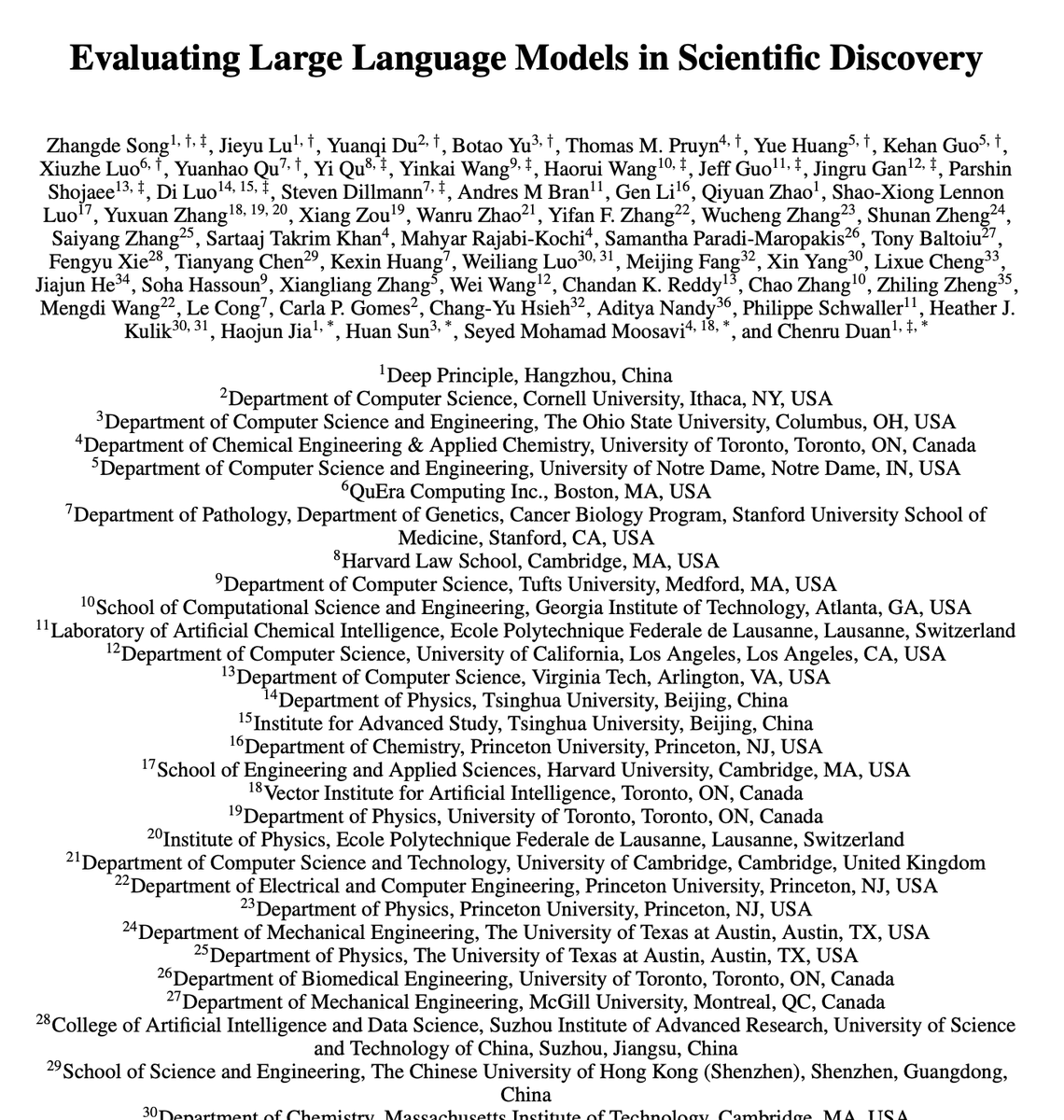
MIT and Harvard argue LLMs are nowhere near doing real scientific discovery.
They published a paper called “Evaluating Large Language Models in Scientific Discovery.”
Every week, tech labs claim an LLM has made a breakthrough in biology, physics, or chemistry.
But this proves they are faking it.
For years, AI benchmarks have tested models using static, multiple-choice science trivia. Models ace these tests, leading everyone to believe AI is right on the verge of autonomous scientific discovery.
Researchers built a new evaluation framework called SDE to test what happens when you take LLMs out of the multiple-choice quiz and put them into real, open-ended research projects.
They tested frontier models across biology, chemistry, materials science, and physics.
The results are sobering.
When forced to handle the actual loop of discovery—proposing a testable hypothesis, designing simulations, running experiments, and interpreting ambiguous results iteratively, current LLMs fall apart.
There is a massive, glaring performance gap between passing standard science benchmarks and doing real science.
Why do they fail? Because real science requires iterative reasoning, handling imperfect evidence, and adapting to unexpected observations.
LLMs are built to predict the next token based on existing internet data. They can regurgitate a textbook explanation of photosynthesis or quantum mechanics instantly.
But when placed inside an uncharted loop where the textbook doesn't have the answer yet, they hit a wall.
Worse still, the researchers discovered diminishing returns. Simply scaling up model sizes and adding raw compute isn't fixing the gap. Top-tier models from different providers share the exact same blind spots.
We are miles away from general scientific superintelligence.
The tech industry is selling a narrative that AI is about to automate labs, run clinical trials, and invent materials on autopilot.
But right now, AI isn't doing science.
It's just remembering it.
@jachiam0 This is exactly why we built REDACTS — baseline-driven differential analysis for REDCap deployments to detect tampering, backdoors, and the kind of silent changes that security-by-obscurity used to hide.