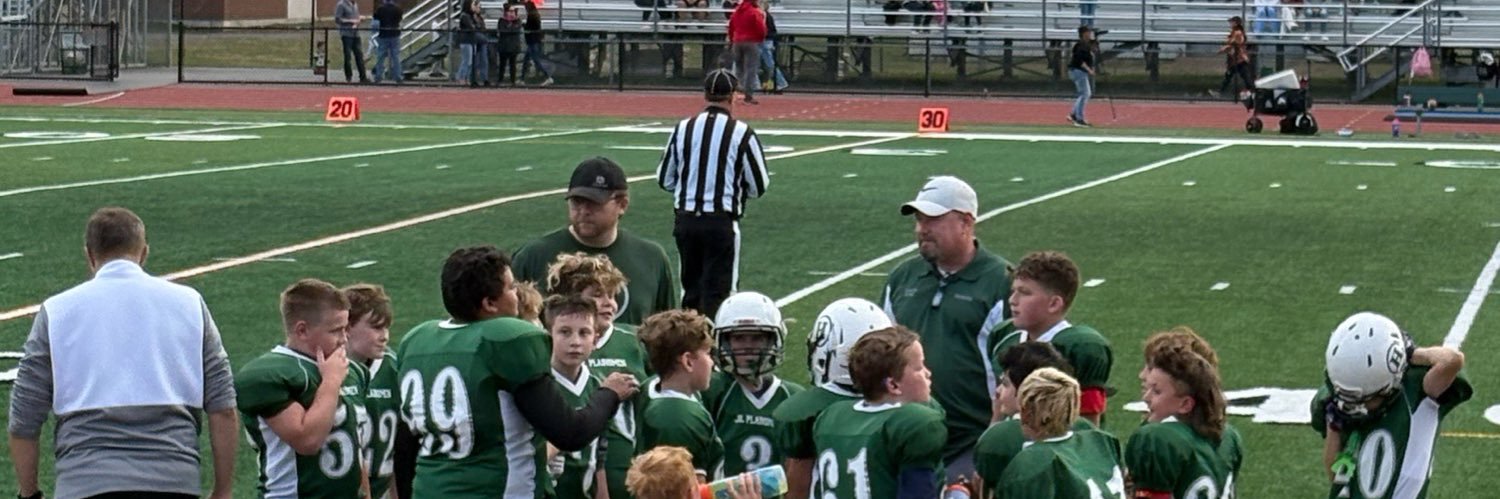
Purveyor of bad jokes, Eagles and Cuse rants and a youth football and basketball coach. The views here are my own, but this standard disclaimer is not.
Jim Boeheim was largely responsible for me loving basketball. I can remember as a kid listening to certain games on the radio, rushing home from school to watch Big East Tournament games, and occasionally getting a chance to go to the Dome.
The Curt Cignetti College Football 27 cover looks like the poster for a 1994 Disney movie in which a recently divorced NFL head coach decides to coach an underachieving high school team of misfits as a way to reconnect with his son who's grown distant after his parents split up.
A PARENT’S JOURNEY THROUGH YOUTH SPORTS:
Age 5: “He’s got a cannon.”
Age 6: “He’s the fastest kid out there. Coach said so.”
Age 7: “Rec ball isn’t challenging him anymore.”
Age 8: “We tried out for select. Obviously made it.”
Age 9: “$2,800 for the season. Plus uniforms. Plus tournaments. Plus hotels.”
Age 10: “Cooperstown is basically a family vacation, right?”
Age 11: “He needs a hitting guy. And a pitching guy. And probably a mental performance coach.”
Age 12: “I’m not a crazy sports parent. The OTHER parents are crazy.”
Age 13: “We changed schools. For academics. (And also baseball.)”
Age 14: “Showcases are a requirement at this age.”
Age 15: “Ya his ranking just ticked up. We’re cooking.”
Age 16: “He just needs to get seen by the right school.”
Age 17: “The D1 schools want him to walk on. He’ll earn a spot by sophomore year.”
Age 18: “Okay, D2 is actually really competitive.”
Age 19: “He’s redshirting. Strategic.”
Age 20: “He’s focusing on school now.”
Age 21: “You know what? He’s so much happier.”
Roughly 7% of high schoolers play in college.
About 1.5% of those get drafted.
Less than half of draftees ever play one day in the big leagues.
The odds of our kids going pro are somewhere between “struck by lightning” and “find a $100 in old shorts.”
I love youth sports (all my kids play a bunch of them) just keep a good perspective my friends. ✌️
That water clarity is an engineering decision, and the math behind it is wilder than the video.
Roman aqueducts ran on gravity alone. No pumps, no pressure systems. Engineers carved channels with a gradient so shallow it borders on absurd. The Pont du Gard in southern France drops 2.5 centimeters over 275 meters. That's roughly the thickness of a coin over the length of three football fields. They surveyed that accuracy with plumb lines and wooden leveling instruments.
The clarity you're seeing is a direct product of flow velocity. Too steep and the water erodes the channel walls, picks up sediment, turns brown. Too flat and it stagnates. Roman engineers targeted a slope of about 20 centimeters per kilometer, which kept the water moving fast enough to stay fresh but slow enough to stay clear. Before the water reached the city, it passed through multi-chamber settling tanks where velocity dropped near zero. Suspended particles sank. Clean water flowed out the top into the next chamber. Repeat three or four times.
Pliny specified the minimum slope in writing. Vitruvius published the exact mortar ratio for hydraulic cement: one part lime to two parts volcanic ash for underwater work. The pozzolana from Pozzuoli reacted with water to form a calcium-aluminum-silicate compound that actually gets stronger the longer it sits submerged. Modern concrete degrades in water. Roman concrete bonds with it.
Scale the whole system and it gets harder to process. Eleven aqueducts fed Rome at its peak. Combined output: roughly 1 million cubic meters of water per day. That works out to about 250 gallons per person for a city of one million. Modern New York delivers about 125 gallons per person per day. Ancient Rome had access to double the per capita water supply of the largest city in the United States, running entirely on slope and stone.
The Trevi Fountain in Rome is still fed by one of them. Two thousand years, same source, same gravity, same water.