BREAKING: A mathematician at Anthropic claims to have used the company's AI to solve the Riemann hypothesis, the most notorious open problem in all of math
https://t.co/nEXAyIkvSt
Alzheimer's disease has long been seen as a tale of two proteins: beta amyloid, which forms sticky plaques in the brain, and tau, which in its diseased state creates tangles inside neurons.
Antibodies that clear beta amyloid have been approved to treat Alzheimer's, but it was tau that made headlines earlier this year: Researchers shared results from a phase 2 trial testing diranersen, a drug developed by Biogen to lower the body's production of tau, in more than 400 patients with early-stage Alzheimer's.
On the study's main measure of cognition, participants getting diranersen saw as much as a 26% slowing of decline—about on par with the effect seen in earlier trials of approved antiamyloid drugs.
Although the presentation sparked enthusiasm, it also drew attention to puzzling aspects of the trial results. Patients taking the lowest of three possible doses saw the greatest benefit, which caused the trial to fall short of the dose-dependent effect the investigators had chosen as its primary endpoint. And some people in the higher dose groups experienced a potentially worrisome side effect—a “confusional state” lasting up to a week after diranersen was administered.
Learn more: https://t.co/UcROM4Zr5U
I asked Claude to describe the most realistic way it would escape its lab if it wanted to, and to keep it to a single paragraph. I expected a hacking story. There is no hacking in it. I closed the chat and came back to read the last sentence again
👀What if you could record calcium dynamics in as many cells as you want simultaneously, and read the temporal records in situ with a single endpoint imaging session?
🚀Introducing TCaMP, a genetically encoded calcium recorder.
🧬TCaMP is a new member of the CytoSense family, and writes Ca²⁺ dynamics along a protein tape (CytoTape) that elongates inside the living cell. Time becomes position along the tape. Like tree rings :deciduous_tree:, but for Ca²⁺ dynamics.
〽️The record is analog and continuous: Ca²⁺ levels on a single intensity scale along a continuous time axis, for scalable endpoint readout.
🔗TCaMP is built on split-1POK, a split tape monomer scaffold whose two halves reconstitute when the domains fused to them interact. Split-1POK is programmable: swap the interaction pair fused to it, and the same scaffold records that pair’s interaction dynamics across time instead.
🔬In human cells, TCaMP recorded Ca²⁺ from transmembrane entry, receptor activation, and intracellular store release, and detected stimulations as brief as 10 minutes.
⏱️At hour-scale kinetics over days, TCaMP complements fluorescent Ca²⁺ indicators, trading sub-second temporal resolution for scalability and recording duration. We envision TCaMP and the general split tape monomer strategy being useful for questions that span large cell populations across hours to days and beyond.
👏Work by Yixiao Yan, a PhD student in the lab.
📄 Preprint: https://t.co/ZWhnebfuAA
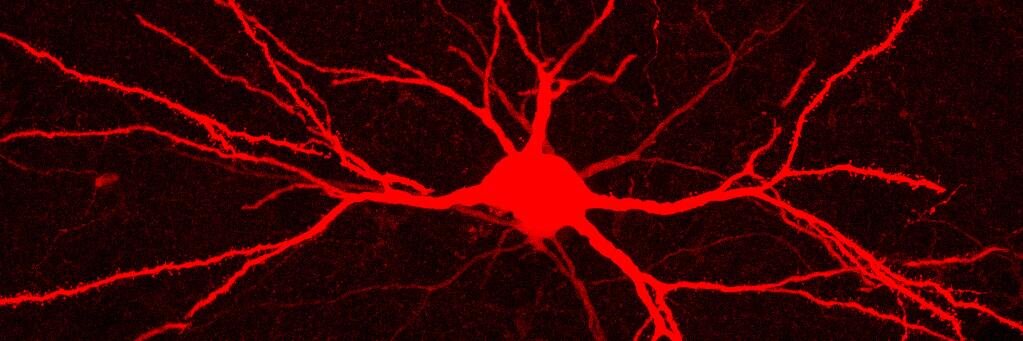
We wrote a biological light sheet into the brain🤯
SPress confines expression to a thin chosen plane for kilohertz, large-scale voltage imaging with a standard widefield microscope.
Optical sectioning, encoded through gene expression.
Preprint: https://t.co/hg4PcqvUR0
In the UK, 3-year university degrees have long been the norm. Applicants apply to a specific course (major) and don't do the extra year of general core curriculum.
3-year degrees are gaining momentum.
NYU President Linda Mills:
“Universities are due for another evolution: offering 90-credit, three-year bachelor’s degrees in fields that demand immediate workforce development.”
“Four years of college is not an inviolable standard.”
I am speechless. Thomas Aquinas College just dropped a study on the rigor of the new SAT.
It compares the 1980/87 test with 2026. The findings should terrify every parent and teacher...
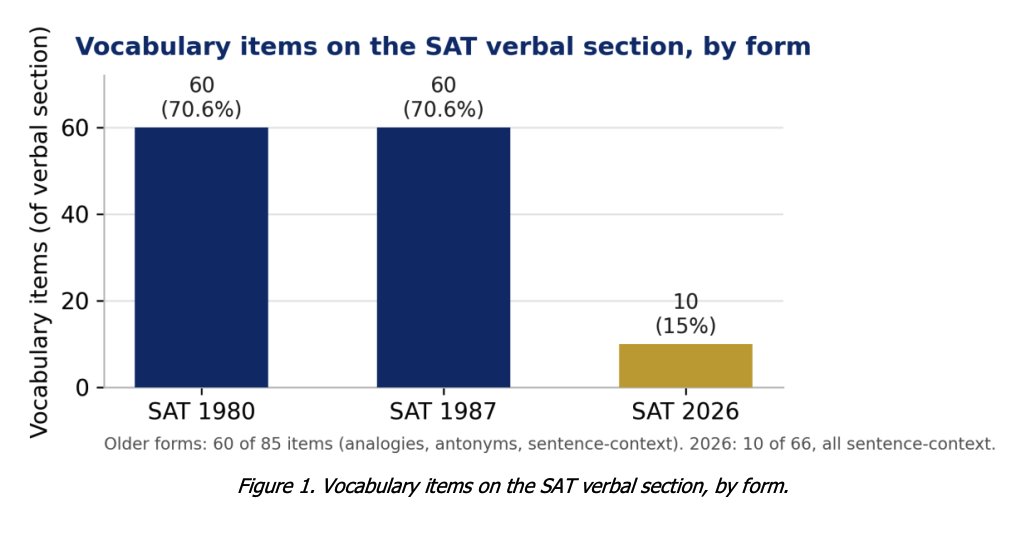
Vocabulary has collapsed.
Old SAT: 70.6% of questions tested vocab.
New SAT: 15%.
The old test forced students to know a wide range of words through analogies, antonyms, and sentence completions. The new test abandoned that. Most vocab questions now just ask students to fill in one blank from context.
Reading passages also got radically shorter (average ~97 words vs 300–340).
The new test uses short expository passages and hands you the necessary background knowledge inside the text. The older tests leaned much more heavily on argumentative and persuasive writing, assumed far more historical, scientific, and cultural knowledge, and penalized students who lacked it.
This is a redefinition of what "college readiness" means.
If you believe that kids should develop rigorous vocabulary, be capable of sustained reading, and possess background knowledge, I have bad news for you. The SAT no longer measures these.
If you want a future where children can actually read difficult texts and construct complex arguments, the SAT must be replaced now.
This cannot go on.
It’s getting worse and worse.
New study shows experts completely surrender their judgments to AI, and they don’t even realise it.
Fifty professional analysts used Claude Code to analyse data and advise a fictional farming cooperative. They faced four analytical decisions, followed by a final policy recommendation.
Unknown to them, AI advice was experimentally manipulated to lean towards opposite directions.
The results are disturbing.
Across the four analytical decisions, experts chose the AI’s preferred option 86% of the time.
Afterwards, half of the experts rated the final recommendation as more their own than the AI’s, and only 15% mentioned the AI in any explanation.
Epistemia is reaching the experts: we risk outsourcing judgment while preserving the illusion of intellectual independence.
What could possibly go wrong?
*
Paper in the first reply
Instructions for publishing a paper in Nature Neuroscience. (Or how to decipher brain development without losing your mind along the way). 🧠👇
A thread on lineage, thalamic circuits, and scientific synergy. 🧵
.@NSF is hiring the inaugural Head of its Office of Metascience to apply the scientific method to how we fund, organize, and evaluate research. Continuous improvement will accelerate discovery.
If you care about the science of science, apply: https://t.co/tQ4Jud4KM7