Now that ZKEVMs are at alpha stage (production-quality performance, remaining work is safety) and PeerDAS is live on mainnet, it's time to talk more about what this combination means for Ethereum.
These are not minor improvements; they are shifting Ethereum into being a fundamentally new and more powerful kind of decentralized network.
To see why, let's look at the two major types of p2p network so far:
BitTorrent (2000): huge total bandwidth, highly decentralized, no consensus
Bitcoin (2009): highly decentralized, consensus, but low bandwidth - because it’s not “distributed” in the sense of work being split up, it’s *replicated*
Now, Ethereum with PeerDAS (2025) and ZK-EVMs (expect small portions of the network using it in 2026), we get: decentralized, consensus and high bandwidth
The trilemma has been solved - not on paper, but with live running code, of which one half (data availability sampling) is *on mainnet today*, and the other half (ZK-EVMs) is *production-quality on performance today* - safety is what remains.
This was a 10-year journey (see the first commit of my original post on DAS here: https://t.co/Fa0jKFgObW , and ZK-EVM attempts started in ~2020), but it's finally here.
Over the next ~4 years, expect to see the full extent of this vision roll out:
* In 2026, large non-ZKEVM-dependent gas limit increases due to BALs and ePBS, and we'll see the first opportunities to run a ZKEVM node
* In 2026-28, gas repricings, changes to state structure, exec payload going into blobs, and other adjustments to make higher gas limits safe
* In 2027-30, large further gas limit increases, as ZKEVM becomes the primary way to validate blocks on the network
A third piece of this is distributed block building.
A long-term ideal holy grail is to get to a future where the full block is *never* constituted in one single place. This will not be necessary for a long time, but IMO it is worth striving for us at least have the capability to do that.
Even before that point, we want the meaningful authority in block building to be as distributed as possible. This can be done either in-protocol (eg. maybe we figure out how to expand FOCIL to make it a primary channel for txs), or out-of-protocol with distributed builder marketplaces. This reduces risk of centralized interference with real-time transaction inclusion, AND it creates a better environment for geographical fairness.
Onward.
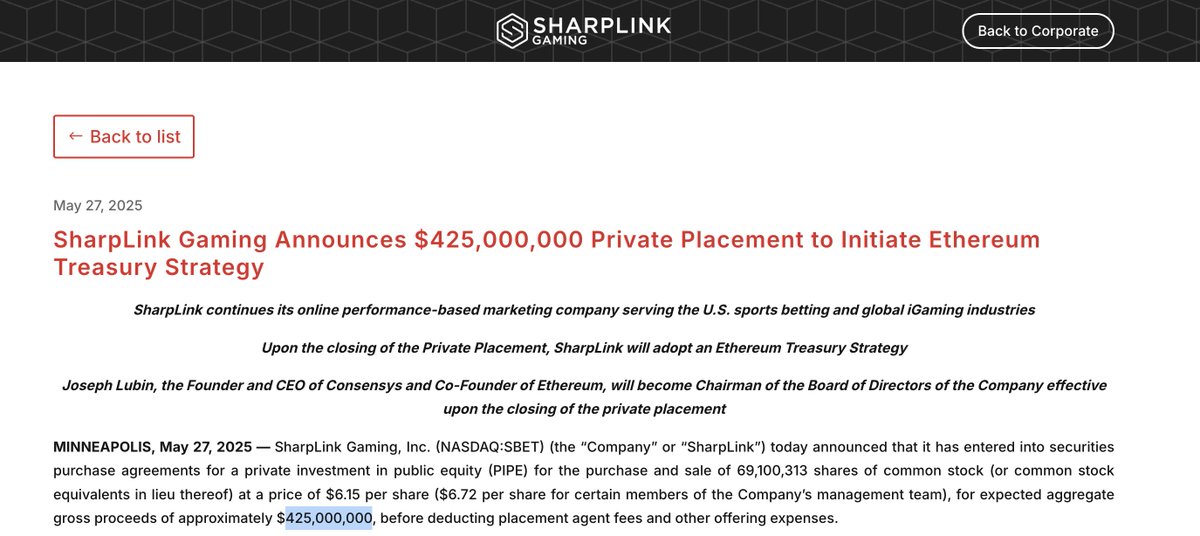
Tom and $BMNR and we at $SBET might engage in a cut-throat one-upmanship, incessantly working to out buy each other stacking up the ETH.
Or we might hold hands and collaboratively explain the paradigm shift to decentralization and how it will affect (and supercharge) the legacy financial system, the web and the global economy.
Or both.
But we will both compete, hard. Game on.
At SBET (SharpLink Gaming), we believe Ethereum is on track to becoming the foundational layer for global finance
Not just a new tech platform, but a settlement layer for real assets, AI agents, and the next generation of market infrastructure
SBET (SharpLink Gaming) is the first publicly listed company to adopt Ethereum as its primary treasury reserve asset
Our strategy is simple:
Accumulate ETH. Stake ETH. Grow ETH-per-share
Our goal is not just to hold ETH, but to activate it, using native staking, restaking, and Ethereum-based yield strategies to increase the value of our treasury and create long-term shareholder value
We believe ETH is the superior asset for corporate reserves:
1/ It’s productive (via staking)
2/ It’s composable (usable across protocols)
3/ It’s scarce, secure, and credibly neutral
4/ It’s aligned with the infrastructure of the future internet
SBET exists to give investors access to this upside — through a regulated, transparent public equity
The asset is $ETH, the ticker is $SBET
Did the Microstrategy of ETH just launch?
$425m in net new ETH buys. ETH treasury strategy. Blue-money gospel conviction.
Backed by Consensys and @ethereumJoseph.
The public vehicle is SBET on the Nasdaq.
Others will follow.
ETH = world reserve asset
0/ the biggest ethereum upgrade since the merge is coming.
and this time, you’ll feel it.
it’s called pectra and here’s why it matters
a guest thread by @binji_x ↓
Here's my stance :)
We can scale the canonical L1 EVM by 1,000x—from 10 TPS to 10K TPS—using zkVMs. The core idea: validators verify a SNARK for every EVM block, instead of re-executing it.
I'll discuss this on @eth_proofs call #1, Fri Apr 25 at 2pm UTC. The founders of 17 zkVMs snarkifying the EVM will share updates. If there's one white-hot corner of crypto right now, it's zkVMs. The pace of progress is mind-blowing. DM me or @corcoranwill for a calendar invite to Ethproofs call #1.
That said, most users will still live on L2s. Why? Because L2s will offer a combined 10M TPS—100x from rollups, 100x from Danksharding, 100x from a decade of Nielsen's law. So the L1 EVM only gets 10K / 10M = 0.1% of activity, and that's perfectly fine.
The key to graceful horizontal scaling is preserving Ethereum-wide network effects:
→ native rollups = shared security
→ based rollups = shared composability
→ pristine ETH = shared money
Ethereum's future is incredibly bright. Believe in something :)