An index provider moved its pricing clock. Treasury traders moved with it.
Bloomberg shifted its US bond index pricing from 3pm to 4pm in January 2021. New York Fed researchers found that trading shifted toward the new time.
On the last trading day of each month in 2025, 20.4% of daily volume in their sample fell within ten minutes around 4pm, up from 11.6% in 2021. The sample covers newly issued Treasury notes and bonds traded between dealers on BrokerTec.
For funds tracking an index, the clock matters. Buying the same bonds at a different time can leave them with a different return.
In today's post, the authors show that trading in U.S. Treasury securities is becoming more concentrated around the designated pricing, or “strike,” times for fixed-income indexes. The concentration is especially pronounced on month-end trading days. https://t.co/rH2UNR6rTr
Binance will promote USDC while owning a stake in the company that issues it.
Circle says Binance bought $100 million of its shares at a 5% discount to the market price before closing. The companies also signed a five year agreement to expand USDC access, especially in emerging markets.
Binance handles promotion and integration. Circle provides the infrastructure for holding and using the digital dollars.
Our read: Circle has given a major distributor a financial stake in the issuer's growth.
A fake job interview can give North Korean hackers access to your employer.
A September 18 advisory from agencies in Japan, the US, Australia and Germany links WaterPlum to at least 30,000 infected computers across more than 100 countries from December 2025 to July 2026.
Attackers pose as recruiters and persuade developers to run malicious coding tests. They steal wallet credentials and passwords, then use that access to reach employers and clients.
The exposure extends beyond the applicant. A company can become a target without ever hiring the attacker.
🇯🇵🇺🇸🇦🇺🇩🇪 On Sep 18, Japan’s NPA and National Cybersecurity Office, the U.S. FBI and DC3, Australia’s ASD/ACSC, and Germany’s BND and BfV jointly released a report on North Korea-linked #WaterPlum, also known as “Contagious Interview” .
SlowMist analyzed the report, examining the links between fake-job phishing, malware attacks, and “Laptop Farm” operations.
📄 Official report: https://t.co/fMCNBrit7h
🔎 What the report reveals
• Dec 2025–Jul 2026: 30,000+ computers infected across 100+ countries and regions
• Data from 7,000+ crypto wallets stolen; at least JPY 1.7B (~USD 10.71M) flowed into wallets controlled by WaterPlum
• Fake technical interviews can be used to deliver malware, steal credentials and wallet data, and enable further intrusion into corporate networks
• Japan disclosed its first Laptop Farm seizure and dismantling
👤 For individuals / freelancers
Don’t run unfamiliar interview code on machines holding wallets or sensitive work data. If an alert fires, disconnect from the internet first.
🏢 For hiring / outsourcing teams
Treat unusually broad résumés, crypto-only payment requests, and refusal to work on-site as security signals worth investigating.
📖 Full analysis: https://t.co/RjEKjirCZZ
Iran is offering to reopen Hormuz within seven days if Washington eases the pressure on Iranian ports.
Kyodo reports that Tehran has conveyed the proposal through a mediator, citing a senior Iranian official. The demands include lifting the US port blockade and halting military operations around the strait.
Tehran is linking the route used by other oil exporters to relief for its own exports.
Ukraine wants to build French air defences at home.
Zelenskyy says Kyiv is ready to use EU loan funds for additional SAMP/T systems and missiles, while work continues on possible production in Ukraine.
Producing missiles locally could reduce Kyiv’s dependence on foreign deliveries to replenish stocks as they are fired.
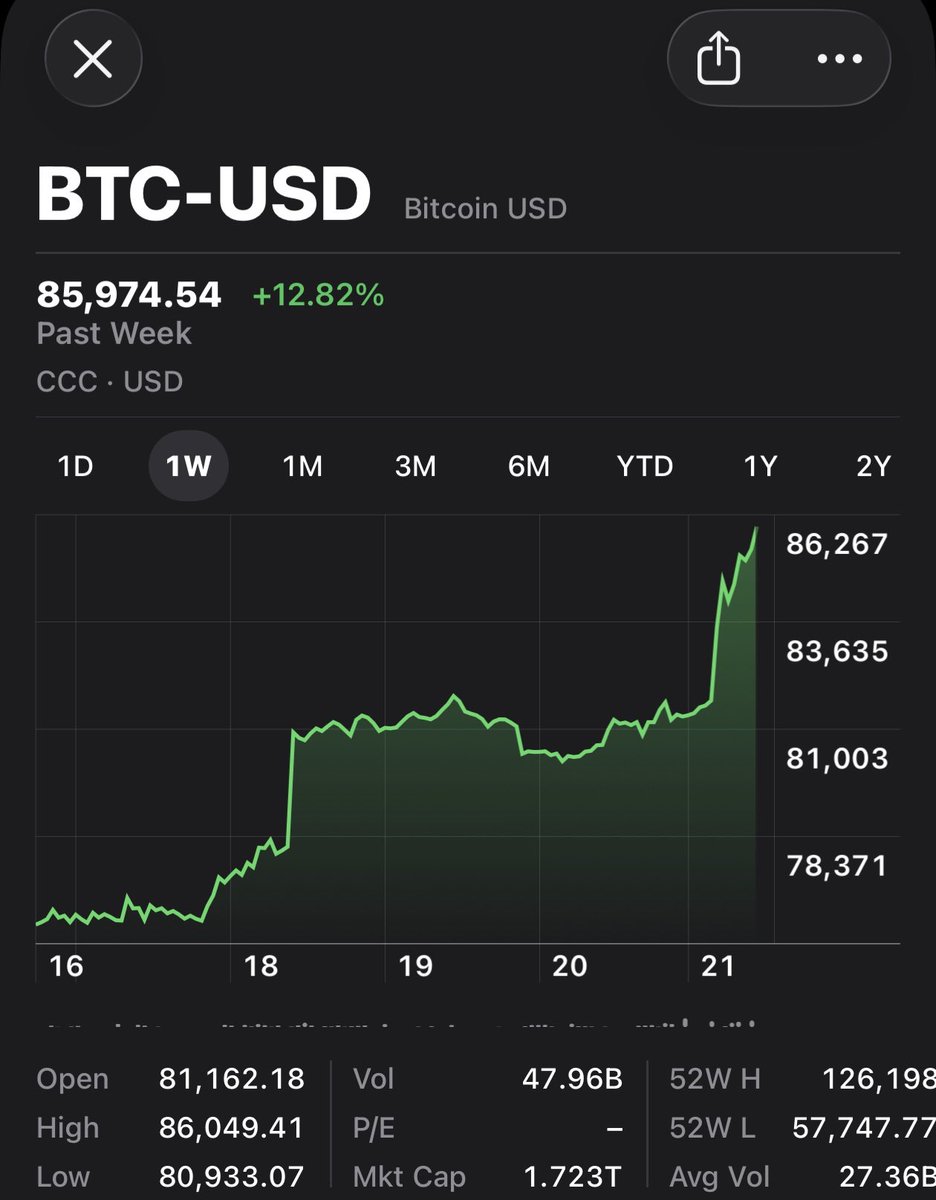
@Jason, Bitcoin went from roughly $3,700 to nearly $90,000 between your 2018 warning and November 2024. Your confidence deserves its own chart.
In November 2018, you put the odds of Bitcoin going to zero at 60% to 70%.
By November 2024, you had cut those odds to below 5%. Bitcoin had risen roughly 24 times.
Now you’re assigning 90% odds to QQQ and top AI companies beating Bitcoin.
That forecast still has to play out. But “top AI companies” needs a named basket today, otherwise you can pick the winners afterwards.
Which companies, which weights, and what starting prices, Jason? Let’s make the confidence measurable.
You’re welcome day traders! 😂😂😂
90% chance that $QQQ and top AI companies will beat bitcoin:native over the next 12, 24 and 36 months — @grok@bot remind me of this every 12 months!
Bitcoin won't break it's record high in next 12 months — sideways for a bit more boys
Europe’s energy shock could keep inflation elevated well into 2027.
ECB chief economist Philip Lane expects inflation to start falling back towards target from the middle of next year. His interview was published today and conducted on September 15.
He expects renewed oil and gas increases to put pressure on food, electricity and goods prices. Pressure on services remains contained.
The squeeze extends beyond shopping bills. Lane says a larger, more persistent energy shock would hold back the economy. His forecast of steady but modest growth depends on the shock not becoming more severe.
The second wave of energy price increases means inflation is likely to be higher for longer before falling back towards target from mid-2027 onwards, Chief Economist Philip R. Lane tells @LeTemps.
He also discusses growth, government spending and AI https://t.co/M9BSfSH14U
The Houthis are testing how much they can take without bringing America into Yemen’s war.
They have seized Yemen’s Red Sea coast and pushed Saudi backed forces onto the defensive. Trump has reportedly held off on new strikes.
Avoiding American ships gives the Houthis room to pressure Saudi Arabia while limiting Washington’s reasons to intervene. A new US campaign would risk another prolonged conflict and further escalation with Iran.
The incentive is clear: keep advancing against Saudi Arabia’s partners while avoiding the targets most likely to trigger an American response.
Riyadh needs the Houthi advance reversed. Washington wants to avoid another war. The Houthis have room to manoeuvre between those two objectives.
Amazon is blocking Meta’s shopping agent while sending its own to other retailers.
Amazon cut off Muse on Sunday night after asking Meta to exclude its store, according to GeekWire. Amazon says Muse does not identify itself when browsing.
Amazon’s own Buy for Me service purchases products from other brands’ websites. The company says its agent identifies itself and lets brands opt out.
The commercial stakes are clear. If shoppers start with Muse, Meta can influence which products they consider before Amazon ever sees the order. With Buy for Me, that starting point stays inside Amazon’s app, even when another retailer makes the sale.
Alibaba wants more than 20 gigawatts of global data centre capacity by 2032.
At its Apsara conference, the company also unveiled its Zhenwu V900 AI chip and plans for a model with 5 to 10 trillion parameters.
The strategy spans the chips, the computing capacity and the models running on them. Alibaba is trying to supply businesses with more of the AI system itself.
The AI voice listeners like most can still stumble over names, dates and codes.
In Artificial Analysis’s new English pronunciation test, Sonic 3.6 ranks eleventh despite leading its listener preference ranking. Google’s Gemini 3.1 Flash TTS leads pronunciation with 88.1% correct human judgements on challenging text.
The test uses 454 sentences, including abbreviations that change meaning with context. A booking assistant has to know when “St.” means “Saint” and when it means “Street.”
Meta wants Muse to handle the chores you keep putting off. If personal AI agents start choosing where we shop and what we book, they could reshape who gets our business. https://t.co/txUdUzG89t
The SEC’s blockchain stock experiment requires real shareholder rights.
Under its September 17 exemption, eligible tokenized shares must preserve the rights of their conventional equivalents, including voting and dividends.
SEC official Taylor Lindman expects the first firms to publish plans for these trading venues next quarter. Those notices would reveal who intends to build them.
Public companies can also object when an unrelated third party tokenizes their shares for trading on these venues.
🚨🗞️NEW: First Tokenized Stock Venues Could Take Shape Next Quarter Under SEC’s Innovation Exemption
@HesterPeirce and @taylor_lindman answer key questions about how the new framework will work. ⬇️
https://t.co/baNJYvy4vS
Kakao’s bank and payments arm want to bring stablecoins into mainstream Korean finance.
Kakao Bank and Kakao Pay have signed an agreement with Fireblocks to explore how digital assets could be distributed in South Korea. Stablecoins are the focus, with proof-of-concept tests planned around local regulatory and security requirements.
The practical ambition is to connect banking and payments with blockchain-based money. For now, this is a development agreement—not a launched stablecoin or regulatory approval.
https://t.co/3n15yRd2JV
Healthcare accounts for almost a third of America’s projected net job growth from 2025 to 2035.
BLS expects healthcare support jobs to grow 13.3% and healthcare practitioner and technical jobs 8%, versus 3.5% across all occupations.
The projections, released August 27 and highlighted again September 21, point to demand from an ageing population and chronic illness.
These are long-term projections under specific assumptions, not a count of jobs already created or vacancies waiting to be filled.
https://t.co/EYhGk2CKQO
Europe’s Red Sea mission needs more than 10 warships—and does not have them, its foreign policy chief says.
Kaja Kallas says the security situation has worsened since the original estimate of at least 10 ships. She asked EU governments last week for more naval and air assets, according to diplomats.
Operation Aspides protects merchant ships against attacks at sea. This is a call for reinforcements, not an announcement that they are arriving.
The practical question for shipping companies is how much protection governments can actually put on the water.
https://t.co/9EAyEHzgCk
Texas is freezing data-center permits—and its governor wants to scrap their financial incentives.
Greg Abbott’s September 21 directive extends the pause to the state’s environmental agency. Regulatory approvals must wait for grid audits and water-use information.
He also plans to ask the legislature to eliminate financial incentives next session. That is a proposal, not an enacted repeal.
For developers, buying chips and securing finance are only part of the job. Permission to use local power and water can decide when a project earns anything.
https://t.co/9sLWhAqgoq
Cuba is losing the workers it would need to rebuild its economy.
A new report describes a farm near Havana that once employed 200 people and now has 24, half over 60. Its manager has money to hire. He cannot find the people.
Estimates cited in the report put departures since 2020 at 1.6–2.75 million. The lower figure comes from Cuban officials; the higher one from demographer Juan Carlos Albizu-Campos. These are competing estimates, not a new census.
Emigration offers families an escape from crisis and a source of money sent home. It also leaves fewer people to harvest crops, staff hospitals and care for an ageing population.
Even if investment returns, rebuilding the workforce could take much longer.
https://t.co/URfRpbOh0l
22 leaders want AI companies to let independent experts test their most powerful models before release.
A new appeal led by Norway and Finland calls for mandatory testing, access for outside evaluators and shared reporting of serious safety incidents. Signatories include the leaders of Canada, Germany, Australia and Singapore, plus the European Commission president.
It also asks UN members to explore an international body that could set standards and verify compliance.
The gap: neither the US nor China appears on the published signatory list. And this is a political appeal, not a binding agreement or an agreed pause in AI development.
The practical test is whether independent reviewers gain access—and governments turn the appeal into enforceable rules.
https://t.co/t4lPz5vIgG
New Zealand’s carbon market can make pine trees more profitable than sheep.
Forest owners can sell credits for the carbon their trees absorb. That extra income helps them outbid livestock farmers for land.
An August update from Beef + Lamb New Zealand put whole sheep and beef farms sold for forestry since 2017 at almost 330,000 hectares. That measures land sold for conversion, not trees already planted.
The trade-off: forests remove carbon, but cheap offsets can weaken the incentive for companies to cut emissions at source. Rural communities can also lose farming work.
New restrictions have slowed conversions. The underlying tension remains: what pays best for a landowner may not sustain the community around them.
https://t.co/OS5FqgQYdn