The role of a venture associate will feel very outdated soon. Firms can run much leaner now.
Market research, deal underwriting & portfolio tracking are no longer differentiators.
It's pretty ironic because we’re all backing AI companies that replace services with software. What do you think happens to entry-level venture roles in the next cycle?
If you want to break into venture today, highly recommend asking yourself what life experiences or skill sets make you a true 1/1 investor. If you don’t have an answer, go find an operating role & build a reputation.
In a great operating role, you meet incredible people who become your career network & learn far more than you ever will sitting in a VC office flipping through decks.
I’ve seen too many 22-year-olds trying to get into venture right after college & especially so in the last few years. I get it bc venture is the most incredible job in the world if you love living/investing in the future.
But unless you work at Sequoia or another true blue chip firm (which is a short list), the best founders want to work with investors who’ve built something they respect.
Go live a little & see if you're any good at building. Venture will still be here if you’re successful & you’ll be far more dangerous when you come back.
venture capital went from weirdos at the fringes of society investing in semiconductors to harvard educated spreadsheet jockeys doing occult excel macros to value brick and mortar private equity rollups at software multiples because the deck said "ai" 25 times.
I believe in raising the foundation for struggling Americans before education and wealth disparities, accelerated by AI, result in regression or revolution.
...in portable, lifelong, universal health insurance, but the private provision of care.
...in a roof over every American's head, but built by the private sector.
...in healthy food on every American's table.
...in world-class education for every student, and parents able to choose what's best for their children.
...in strong nat'l defense w/o spending $1 trillion/yr while 60% of Americans can't afford a $500 emergency.
...in competent, experienced, and high integrity executives in public and private sector offices.
...in public safety for all Americans, no matter one's zip code, and accountability for anyone who causes harm.
...in mandatory national service, be it military, Peace Corps, or AmeriCorps.
...and I believe in all of us to get it done.🇺🇸
For everyone DMing me, every Hadrian for X is just Hadrian, but I think competition is important to keep me not lazy. Beat me, join me, get acquired or lose - but the net:net is that I need 20x capital and talent into manufacturing and greatful @ycombinator is instantiating the mission. There is no sovereignty without a sovereign industrial base.
There is no point making money without a sovereign country to make it it.
Onshore or Die
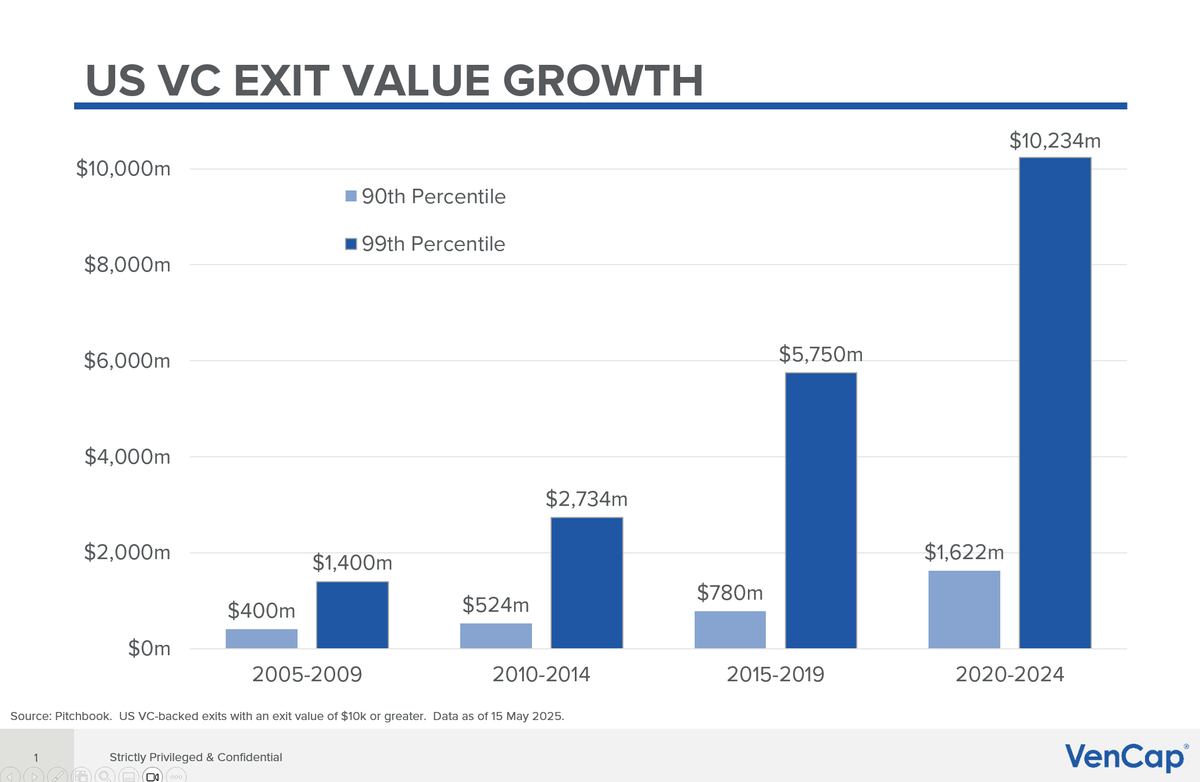
So what are the takeaways? We've seen the value of the top 1% exits essentially double every 5 years. If this trend continues then the top 1% exit for funds investing today would be $40bn+ (8-10 year holding period). This doesn't seem unreasonable. /6
I’ve never understood why we lose touch after war.
You’d think going through that kind of hell would keep people close forever. But it doesn’t. We scatter. Drift.
No fallout. No betrayal. Just silence.
Maybe it’s the weight we each carry, too heavy to share.
Maybe it’s survival. Still, every time I reconnect with one of you, it hits me:
The bond never left. It just went underground. So if you're reading this, and we bled on the same ground, reach out.
You don’t have to explain anything. I already know.
"If the future of an industry is based on an average VCs ability to understand it, you're not gonna make it."
This quote from @kwharrison13 illustrates why valuation is so important, despite being poorly understood by modern VC.
Historically, valuation was how technology startups could translate the opportunity for investors who couldn't understand the science — using the language of business economics.
Unit economics, cash flow, operating leverage, growth strategy, barriers to entry, moats, margins... It doesn't matter if you are making SMRs, LLMs or AUVs, these are universal concepts.
Research has demonstrated that VCs are less likely to invest in ideas if they do not understand the value, which in turns pulls founders towards consensus ideas — an obvious drag on innovation.
"Information frictions in valuation can lead startups to select projects that align with the expertise of potential venture capital (VC) investors, a strategy I refer to as catering [...] Catering applications are 19.3% less likely to get patent approval, suggesting low project quality."
(source: "Startup Catering to Venture Capitalists")
It is therefore critical that both investors and founders have a shared language around valuation, which they can use to reach common ground on the potential of the company — particularly when the technology itself is novel and disruptive.
The rot set in with the dotcom boom, when startups were priced on ridiculous multiples of web traffic or registrations. It worsened in the decade of low-interest SaaS investing, where VCs were drawn into pumping an dumping companies with cheap capital and superficial metrics.
"Investors need to spend more time thinking about the value they are getting, not just the price they pay. Venture capital is a long-term game, and if you behave like a trader then you’ll inevitably get trampled when the market turns and you’re unable to exit."
(source: "Price vs Value: The Momentum Trap in VC")
Today, not only do VCs fail to grasp valuation, many aren't particularly financially literate. They don't understand the use of projections, they can't read a balance sheet, and they have a surprisingly hard time detecting revenue fraud.
Valuation is not about perfectly calculating round prices or markups. It is an objective input that allows you to assess a business in a repeatable, methodical and scrutable manner to enable better decisions, which LPs (and auditors) will appreciate.
For more, I reccomend reading the guide linked below (at least Section 4) and my inbox is open if you have any questions.
"Periods of market exuberance might lead to prices far exceeding fundamental value (overvaluation), while downturns might present opportunities where price falls below value (undervaluation).
Structured valuation methodologies aim to bridge this potential gap. By providing a transparent framework based on defined inputs and calculations, they help ground the negotiation process in an assessment of fundamental potential, rather than letting it be driven solely by market heat, FOMO (fear of missing out), or desperation."
(source: "Startup Valuation: The Ultimate Guide")
ANNOUNCING: The REINDUSTRIALIZE 2025 lineup is here! Six power-packed tracks bringing together the brightest minds rebuilding American manufacturing. From factory floors to funding—we're assembling the ultimate industrial dream team at Hudson's Hall in Detroit this July!
Sorry, I know you guys really want me to join the hysteria. But it’s been ten years of this now, and I sort of just refuse to care. Call me in a year and we can talk the tariffs over (if you even remember this happened).
If you need training,
Do not join an early stage start-up
If you need help setting up your computer,
Do not join an early stage start-up
If you want to spend your first month ‘getting up to speed’,
Do not join an early stage start-up
If you want max out your time off,
Do not join an early stage start-up
If you can’t send a weekly email of what you got done,
Do not join an early stage start-up
If you can’t ship in week one,
Do not join an early stage start-up
If you can’t sell without a brand behind you,
Do not join an early stage start-up
If you need kudos for just doing the basics,
Do not join an early stage start-up
🚨The Smears That Kill Us No More🚨
You know, I had an epiphany in the last 24 hours. This isn't just a post. It's a warning. It's a call. It's a gut punch. TLDR? Get over it:
I’ve spent years watching good men and women in uniform crumble under the weight of accusations—many of them baseless. I've seen us crushed under the weight of illegal orders as well. And I finally understand the pattern: The media has weaponized our honor against us.
Honor. That thing the media/politicians barely talk about anymore. That thing that burns inside every warfighter and civilian who still believes in duty, sacrifice, and loyalty. It’s what makes us different. It’s what makes us dangerous to our enemies. And it’s what makes us vulnerable to the cowards with keyboards.
Do you know what honorable people do when they’re accused of something awful—even when they’re innocent? They shut down. They spiral. They think about ending it. Because we are built to care. To carry the weight. To never bring shame on our name. And the enemy knows this.
Malign actors in the media, in politics, in legal offices—they know exactly what they’re doing. They don’t have honor. They don’t have guilt. They have playbooks. Sexual misconduct. Racism. Alcohol. Drugs. Extremism. NATSEC. They’ll run through the whole list just to ruin someone they see as a threat.
It’s why good officers and enlisted leaders keep getting destroyed. It’s why senior leaders investigate everyone for everything—even when they know it's nonsense.
Because they’re scared. Scared of the next headline. Scared of the next tweet. Scared of the mob.
We live in a military and culture where being accused is enough. Not being guilty—just being accused. That’s all it takes to lose your career, your family, your life.
That's not justice. That’s lawfare. That’s warfare.
The DoD and country as a whole isn’t going to fix this with another policy. The center of gravity isn’t regulation—it’s leadership. We need leaders—uniformed and civilian—who are immune to smears. Immovable. Untouchable. Spine-having, warfighting, smear-proof warriors. I see that in the current administration and I am THANKFUL. CHANGE STARTS THROUGH THEIR DEFIANT EXAMPLE.
Because when they stand strong, others do too. JAGs start asking real questions. Commanders stop rubber-stamping punishments. Generals stop pulling the investigation trigger at the first sign of controversy. The culture shifts.
If the top bends the knee, the ranks get crushed.
But if the top stands tall, the whole formation holds.
I’m sick of watching the media ruin lives of service members they could never understand (yes that includes our senior civilian leaders desperately trying to do the right thing).
I’m sick of being told that common sense is political.
It’s not. It’s rare. And I’m infected with it. There is no cure. I am not political. I am for whoever harms my brothers and sisters the least. I am in uniform. I have no agenda other than protecting the people to my left and right.
And I’m telling you—we are in a crisis. We are losing our best. We pushed out real leaders over a vaccine. We punished innocent troops for things they never did. We promoted cowards to keep the narrative intact.
All because of the malign actors in media and politics. All because no one had the guts to say “No.” Well, I’m saying it now. NO MORE.
I’m in my early 40s. My resting heart rate is 30 BPM higher than before the vaccine. I have advanced cataracts. I’m still fit to fight—but I’m not OK. It’s going to take a long time to fix me. I'll get there though.
But I’ll tell you what gives me strength:
Knowing I’m not the only one.
Knowing there are thousands of us.
Knowing we’re not crazy—we’re just awake.
This is the battle. Not for medals. Not for promotions.
For the soul of the military and the country.
Stand with us. Or stand aside.
Because we’re not going anywhere.
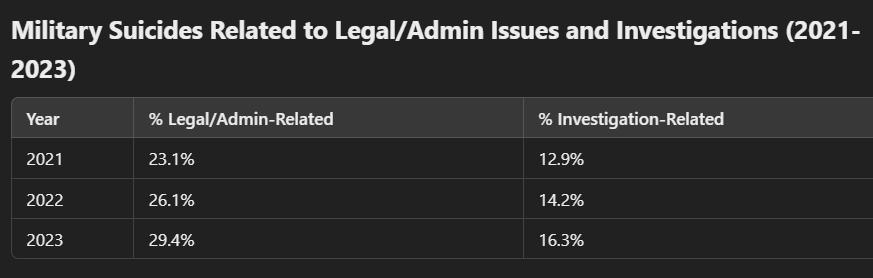
I will not yield until these suicide numbers depicted are reduced significantly. WE will not yield until justice is served. To the enemies of freedom: Your days of weaponizing our sacred honor and duty to country are over.
I don’t know if heartbroken is the right word for what we felt when Afghanistan fell. It was something darker. Something deeper. Maybe only the men who watched Saigon burn can understand.
We buried too many. Brothers and sisters who gave everything for Iraq and Afghanistan. We fought, bled, and lost, only to watch it all unravel in days.
Fifteen-month tours, back-to-back. We fought with one arm tied behind our backs, shackled by rules written by men who never heard the crack of a rifle in the dead of night. We stood in the sand, in the heat, saluting Hero Flight after Hero Flight, watching our own leave lifeless.
We were told the victories belonged to the host nation. The failures? Those belonged to us. We stood “shoulder to shoulder” with allies who, too often, turned their weapons on us. And when we pointed this out, we were told to keep trusting.
We fought like hell, shifting from humanitarian workers to killers and back again, never steadying our feet. We had to do everything, which meant we mastered nothing.
But we won battles. We always won battles.
And still, we lost the war.
We came home, then went back, then came home again. Until America forgot. Life went on while we held the line, guarding some outpost no one cared about anymore.
Some of you wonder why I am so fiery. So unrelenting. So unwilling to accept the same failures from the same institutions.
Because we must never, EVER, let this happen again.
Losing so many great Americans, losing two wars in one lifetime—this is hell on earth for those of us who lived it.
A third? Unthinkable.
As long as I draw breath, as long as men like me still stand, we will never let it happen again.
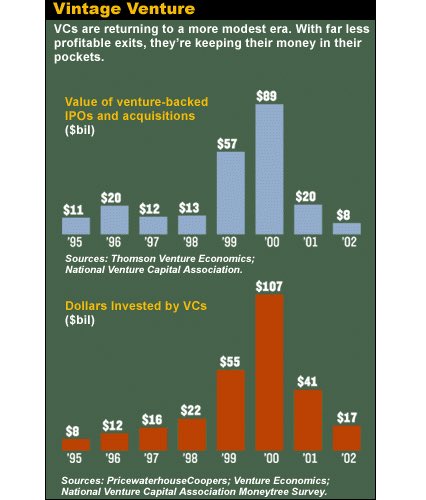
The connection between low-interest-rate investing and systemic overpricing is well understood in theory and clearly apparent in past cycles.
It destroys exit markets every time.
Many investors (like @Jason, below) are presenting today’s liquidity crunch as a policy problem, with Lina Khan as the convenient scapegoat.
These excuses play into venture capital’s responsibility-shy nature and the institutional resistance to learn from past cycles.
Similarly, narratives about venture as a game of exploiting narrow liquidity windows perpetuate the reckless behavior that shrinks liquidity windows in the first place.
Like most markets, venture is cyclical. There’s no avoiding bubbles, and in some sense they are productive. However, it is also packed with unnecessary procyclical behaviour that produces mutant companies at the top of each cycle with no shot at exit.
This is entirely avoidable.
Going from Series A to Series B is so brutal now.
Only 9% make it within 2 years.
Are lack of down rounds in early-stages to blame?
Seed startups w\o bridge are 2x+ likely to raise Series A, 10x from A to B.
Extending rounds by stacking SAFEs doesn't work.
@PeterJ_Walker
The Evolution of VC Core Competencies
When I was entering VC (2012) we were coming off the age of the “technologist”. The core risk of most startups was technology/product risk thus the core strength of a VC was their ability to understand/underwrite/mitigate that risk. Most VC has technical degrees and/or held roles in technology companies with deep networks of CIO/CTOs.
Shortly thereafter, funding risk was the principal threat. Startups were ample and VC still scarce post GFC, thus creating a need for the “banker” to help companies raise capital amidst this scarce environment. Companies anchored themselves to high growth and loosely underwritten on revenue multiples based on VCs ability to help these companies raise capital to deter further competition and solidify a moat. Many of the VCs I knew came up through banking or MBA programs, moved to VC early in their careers and bore witness to a decade plus bull run.
We then entered the phase where startups without risk. We entered the age of the “socialite” given the perceived benefits of access. Technical, operational or financial acumen, just whether you could get into hot deals. This oriented VCs to marketing and gossip in order to access those deals. These VCs have come from traditional and non-traditional backgrounds, but have become experts in social media and social engineering.
Today, I believe we areentering an age of “reason”. Where businesses will be critically evaluated for not just product pull, but durability/persistence. Where the critical skillsets of VC will be independent conviction and an ardent understanding of how to create true business value, rather than just mark-ups. No more tricks, VCs just needing to creatively source, critically analyze and meaningfully support founders in building great businesses.
New phases will come and go with reason becoming scarcer during ages of hubris, but reason will NEVER go out of style.
one of the firms we invested in recently raised their Series A. to start the process, the company sent emails to many VCs. stats on raise:
* the top branded partners at the top branded firms: almost all responded to the email within 4 hours. all wanted to set up a meeting within a day.
* the top branded partners at the mid-tier firms: usually needed to receive 2 emails to set up a mtg. mostly requested mtgs within 4 days of 2nd email.
* the low-tier firms: had the lowest response rate. many times they wanted to set up a mtg 2-3 weeks out. they all missed seeing the deal.
i'm surprised that the top-tier firms are more responsive than the low-tier firms but kinda makes sense. always be hustling.
working at a big company is basically an accelerated course in how power actually works. once you see the sheer level of inefficiency, rent-seeking, & arbitrary decision-making, it kind of breaks all illusions about big companies.
the best part is realizing that half the people in charge have no clue what they’re doing but just sound confident. once you internalize that, you stop overestimating the competition & start realizing that most barriers to entry are just psychological.
What’s happening in America is roughly equivalent to the yearbook committee and theater kid types getting rocked by a football team and chess club alliance.
% of startups get from Seed to Series A is a perfect illustration of why vintage matters so much in VC.
Each line is a cohort of startups by the date of their seed raise (all Q1s from 2016-2024)
Maybe some optimism for the Q1 2024 cohort?







![credistick's tweet photo. "If the future of an industry is based on an average VCs ability to understand it, you're not gonna make it."
This quote from @kwharrison13 illustrates why valuation is so important, despite being poorly understood by modern VC.
Historically, valuation was how technology startups could translate the opportunity for investors who couldn't understand the science — using the language of business economics.
Unit economics, cash flow, operating leverage, growth strategy, barriers to entry, moats, margins... It doesn't matter if you are making SMRs, LLMs or AUVs, these are universal concepts.
Research has demonstrated that VCs are less likely to invest in ideas if they do not understand the value, which in turns pulls founders towards consensus ideas — an obvious drag on innovation.
"Information frictions in valuation can lead startups to select projects that align with the expertise of potential venture capital (VC) investors, a strategy I refer to as catering [...] Catering applications are 19.3% less likely to get patent approval, suggesting low project quality."
(source: "Startup Catering to Venture Capitalists")
It is therefore critical that both investors and founders have a shared language around valuation, which they can use to reach common ground on the potential of the company — particularly when the technology itself is novel and disruptive.
The rot set in with the dotcom boom, when startups were priced on ridiculous multiples of web traffic or registrations. It worsened in the decade of low-interest SaaS investing, where VCs were drawn into pumping an dumping companies with cheap capital and superficial metrics.
"Investors need to spend more time thinking about the value they are getting, not just the price they pay. Venture capital is a long-term game, and if you behave like a trader then you’ll inevitably get trampled when the market turns and you’re unable to exit."
(source: "Price vs Value: The Momentum Trap in VC")
Today, not only do VCs fail to grasp valuation, many aren't particularly financially literate. They don't understand the use of projections, they can't read a balance sheet, and they have a surprisingly hard time detecting revenue fraud.
Valuation is not about perfectly calculating round prices or markups. It is an objective input that allows you to assess a business in a repeatable, methodical and scrutable manner to enable better decisions, which LPs (and auditors) will appreciate.
For more, I reccomend reading the guide linked below (at least Section 4) and my inbox is open if you have any questions.
"Periods of market exuberance might lead to prices far exceeding fundamental value (overvaluation), while downturns might present opportunities where price falls below value (undervaluation).
Structured valuation methodologies aim to bridge this potential gap. By providing a transparent framework based on defined inputs and calculations, they help ground the negotiation process in an assessment of fundamental potential, rather than letting it be driven solely by market heat, FOMO (fear of missing out), or desperation."
(source: "Startup Valuation: The Ultimate Guide")](https://pbs.twimg.com/media/GpKw3QVWwAE9DmV.png)