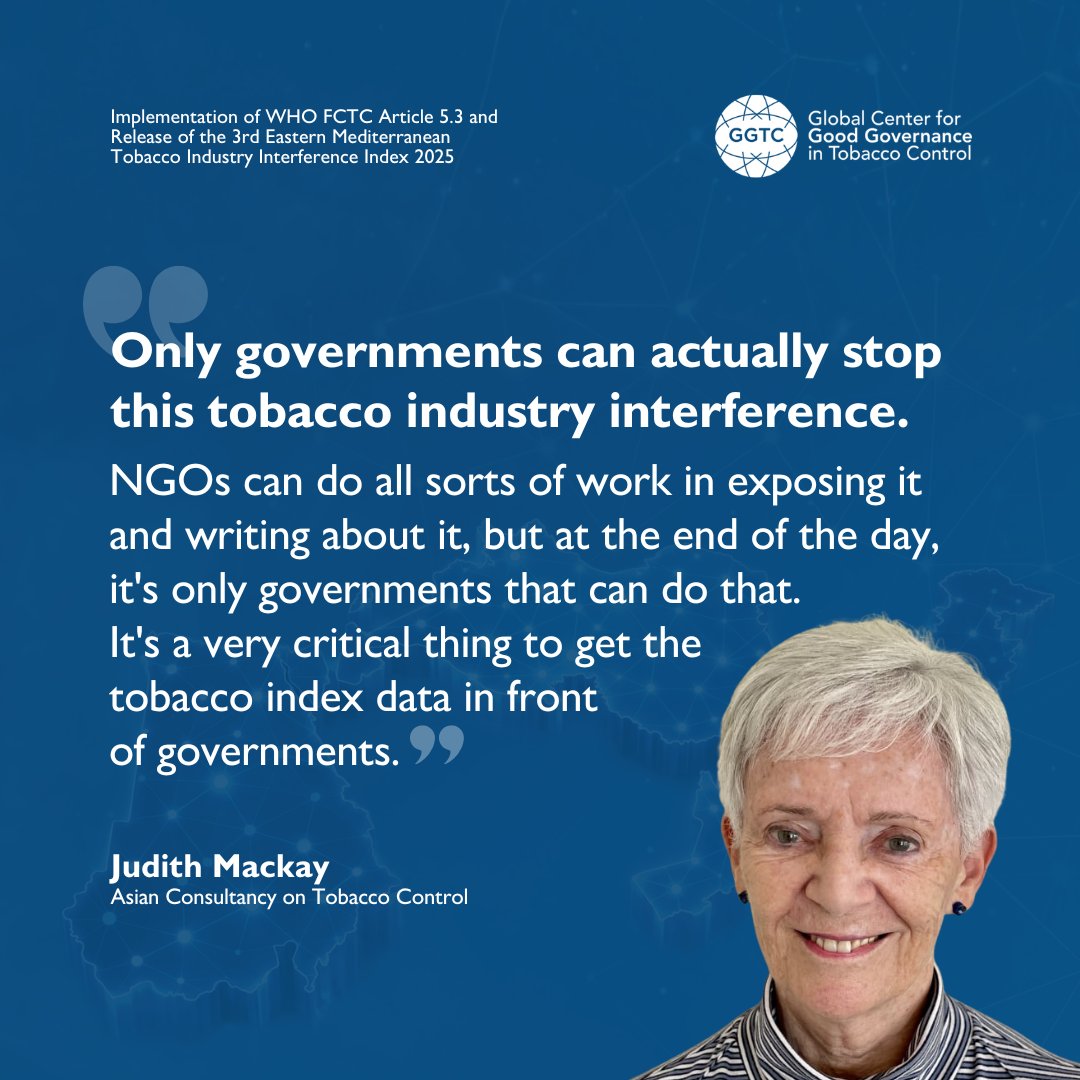
Civil society and public health advocates play a critical role in exposing tobacco industry tactics, but governments remain central to implementing and enforcing protections against industry interference under WHO FCTC Article 5.3.
During the webinar on the implementation of WHO FCTC Article 5.3 and the release of the 3rd Eastern Mediterranean Tobacco Industry Interference Index 2025, speakers highlighted the importance of ensuring that policymakers have access to evidence documenting tobacco industry influence and interference.
Explore the Eastern Mediterranean Tobacco Industry Interference Index 2025 and related regional resources: https://t.co/NXVrdThzBe
#TobaccoIndustryInterference #Article53 #GGTC #TobaccoControl #EMRO
Protecting public health policies from tobacco industry interference requires coordinated action across governments, civil society, and international institutions. Strong implementation and accountability mechanisms remain essential in advancing WHO FCTC Article 5.3 across the region.
During the release of the 3rd Eastern Mediterranean Tobacco Industry Interference Index 2025, speakers underscored the need for sustained technical support, stronger enforcement, and continued transparency measures to counter tobacco industry influence.
Explore the Eastern Mediterranean Tobacco Industry Interference Index 2025 and related regional resources: https://t.co/NXVrdThzBe
#TobaccoIndustryInterference #Article53 #GGTC #TobaccoControl #emrobicdancexforce
@WHOEMRO
Article 5.3 of the WHO Framework Convention on Tobacco Control obligates governments to protect public health policies from tobacco industry interference. This includes rejecting partnerships, avoiding conflicts of interest, and strengthening safeguards against industry influence.
At the launch of the 3rd Eastern Mediterranean Tobacco Industry Interference Index 2025, speakers emphasized the importance of a whole-of-government approach in addressing tobacco industry tactics and reinforcing accountability mechanisms across sectors.
Explore the Eastern Mediterranean Tobacco Industry Interference Index 2025 and related regional resources: https://t.co/AHuZlGzvcC Health Organization (Eastern Mediterranean Regional Office)
#TobaccoIndustryInterference #Article53 #GGTC #TobaccoControl #EMRO
🔔Launch reminder: #MakeBigTobaccoPay Global Week of Action + Media Briefing
Today, on June 1, advocates and partners around the world will come together to launch the #MakeBigTobaccoPay Global Week of Action.
This global effort calls on governments to hold Big Tobacco accountable for the harms it causes to people, public health systems, and the planet.
Date: Monday, June 1, 2026
Time: 8:30 AM Boston / New York time
Platform: Zoom + YouTube
Register here: https://t.co/cLqwRH2WaW
Join us and help amplify the call to make #BigTobacco pay.
More information about the Global Week of Action: https://t.co/3x2HtljnEA
Ahead of #WorldNoTobaccoDay2026, a group of @GYV_movement members who participated in GGTC-supported AI Advocacy Bootcamp came together to raise their voices against the tobacco industry's latest playbook.
From colourful packaging and appealing flavours to influencer marketing and misleading "harm reduction" narratives, new nicotine products are being designed and promoted to attract a new generation of users.
Using the advocacy, policy, and digital storytelling skills, these young advocates developed this collective message to expose the tactics behind the appeal and call for stronger action to protect youth from nicotine addiction.
The message is clear: addiction isn't accidental. It's engineered.
Young people are demanding that governments place a comprehensive ban on all tobacco and nicotine products and reject industry tactics designed to normalize addiction among future generations.
Leanr more about engineered nictoine addiction 🔗https://t.co/waPW0WtL3C
#UnmaskTheAppeal #TobaccoExposed #WNTD2026
@GYV_movement
Indonesia scores 82/100 on the Global Tobacco Industry Interference Index 2025, yet tobacco ads still flood schools & youth events across Southeast Asia. Influencer marketing & greenwashing keep targeting the next generation. https://t.co/ECf9kZVCa0
#WNTD2026#GTI2025@ayoasean
The #tobaccoindustry continues to use Corporate Social Responsibility (CSR) activities to improve its image, gain access to policymakers, and distract from the harms caused by its products.
According to the #WHOFCTC, tobacco industry CSR is considered a form of promotion disguised as public goodwill.
From environmental cleanup drives and charity initiatives to community partnerships and public donations, these activities help the industry present itself as socially responsible while continuing to profit from addiction, disease, and environmental harm.
CSR programs can also create opportunities for the industry to build relationships with governments and institutions that are meant to regulate it.
The Global Tobacco Index reported that 32 countries have already banned tobacco-funded CSR activities, recognizing how these initiatives can interfere with public health policy and tobacco control efforts.
This #WorldNoTobaccoDay2026, exposing tobacco industry tactics means recognizing that CSR is not separate from the tobacco business model — it is often used to rehabilitate industry image, influence decision-makers, and normalize a harmful industry.
Interested to learn more? 🔗https://t.co/GvbWpOMCeC
#TobaccoExposed #UnmaskTheAppeal
Today’s nicotine products were not designed to look dangerous.
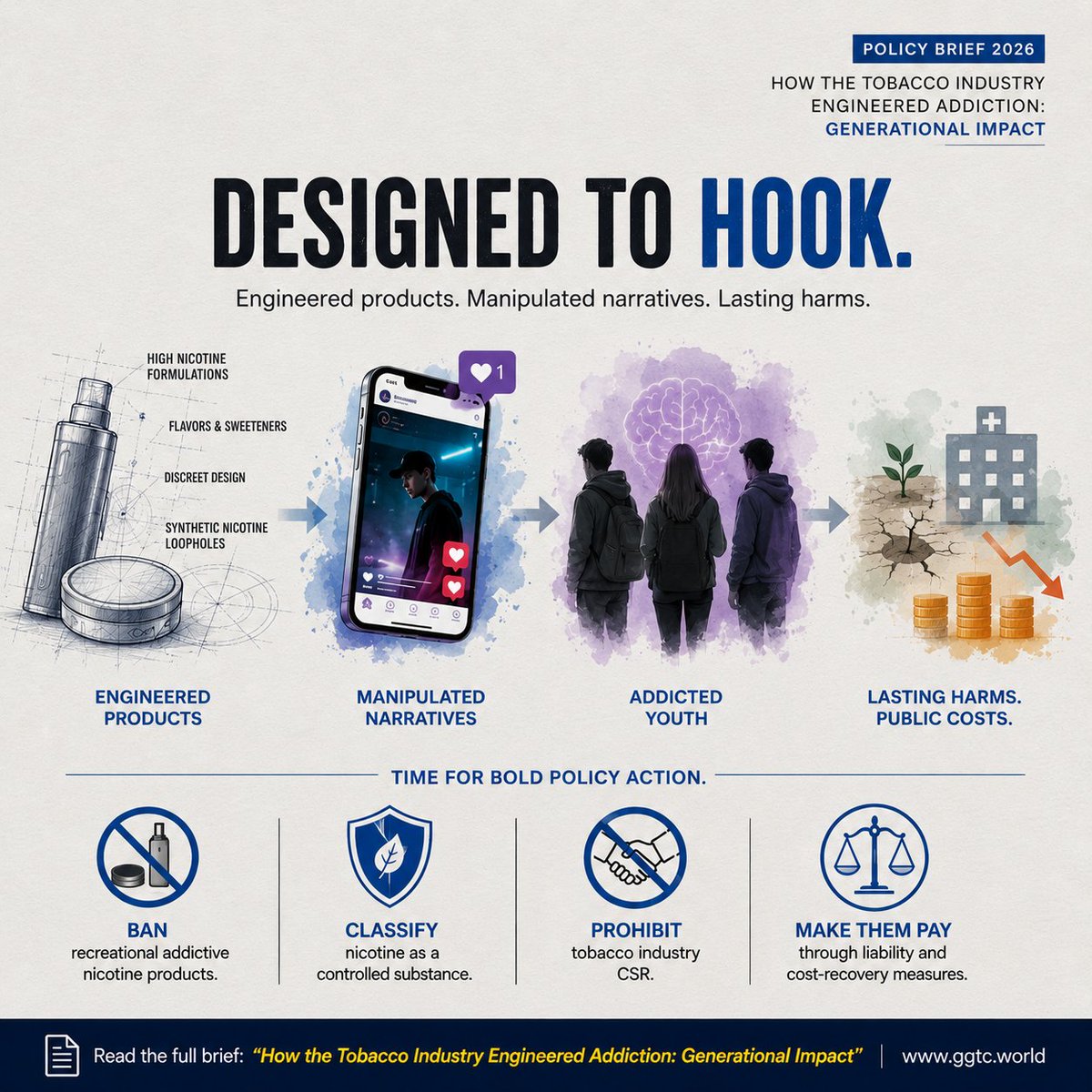
Ahead of #WorldNoTobaccoDay 2026, GGTC’s latest policy brief examines how the tobacco industry redesigned nicotine itself — from nicotine salts and high-strength formulations to flavours, discreet devices, and synthetic nicotine loopholes — to make addiction easier, faster, and harder to escape, especially for young people.
💡The brief highlights:
• Nicotine’s 67.5% lifetime dependence probability — higher than alcohol, cocaine, or cannabis
• Product engineering specifically designed to reduce sensory barriers and normalize use
• Growing evidence linking nicotine use among youth to mental-health harms, including anxiety, depression, and suicidal ideation
• The industry’s use of “harm reduction” narratives and CSR to protect profits and influence policy
The brief calls for:
☑️Banning recreational addictive nicotine products
☑️Classifying nicotine as a controlled substance
☑️Prohibiting tobacco industry CSR
☑️Expanding liability and cost-recovery measures so the industry pays for the harms it caused
🔗 Read the full brief: https://t.co/waPW0WtL3C
#UnmaskTheAppeal #wntd2026 #TobaccoExposed #ProtectYouth
Want to learn more about the rapid expansion of nicotine pouches and the tactics used to target young people?
Read the World Health Organization (WHO)’s full report:
https://t.co/T5nOW3ylIx
Nicotine pouches are rapidly spreading across global markets — and young people are being aggressively targeted in the process.
In its new report, @WHO warns that nicotine pouch brands are using youth-oriented flavours, influencer marketing, sleek packaging, lifestyle branding, and social media promotions to normalize nicotine use and hook a new generation into addiction.
🔎Key findings from WHO’s report:
• Retail sales exceeded 23 billion units in 2024 — a rise of over 50% from the previous year
• Around 160 countries still have no specific regulation for nicotine pouches
• Products are promoted using flavours like “bubble gum” and “gummy bears”
• Marketing includes influencers, concerts, festivals, sports sponsorships, and aspirational youth branding
• Some products contain nicotine levels labelled up to 150 mg
• Packaging and messaging often encourage discreet use in schools and smoke-free spaces
WHO recommends urgent action, including:
• Bans or strong restrictions on flavours
• Advertising and influencer marketing bans
• Strong age-verification and retail controls
• Plain packaging and health warnings
• Caps on nicotine levels
• Taxation and stronger enforcement measures
Youth protection starts with policy protection.
🔗 https://t.co/daExwJJbRG
#UnmaskTheAppeal #TobaccoExposed #WNTD2026
Learn more about how the tobacco industry uses new and emerging nicotine products, deceptive marketing, and industry interference to sustain addiction and weaken public health protections through the Global Tobacco Industry Interference Index: 🔗https://t.co/2fQlRebTBs
New tobacco and nicotine products are being designed to make addiction appear modern, clean, and socially acceptable.
From “smoke-free” heated tobacco products (HTPs) to Electronic Nicotine Delivery Systems (ENDS) such as vapes, the tobacco industry continues to repackage nicotine dependence through sleek technology-driven products.
While marketed as innovative alternatives, these products still deliver nicotine, sustain addiction, and expose users to serious health risks and death.
At the same time, weaker and evolving regulatory safeguards allow newer nicotine products to reshape how addiction is normalized and consumed.
Behind the polished packaging and modern image is the same business model: keeping nicotine dependence profitable.
This #WorldNoTobaccoDay2026, exposing tobacco industry tactics means recognizing how new products are engineered to sustain addiction under a new appearance.
#TobaccoExposed #UnmaskTheAppeal #WNTD26
Learn more about how the tobacco industry uses new and emerging nicotine products, deceptive marketing, and industry interference to sustain addiction and weaken public health protections through the Global Tobacco Industry Interference Index: https://t.co/2fQlRebTBs
Tobacco control advocates from across the Eastern Mediterranean Region came together at a webinar organised by GGTC to launch the third edition of the Eastern Mediterranean Tobacco Industry Interference Index 2025.
The report covers 11 countries — Egypt, Iran, Iraq, Jordan, Kuwait, Lebanon, Oman, Pakistan, Sudan, Tunisia, and Yemen — and assesses how governments are implementing WHO FCTC Article 5.3 to protect public health policies from tobacco industry interference.
🔎The findings reveal varying levels of tobacco industry influence across the region. Iran ranked 7th globally, demonstrating comparatively lower levels of interference, while Jordan ranked 89th, reflecting significantly higher levels of industry influence on policymaking.
The Index highlights the urgent need for stronger safeguards against industry interference and greater implementation of Article 5.3 measures across the region.
The report is now available. Explore your country’s score and learn how the tobacco industry continues to influence policymaking across the Eastern Mediterranean Region.
🔗https://t.co/NXVrdThzBe
#GlobalTobaccoIndex2025 #TobaccoExposed #Article53 #TobaccoIndustryInterference
@exposetobacco@WHOEMRO@BathTR
Learn more about tobacco industry interference and how stronger protections can help safeguard public health through the Global Tobacco Industry Interference Index: https://t.co/2fQlRebTBs
Lobbying and policy manipulation are among the tobacco industry’s most persistent tactics to protect profits and resist stronger regulation.
From funding research that creates doubt, to using front groups to shape public opinion, to pressuring governments through legal and political tactics, tobacco industry interference continues to undermine effective public health action around the world.
These strategies are designed to delay safeguards, weaken tobacco control measures, and keep harmful products on the market for as long as possible.
This #WorldNoTobaccoDay2026, exposing tobacco industry interference means recognizing how influence is built behind closed doors — and why protecting public health requires stronger safeguards against industry manipulation.
#TobaccoExposed #UnmaskTheAppeal
Want to understand how the tobacco industry influences policymaking in your country?
Explore the latest Global Tobacco Industry Interference (GTI) findings: https://t.co/2fQlRebTBs
The tobacco industry isn’t just designing products to appeal to youth — it is also working to shape the policies that keep these products attractive, accessible, and poorly regulated.
Behind the rhetoric of “harm reduction” and “smoke-free futures,” the industry continues to oppose stronger measures such as flavour bans, marketing restrictions, and tighter regulation of emerging nicotine products.
From lobbying and front groups to youth-oriented branding and digital marketing, these are coordinated strategies to protect profits and sustain addiction among a new generation.
This #WorldNoTobaccoDay2026, we must expose not only the products — but also the interference that enables them.
Protect young people by protecting policymaking.
#TobaccoExposed #UnmaskTheAppeal #ProtectPublicHealth