Our latest from @TheCrick, now on @biorxivpreprint:
https://t.co/5KYA031Wja
Michael Herger (@HergerMichael) and Christina Kajba jointly led development of a new prime editing platform for testing large numbers of human genetic variants.
@AkramulSourav Dear Akramul,
Yes - Crick PhD positions are open to international students! Out of fairness, I don't discuss project opportunities with individual applicants until shortlisting, but please apply using the link above if interested.
Best,
Greg
Crick PhD recruitment for fall 2025 is officially open! Please apply to our lab through the Crick application portal if interested. 👇
https://t.co/fVnzOTFmey
New from our lab @TheCrick , led by @BetkaRoe. A fun side project that tried to understand what happens when a chaperonin encounters a translating ribosome.
https://t.co/2t0cpKIMKl
Come join us in making agriculture sustainable at @PhytoformLabs! 🌱We are looking for an R&D scientist with a background in Synthetic biology to join our tools & traits team for precision genome editing 🧬. If you think this could be you, please apply!
https://t.co/xCCUz8IbQ8
So excited that our paper “De novo variants in the RNU4-2 snRNA cause a frequent neurodevelopmental syndrome” is out today in @Nature https://t.co/FeDLGm14MB
🧵 1/16
We are delighted to announce that Professor Edith Heard has been appointed as our new director and chief executive!
Edith, who is currently director-general at @EMBL, will succeed Paul Nurse in leading the Crick from the summer of 2025.
🔗 https://t.co/CcJR4TFxbF
Our work led by @megan_buckley01 on Saturation Genome Editing of VHL is now out in @NatureGenet:
https://t.co/HytcJynmkT
Many new experiments and analyses to quickly highlight… (1/n)
Finally, we’re delighted to see this published back-to-back with a massive SGE analysis of BAP1 led by Andrew Waters, @David_J_Adams and co. @sangerinstitute:
https://t.co/G98Rju7DpM
So many more variants now readily interpretable, and still more on the way! (9/9)
Of course, we hope you read the paper and use the data. Do feel free to reach out with questions on anything from protocol tips to variant classifications.
(8/n)
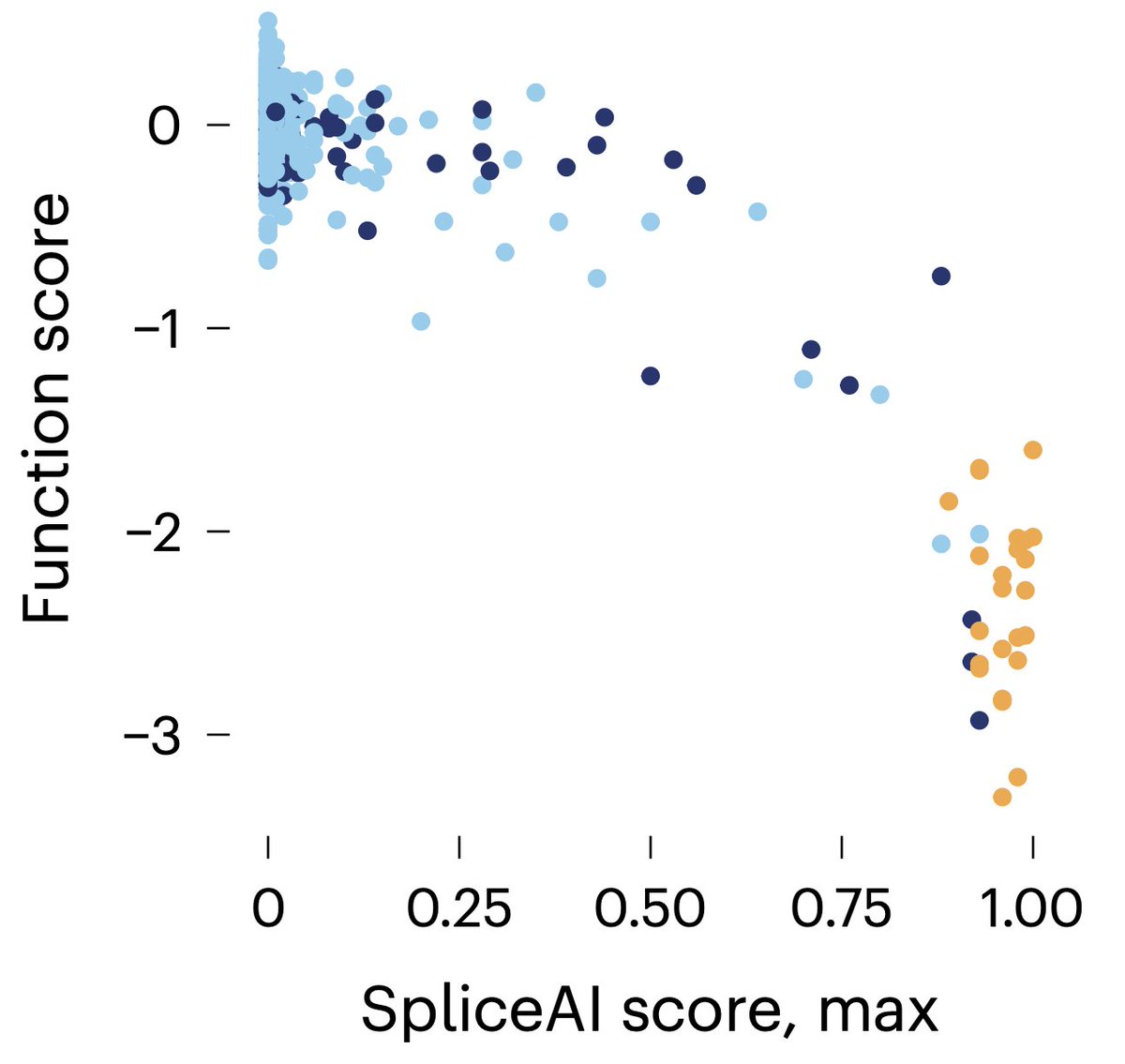
Lots more new analyses and validations in the paper, too. For instance, comparing function scores to SpiceAI and FoldX computational predictions – both of which do reasonably well. (6/n)
In new experiments, we also characterise novel mechanisms made apparent by SGE. Specifically, we show that a long C-terminus extension leads to LoF via VHL protein destablization and that stop-codon readthrough can impact the degree of functional impairment. See Fig. 6! (5/n)
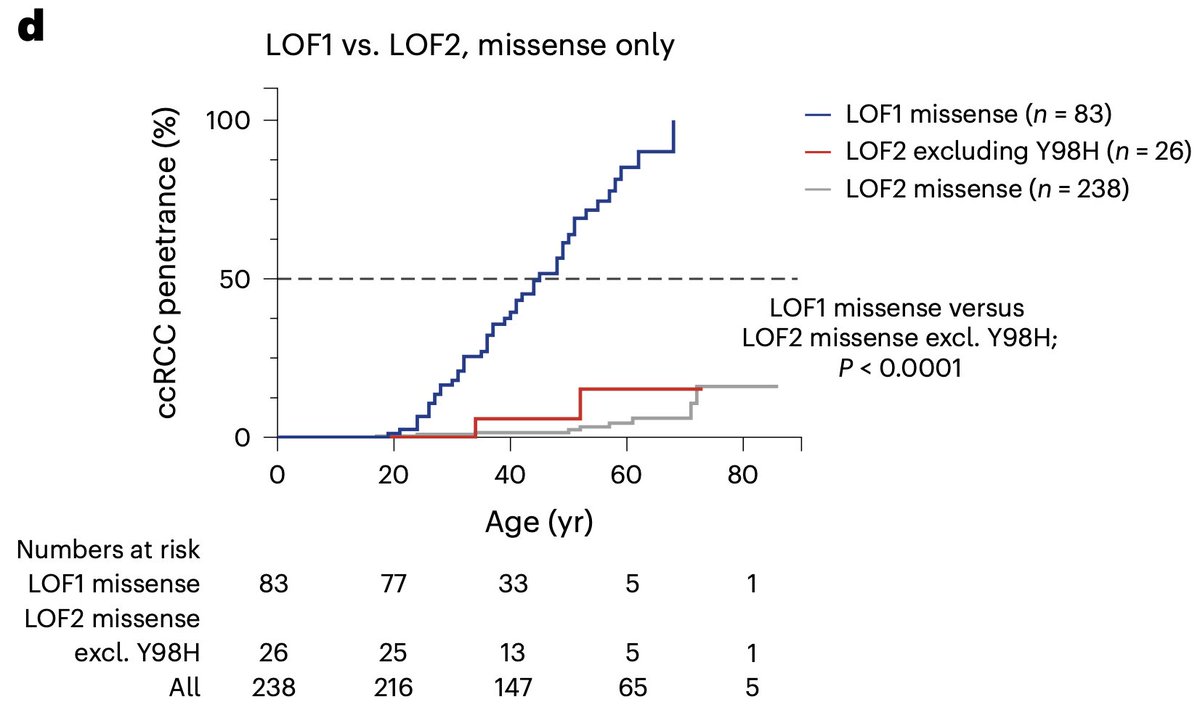
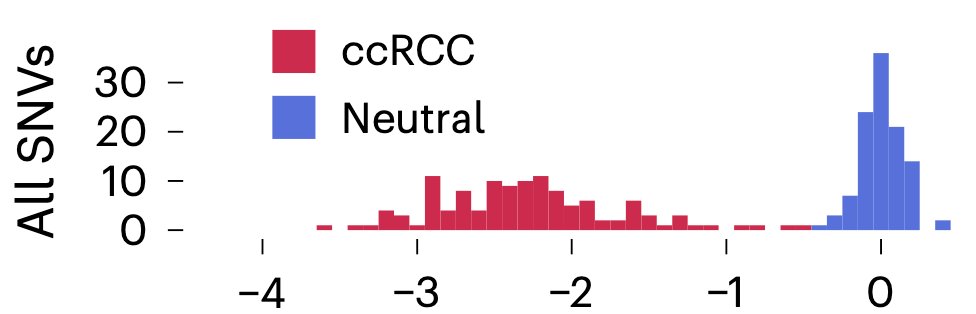
Importantly, we now split loss-of-function variants by SGE score into LOF1 (lowest) and LOF2 (depleted, weaker effect).
In collaboration w Athina Ganner and Freiburg colleagues, we show how patients with VHL disease can be stratified by ccRCC risk using these categories. (4/n)
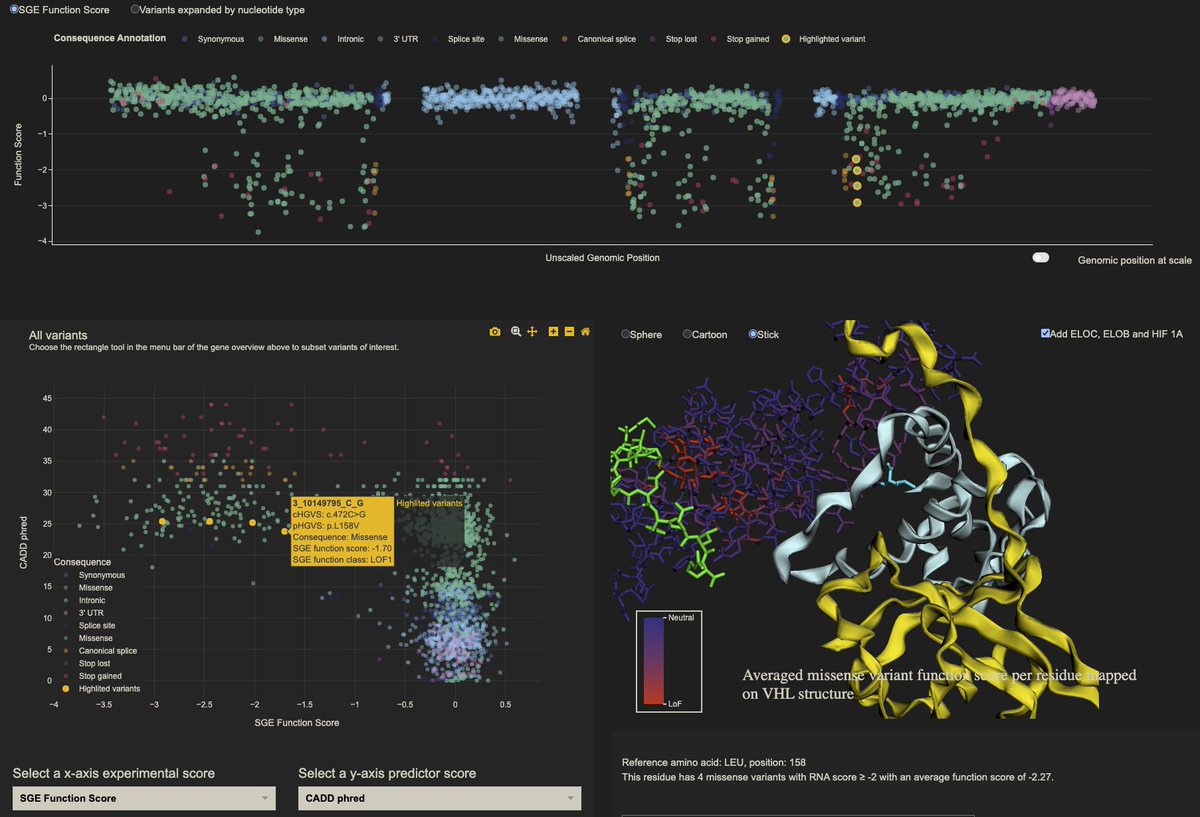
The VHL data can also be searched, visualised, and explored using this awesome SGE visualisation platform made by @ChloeTerwagne:
https://t.co/YEtNHhzcl4
Chloé’s code is all on GitHub if you’re interested in viewing and sharing your own data like this. (3/n)
Most importantly, all SGE scores and variant classifications are available for download in Supplementary Table 1 and from MAVEdb (https://t.co/v5CF8oJ9dw).
Given the data’s high precision, we expect this will lead to a steep reduction in VUS reported clinically. (2/n)