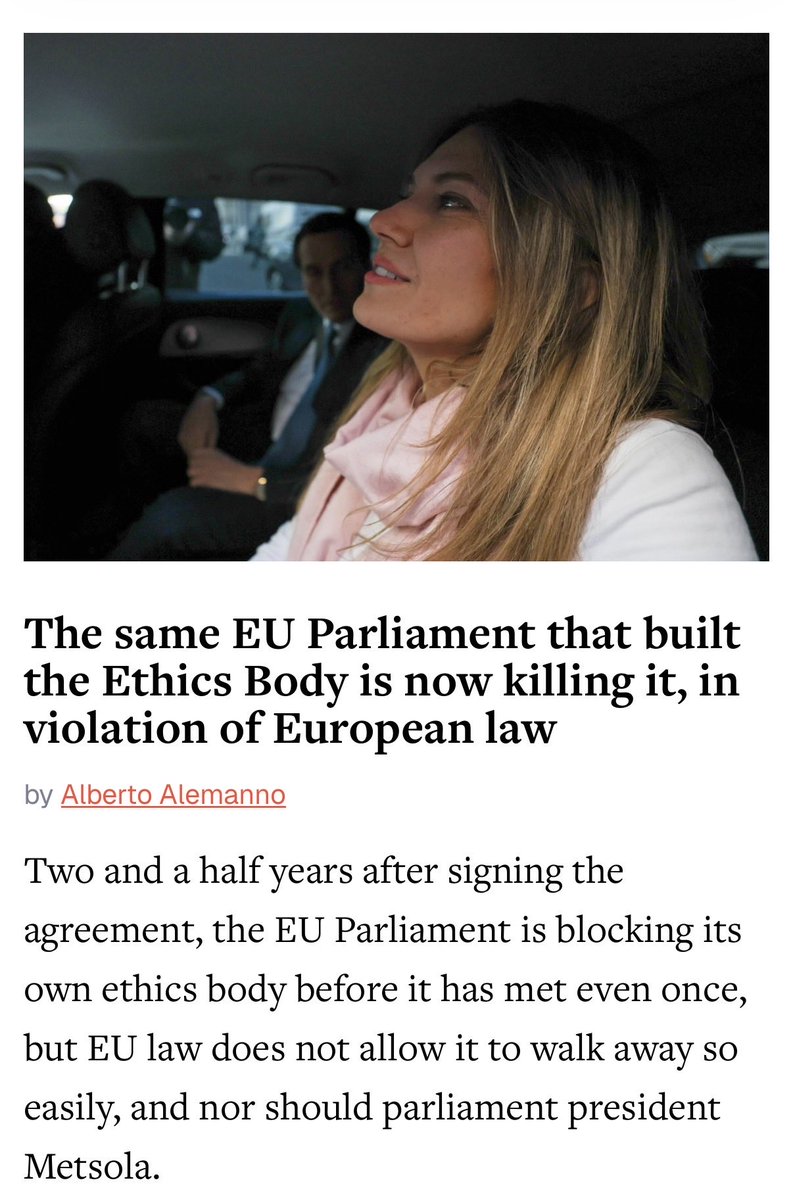
The EU has never been closer to having its first common Ethics Body, one set of integrity standards across its institutions. That would be the only true legacy of Qatargate.
Yet the European Parliament's right-wing majority, led by the @EPPGroup is stopping it from starting work.
Their strategy is to kill the body before it ever meets, quietly and away from public scrutiny.
But Parliament can't simply walk away from a legally binding interinstitutional agreement (Art. 295 TFEU) that its own plenary approved in 2024.
If its majority wants out, it must say so openly to its own voters, through a formal plenary decision. Killing it softly isn't an option.
This puts President @EP_President Metsola under the spotlight. Instead of letting her own political family, notably @vinczelorant & co., obstruct the agreement, she should make sure Parliament honours its commitments, or put withdrawal to a plenary vote.
The current EU Parliament’s slow-walking of this file risks breaching the agreement. The other signatories could formally call on Parliament to act and, if it doesn't, bring a failure-to-act case (under Article 265 TFEU) before the Court of Justice of the EU.
My full analysis in EUobserver https://t.co/oziSrI0A0l #EUCO @vonderleyen@EP_Legal@daniel_freund@europeangreens
European leaders gathering in Dublin to discuss breaking free from US tech dependence, on the very day a Microsoft outage locks them out of their own email
The irony is deafening.
Extraordinary times or the new normal?
After the 21-hour Microsoft glitch, now it’s the airspace:
ALL flights have been grounded across the US since.
https://t.co/Qa0pcnpwiN
The more I see polls suggesting that the French presidential election is already crystallising into a Le Pen–Mélenchon contest, the more I expect a surprise candidate to emerge.
And if I had to bet on one name, it would be… Christine @Lagarde
Delighted to debunk your debut
1. EU primacy is in Declaration 17 to Lisbon, and in the acquis when the Polish Parliament ratified EU accession in 2004. Primacy stems
also from Art. 91(3) of Poland's own Constitution.
2. The German Constitutional Court defied the CJEU in 2020 and no one called it a rule-of-law breach, because Karlsruhe is lawfully composed.
Warsaw's Tribunal isn't, per Strasbourg (2021) and Luxembourg (2025) judgments.
The coup was 2015. The rest is conspiracy #Poland
Part of Poland's elite keeps treating PiS and Tusk as two sides of the same coin. They are not.
PiS captured the courts and public media. Tusk set out to restore their independence.
How he is doing it is open to fair criticism. Methods matter, and some of his have been rough. But the aim is not up for debate.
Independent courts and free media are not one party's agenda. They are the precondition for democratic life to work again, and EU law requires them.
Treating the arsonist and the firefighter alike because the firefighter broke a window serves only those who lit the 🔥 #Poland
Let me get this straight:
The Tusk government should continue restoring the Constitutional Tribunal.
It should do so through transparent, publicly defensible procedures anchored in European judgments; better communicate the rationale of its actions; and invite independent scrutiny of its methods rather than resist it.
The test is not whether Poland can free its Tribunal from those who captured it. It is whether it can build one that is also independent of the government now committed to repairing it.
Redemocratisation means restoring the rule of law, not swapping one form of political control for another.
READ my latest for EUobserver https://t.co/SS5nnefMc4
Is the solution to the Polish Tribunal Stand-off as simple as @donaldtusk argues?
He got the law on his side, but the Friday’s actions and identity of some
the newly elected judges may have complicated things.
#Poland
Let me get this straight:
Poland is legally obliged to have an independent constitutional court, and anyone blocking the new legally appointed judges is not defending the law, but going against it.
We can question the methods used by the Tusk-led government but not its mission, which is required by the law (Polish and EU)?
https://t.co/ECvXvdetPb
Poland's Constitutional Tribunal stand-off raises a question that reaches well beyond Poland:
How can a constitutional democracy restore institutions dismantled from within, using the very procedures and authorities meant to protect them?
My latest on European Question Time 👇
https://t.co/ECvXvdf1EJ
#Poland #RuleOfLaw #EUlaw #EuropeanDemocracy
The losers are also corrupt (that's why they lost big to @magyarpeterMP):
💰Three of Viktor Orbán’s former ministers are already in custody over alleged corruption.
Sums involved: Seszták €30m; Hankó €47m; the wider Matolcsy/Hungarian National Bank scandal €1.37bn.
Seszták allegedly kept HUF 9bn (€24m) in cash in safes at home and hid it before his arrest. @panyiszabolcs reports
When you decided to join the EU, you accepted to abide by commonly-agreed rules:
- judicial independence
- media fredom
If you depart from them, you affect all other member states and therefore must back up.
Btw if you can always leave the EU, any time - instead of weakening it from within #EUCO @eucopresident
The ultimate test is whether Poland can regain a constitutional court independent of both the government that captured it and the government now seeking to fix it.
The methods chosen to restore the rule of law in Poland must be judged on their legality.
But the duty to restore judicial independence is - and should not be - up for debate.
Read my latest @Substack https://t.co/9x39002q4N
There’s a lot of confusion around Poland’s Constitutional Tribunal crisis.
Here’s what you must know:
1. The Polish Constitutional Tribunal is not a lawful court
The CJEU has ruled that it is not a tribunal previously established by law, owing to serious irregularities in the appointment of three judges and its President (C-448/23, 18 Dec 2025). The ECtHR (Xero Flor v Poland, 2021) and the Venice Commission reached the same conclusion.
2. Restoring judicial independence is a legal obligation, not Tusk's caprice
Articles 2 and 19(1) TEU require every Member State to guarantee independent courts, because: (i) National courts are part of the EU’s system of judicial protection, (ii) their decisions affect all Europeans. The President’s refusal to receive the oaths of four of the six judges elected by the Sejm in March 2026, and the Tribunal leadership’s refusal to let them sit, prompted an ECtHR interim measure in May requiring that nothing hinder them from taking up and exercising their functions.
3. EU law offers no blueprint, but the Commission and the EU courts can check the chosen methods
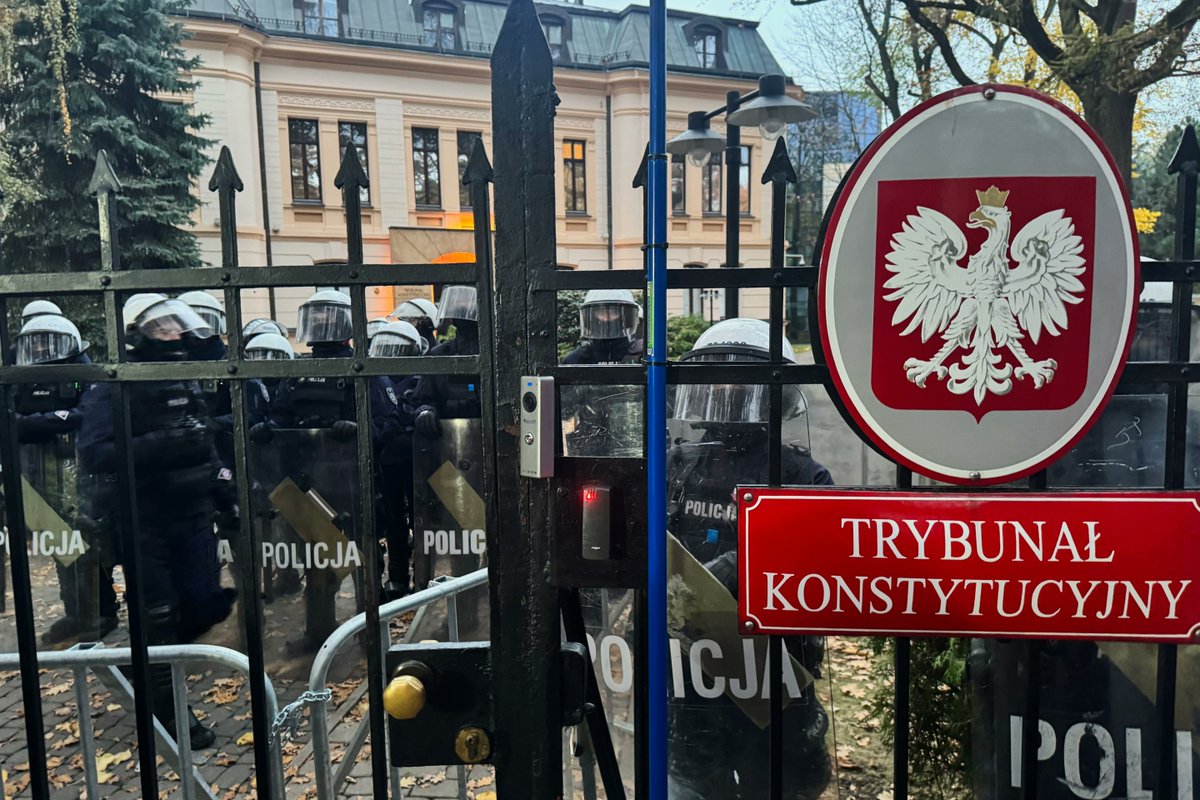
Appointing Maciej Berek, a minister until weeks earlier and Tusk’s “right-hand man”, to the bench contradicts the government’s pledge to depoliticise the Tribunal. The Friday suspension of the Tribunal’s president and vice-president, ordered by one judge and accompanied by a police presence outside the building, is not in itself a “coup”: the stated aim is to restore a lawfully functioning court. But restoring the rule of law must itself be done lawfully.
4. The EU has weakened its own leverage.
In February 2024, it released up to €137bn in suspended funds on the strength of promises, before durable change was secured. What the EU could do is to reopen an Article 7 TEU procedure against Poland.
5. No: this is not a two-sided, symmetrical dispute
If the Polish government is trying to repair an institution captured under PiS, its opposition is striving to retain some control through illegal means.
Bottom line: restoring judicial independence is a legal duty, and the methods chosen by the Polish government deserve scrutiny. Equating the two sides, or reading that scrutiny as opposition to restoring the Tribunal, is, therefore, deeply misleading.
Not really.
“Restoring the rule of law” is exactly what the EU and its Member States expect from the Tusk’s government, in line with the judgments of the Court of Justice.
To dismiss this as “an exceptionally effective piece of political messaging” is legally inaccurate.
This is not to condone the Tusk’s methods to attain that objective.
CC @EUCssrMcGrath@EUCourtPress Venice Commission @ProfPech@RULEOFLAWpl@ourruleoflaw_eu
The students’ electoral win in Serbia is the most powerful warning from Europe’s angry youth today, but also a test case to solidify in a governing force
#serbiaelections#Serbia
https://t.co/ceSkz5kxx8