Jim Bianco @biancoresearch on A.I. Capitalization and it's Future Role:
"So will it meet that promise that it's going to fundamentally change the way we interact with data through software in a computer? If it does, it's not overdone."
Full interview: https://t.co/RDB8y21ctr
Limited supply means incremental demand is met with higher prices – leading to better total returns; lower losses from severe weather lowers the risk of CAT bonds having their loss triggers hit.
@SamuelRines: Macro Strategist at WisdomTree and contributor to Arbor Data Science
According to its latest annual report, @SocialSecurity can pay 100% of scheduled benefits through 4Q2032, one quarter earlier than projected last year … by 2033, with estimated $0.18 trillion in funds remaining, the program would be able to cover only 78% of benefits
@DataArbor
The total holdings of the two funds that comprise social security, the Old-Age and Survivors Insurance trust fund and the Disability Insurance trust fund, peaked at $2.91 trillion in 2020. Recent projections estimate that these two funds will hold only $0.18 trillion by 2033.
According to @UScensusbureau population estimates, there were 39 million children between the ages of 0-9 in 2025, lowest count for any age group under 70
@DataArbor
2/2
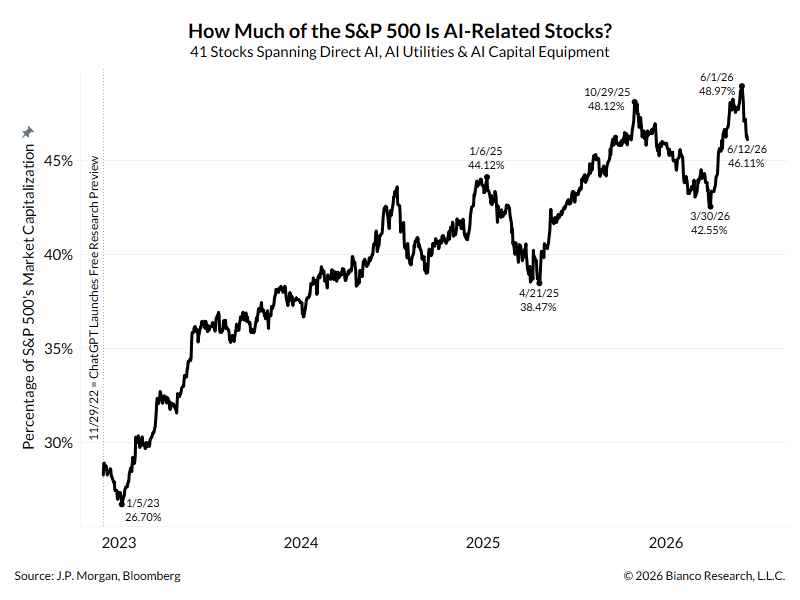
At their peak last week, AI stocks were 49% of the S&P 500 (chart).
This is the most concentrated the stock market has been on a single theme since the railroad stocks of the late 19th century. Higher when SpaceX, Anthropic, and OpenAI are added, after they are all public.
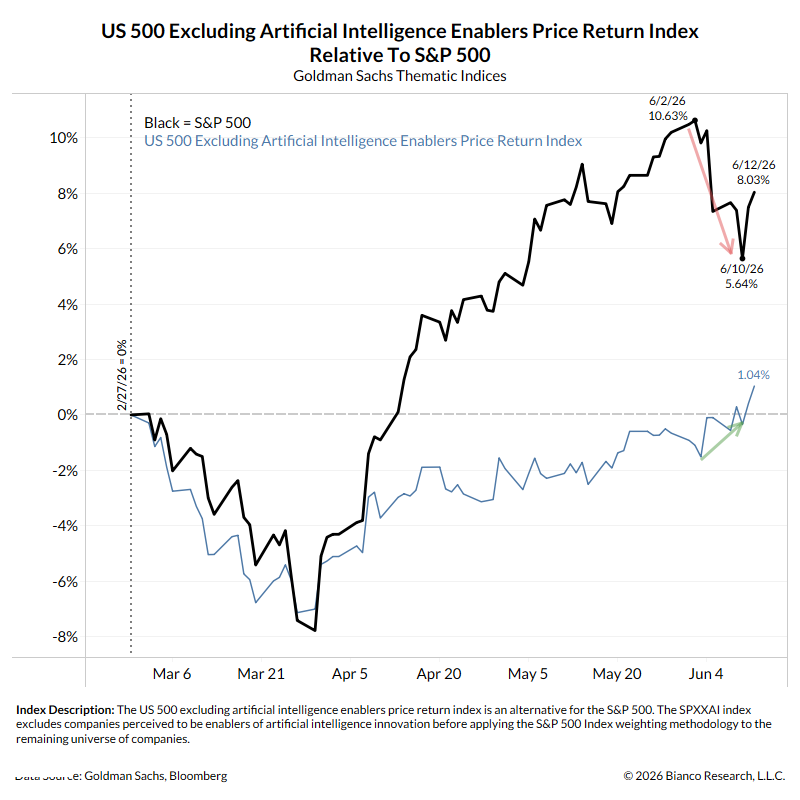
Given this historic concentration, and AI and non-AI stocks are moving opposite each other (above), is the stock market effectively two asset classes
* AI
* Everything Else
1/2
Since the War began on Feb 28:
The S&P 500 (black) is up 8.03%
The 500 stocks WITHOUT AI-related stocks (blue) are up just 1.04%.
Between June 2 and June 10
The S&P 500 corrected ~4.5% (red arrow)
The 500 stocks WITHOUT AI-related stocks ROSE (green arrow).
Consumers cited avoiding foreclosure/eviction as top reason for taking a 401(k) hardship withdrawal, followed by medical expenses and tuition
@DataArbor
No matter what your local politician says, taxes and inflation were the two most important issues facing small businesses in May 2026. Each issue had approximately 20% of respondents stating that it was their single most important problem during the month.
Since the War began on Feb 27th, the S&P 500 (black) is up 7.34%. But the S&P 500 without AI stocks (blue) is effectively unchanged. So, the entire S&P 500 Index rally since February has been driven by AI stocks.
But look at what happened on Friday, June 5th!
The S&P 500 was down 2.6%, its biggest daily loss since last October.
The S&P 500 without AI was up 0.02% (call it unchanged).
So, the entire sell-off on Friday was AI stocks. The "normal world" did nothing on Friday.
U.S. large cap ETF flows continued to dominate for a fifth consecutive week with largest inflows for week ending 6/5/26; consumer cyclical sectors saw largest outflows
@DataArbor
According to Vanguard, the two biggest reasons that consumers took 401(k) hardship withdrawals were to avoid foreclosure/eviction and to pay off medical expenses.
Since start of Iran war, just 29 oil tankers have successfully navigated (escaped) out of Strait of Hormuz while 80 still remained trapped in Persian Gulf
@DataArbor