@dadrabbot@dotkrueger@clinkie44@saylor I didn't expect Saylor to start retweeting Ethereum DeFi protocols and telling people that Strategy makes Bitcoin into money, so that makes two of us with losing bingo cards
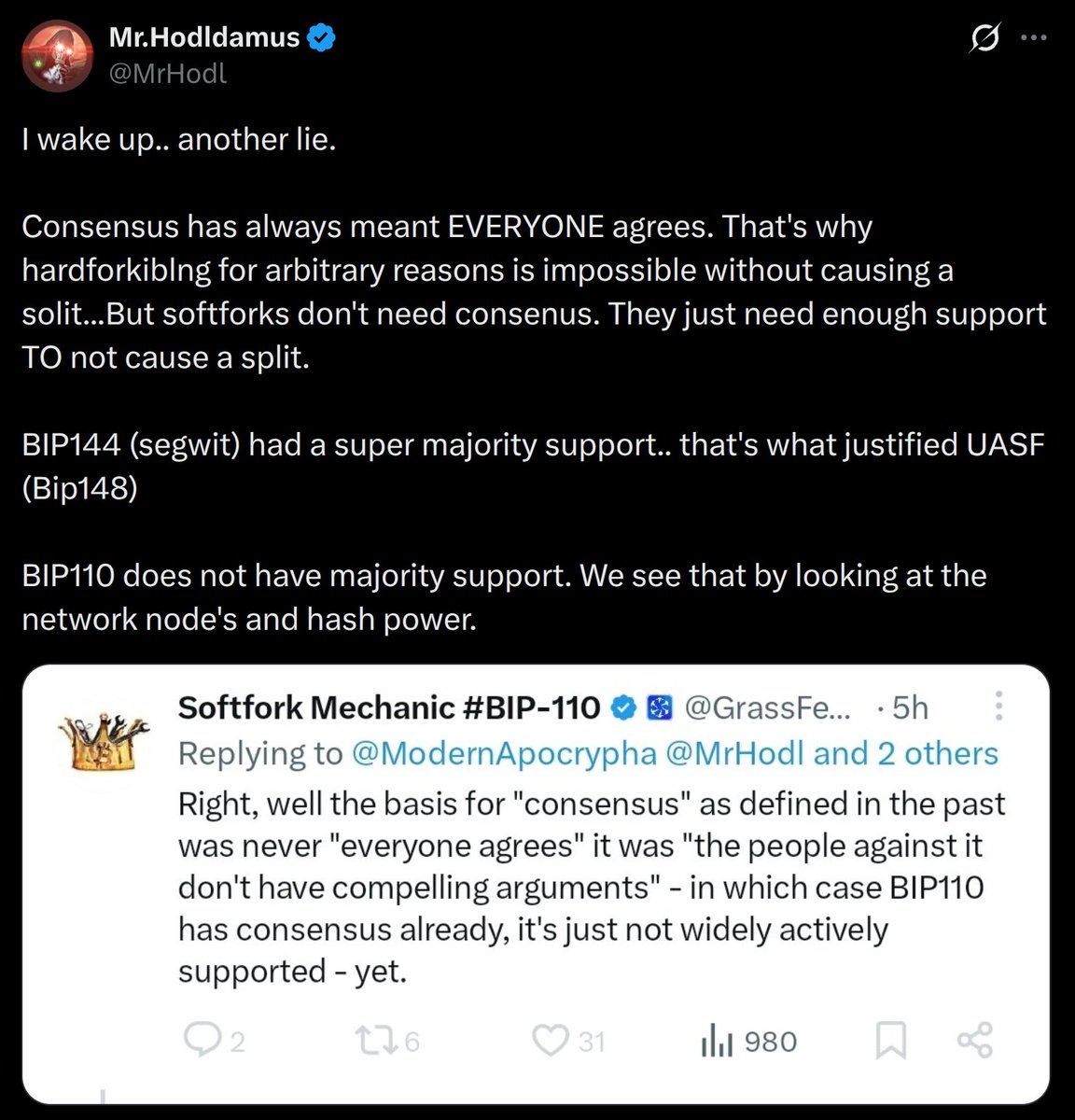
BIP110 has enough support to not cause a split @MrHodl
Is there a risk anyway? Sure. BIP148 supporters accepted the exact same risk.
You are clutching at straws trying to come up with a rationalization for why BIP148 was OK and BIP110 isn't.
They're both minority softforks and neither of them had consensus.
It you want justification where one is NOT REQUIRED for the risk you're pretending only applies to BIP110 then Core 30 is that justification.
But the reality is that it does not even need a justification because it is already just by virtue of making Bitcoin self evidently better and the critiques against it all being lazy smears rather than substantive arguments.
IMO the issue isn't whether uncapping OP_RETURN technically reduces one specific workaround.
It's that Core, with that change, announces a clear philosophical shift away from the long-standing stance that Bitcoin is money first, and keep it as simple/unfuckable as possible, not lower friction for non-monetary payloads just because a grifting minority already found ways to do it anyways.
The old default policy (80 bytes) was a clear signal: "this isn't a subsidized database."
Changing it in v30 normalizes and standardizes non-money use in the reference implementation. That's not neutral harm reduction, it's a clear pivot. It invites more boundary-pushing, makes it easier for newcomers/grifters to justify "but Core allows it," and adds very predictable social-layer infighting (which we’re seeing right now).
You say my points repeat "false narratives" debunked over 1000s of hours. That doesn’t address the philosophical shift at all.
Of course that feels like handwaving and appeal to technical authority. If this shift can’t be solidly explained and justified in layman’s (pleb) terms, then that’s a red flag to me.
Why not keep resisting accommodation for data embedding instead of facilitating it?
The backlash against core is a good faith immune response by people who care a lot and are not talking some VC narrative. It is the voice of maxis/plebs defending the ethos that drew most of us in.
Core can push changes, but the community can (and will) push back hard when it smells like erosion of first principles.
@MartyBent Reminds me of these 31 spooks signing a statement to continually adapt the 'reference' implementation to the whims of shitcoiners on Bitcoin.
https://t.co/EjrCFfQzKb
People need to stop trying to dress up attacks on Bitcoin as "debates". That implies there are two legitimate "sides".
There is no "debate" around OP_RETURN. There is an attack, and it must be fought.
Which seems insanely risky from their perspective.
If I'm mining invalid blocks per BIP-110 rules in a scenario where BIP-110 blocks exist then it seems obvious that one day my blocks will all be disposed of.
They cannot insta-sell either to insulate themselves from erased coinbase rewards because they have the 100 block cool-down (not to mention ramifications of defrauding some exchange) while moving at a slower speed than normal to boot having lost some % of the hashrate to the other side.
I'm constantly second guessing myself thinking I have to be wrong somehow but...I just don't see it.
Minority soft forks are a thing in Bitcoin and the opposition either needs to show up with a real reason for us to abandon it or they're just playing a confidence game hoping people don't understand the power their nodes have.
Mechanic banned from r/Bitcoin for referring to bip110 miner signaling.
The very same people framing individual node operator policy as censorship, are fully censoring any mention of bip110.
That signals two things: hypocrisy and weakness
I’d be happy to have the conversation.
It doesn’t even have to be a debate; you can simply critique my perspective.
I’m here to share what I believe to be true.
If you think I’m wrong about anything, I’m always happy to update my understanding.
I don’t care about popularity.
I only care about accuracy.
We’ve met before.
I’m happy to share my views, receive pushback, and help move people closer to the truth.
And, respectfully, while I know your prior work was quoted in the Bitcoin white paper, you said you were playing catch up on Bitcoin in 2013.
I draw much of my analysis from being around some of the Bitcoin developers in 2011 and from being a shareholder in more than 100 Bitcoin companies since the early days.
As you may remember, and for full transparency, I even tried to invest in Blockstream, but the company ultimately became dominated by venture capital and financial-industrial-complex interests, and your board declined my investment.
I also believe Blockstream took Epstein-connected funding through Brock Pierce, who later sold his shares, as you publicly confirmed recently.
Care to push the conversation forward respectfully, Adam?
They hate Luke for continuously showing them mirror, since 2023. The below post is from 2025.
This is how long the conversation has been going on. There's no reasoning with Core or their apologists.
RDTS/BIP-110 is all but rushed.
Don't allow those banking cartel minions to highjack Bitocoin. Defend Bitcoin to remain money.
Run latest Bitcoin Knots node with RDTS/BIP-110.
Yes, this is the pattern that we've seen with 90%+ of the Bitcoin influencers class (many of whom I've looked up to) this past year...it's very revealing.
1. They remain silent on the spam issue and Timechain bloat issue, even though they know deep down that it's a problem and they hate it
2. They remain silent because they're all buddies with Core™ devs and their sponsors want ever more arbitrary data on Bitcoin. They won't support solutions like Knots and/or BIP-110 because that might put them at odds against their friends or sponsors
3. When you ask them, 'yo why aren't you speaking up?', they'll dodge the question and sweep it under the rug
4. When you press them further, they'll finally snap and say they've done more for Bitcoin in the past than you plebs ever will
I'm past being angry, I've fully arrived at acceptance/disappointment that this is who these people really are.
Slay your heroes.
Hi Greg, you refuse to talk on Twitter and I refuse to talk on Reddit (this is the more reasonable venue as most of what I post on Reddit just gets immediately deleted so screw you for even continuing to use it.)
At present there are 0 UTXOs in existence that would be rendered unspendable by the activation of BIP-110.
Not "almost zero". Literally zero.
There are contrived conditions where you could have committed to something where a UTXO must be created in a specific way that cannot occur until blockheight X that results in someone creating it during the relevant time period that *would* render it unspendable temporarily.
For that to be the case it must also have no key path available, *and*
1. Have > 128 leaves and thus too large a control block, and/or
2. Contain OP_(not)IF/OP_SUCCESS
The chances of someone accidentally ending up in this situation is beyond laughable. They're somehow one of the most advanced users of Taproot and unaware of incoming rules being enforced by an implementation run by >20% of the network.
Further still - if someone ends up unwittingly making such a UTXO then they simply won't be able to spend it until Sept 2027, unlike with other permanent soft forks where if you generate an unspendable UTXO, it becomes *permanently* unspendable.
Amusing how no one cares if I generate a UTXO that CTV/CSFS/CAT etc would render unspendable were it to activate, where it would become so again, permanently rather than temporarily in some absurdly contrived scenario where the person "affected" intentionally self-impaled in an effort to frivolously obstruct as you have been doing for months.
The trolling about confiscation is a result of the fact that we are no longer a serious space. Standards around confiscation, governance, processes, moderation, hiring, grants, PR approval, venues for discussion, forks etc are invoked for political reasons and selectively enforced as @hodlonaut and others have demonstrated beyond reasonable doubt.
That water clarity is an engineering decision, and the math behind it is wilder than the video.
Roman aqueducts ran on gravity alone. No pumps, no pressure systems. Engineers carved channels with a gradient so shallow it borders on absurd. The Pont du Gard in southern France drops 2.5 centimeters over 275 meters. That's roughly the thickness of a coin over the length of three football fields. They surveyed that accuracy with plumb lines and wooden leveling instruments.
The clarity you're seeing is a direct product of flow velocity. Too steep and the water erodes the channel walls, picks up sediment, turns brown. Too flat and it stagnates. Roman engineers targeted a slope of about 20 centimeters per kilometer, which kept the water moving fast enough to stay fresh but slow enough to stay clear. Before the water reached the city, it passed through multi-chamber settling tanks where velocity dropped near zero. Suspended particles sank. Clean water flowed out the top into the next chamber. Repeat three or four times.
Pliny specified the minimum slope in writing. Vitruvius published the exact mortar ratio for hydraulic cement: one part lime to two parts volcanic ash for underwater work. The pozzolana from Pozzuoli reacted with water to form a calcium-aluminum-silicate compound that actually gets stronger the longer it sits submerged. Modern concrete degrades in water. Roman concrete bonds with it.
Scale the whole system and it gets harder to process. Eleven aqueducts fed Rome at its peak. Combined output: roughly 1 million cubic meters of water per day. That works out to about 250 gallons per person for a city of one million. Modern New York delivers about 125 gallons per person per day. Ancient Rome had access to double the per capita water supply of the largest city in the United States, running entirely on slope and stone.
The Trevi Fountain in Rome is still fed by one of them. Two thousand years, same source, same gravity, same water.