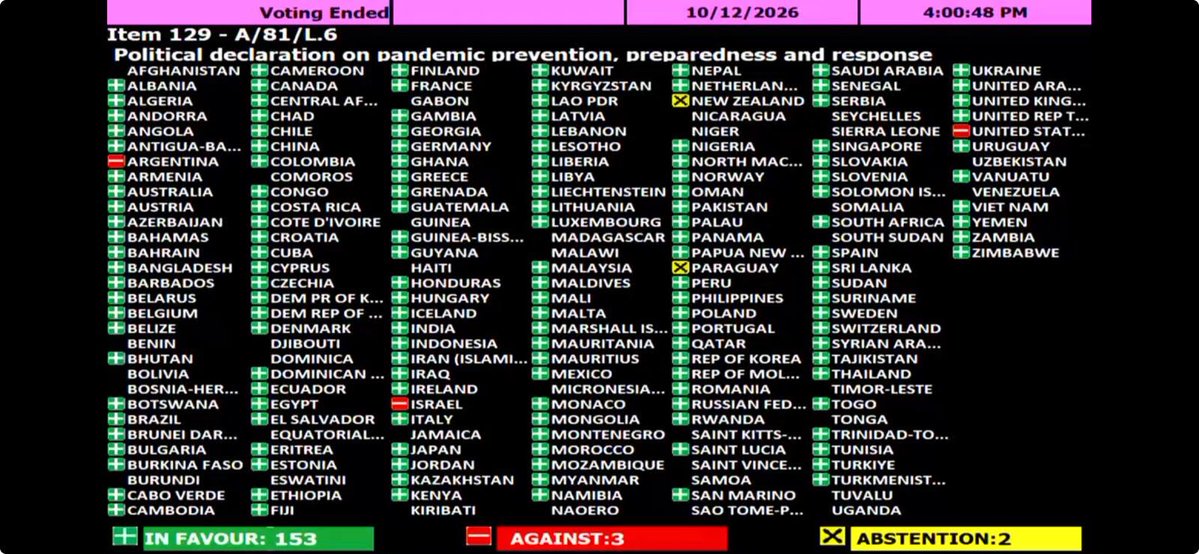
👏The UNGA has adopted the Political Declaration on #PPPR. 153 for, 3 against, 2 abstaining.
"Which political leaders will now step forward to turn that urgency into policy change & investment in countries and regions?"
Friends of the HLM on PPPR: https://t.co/p0hlhDWsaT
In 2024, I investigated why Biden Admin had slow-walked response to #H5N1 outbreak in dairy cows. The answer: @USDA let farmers not test cows, at dairy lobby's behest.
https://t.co/a4812ZzbIN
Strong 🧵on evolution of H5N1 risks: "This should have ended 2 years ago." 👇
The @UN has adopted a political declaration on pandemic preparedness, with 153 countries voting in favor.
Only the US, Israel and Argentina opposed it, while New Zealand and Paraguay abstained.
📰➡️https://t.co/BkyHyE3gur
✍️Sophia Samantaroy
@UN@WHO@WTO@IFPMA@TheIndPanel@DrTedros@HelenClarkNZ
The UN General Assembly adopted a political declaration on pandemic prevention, preparedness and response.
The non-binding declaration calls for stronger international cooperation to prevent and respond to future pandemics.
https://t.co/NFVD40zZpz
The Elders welcome the official adoption by the UN General Assembly of the Political Declaration on PPPR.
Leaders must now act to turn words and commitments into action.
@TheIndPanel@HelenClarkNZ
The UN General Assembly has adopted a political declaration on pandemic prevention, preparedness and response, which calls for stronger international cooperation.
✅️ 153 in favor
❌ 3 against (USA, Israel, Argentina)
🚫 2 abstentions (Paraguay, New Zealand)
.@WHO welcomes the adoption of the #UNGA Political Declaration on Pandemic Prevention, Preparedness and Response, and commends co-facilitators Armenia and Rwanda for their leadership in building consensus. This important milestone reflects a shared commitment to equity, global solidarity and collective action to make the world safer from future pandemics. We also welcome the ambition to successfully conclude negotiations on the Pathogen Access and Benefit Sharing Annex.
https://t.co/9diIQeJifh
Last Friday, the 2nd of October, the first media reports emerged of a suspected case of pneumonic plague in a laboratory worker at the Irkutsk Antiplague Research Institute in the Russian Federation.
The lab worker died after being hospitalized with severe pneumonia. Initial media reports suggested pneumonic plague following an accidental lab exposure.
@WHO is aware that the Russian government held a meeting on the 2nd of October because they suspected a resident of the Irkutsk oblast had contracted a dangerous infection.
On Saturday, WHO asked the Russian Federation for more information, in accordance with the International Health Regulations.
On Tuesday, the Russian Federation responded, saying that no case of plague had recently been reported in the Irkutsk oblast, and that they had placed about 200 contacts in quarantine.
However, WHO has requested further information on the laboratory tests conducted on the individual who died and the contacts, more detail on what prompted the public health measures, and details about the health status of the contacts.
We have also sought verification of media reports of a second employee with pneumonia of undetermined cause.
WHO has offered technical support related to plague and lab biosafety and biosecurity.
As we don’t yet have the full picture of this event, we are not able to conduct a full risk assessment.
Timely, complete and transparent information sharing under the International Health Regulations is essential to clarify conflicting reports and enable an accurate assessment of potential public health risks.
A new early-stage trial assessing @UniofOxford's Bundibugyo ebolavirus vaccine candidate has launched in Uganda.
The CEPI-funded study is being conducted by @MRC_Uganda with the @OxfordVacGroup and @PSIOxford and @SerumInstIndia manufacturing doses: https://t.co/1LanTcspQs
The Ebola Transit Centre in Kigonze camp was staffed by committed Congolese professionals. It is disappointing that it burnt down despite being in a secured area. The dispersal of the 19,000 camp inhabitants also complicates humanitarian response.
https://t.co/OFKL2zRh6M
The next pandemic threat will not wait for negotiations.
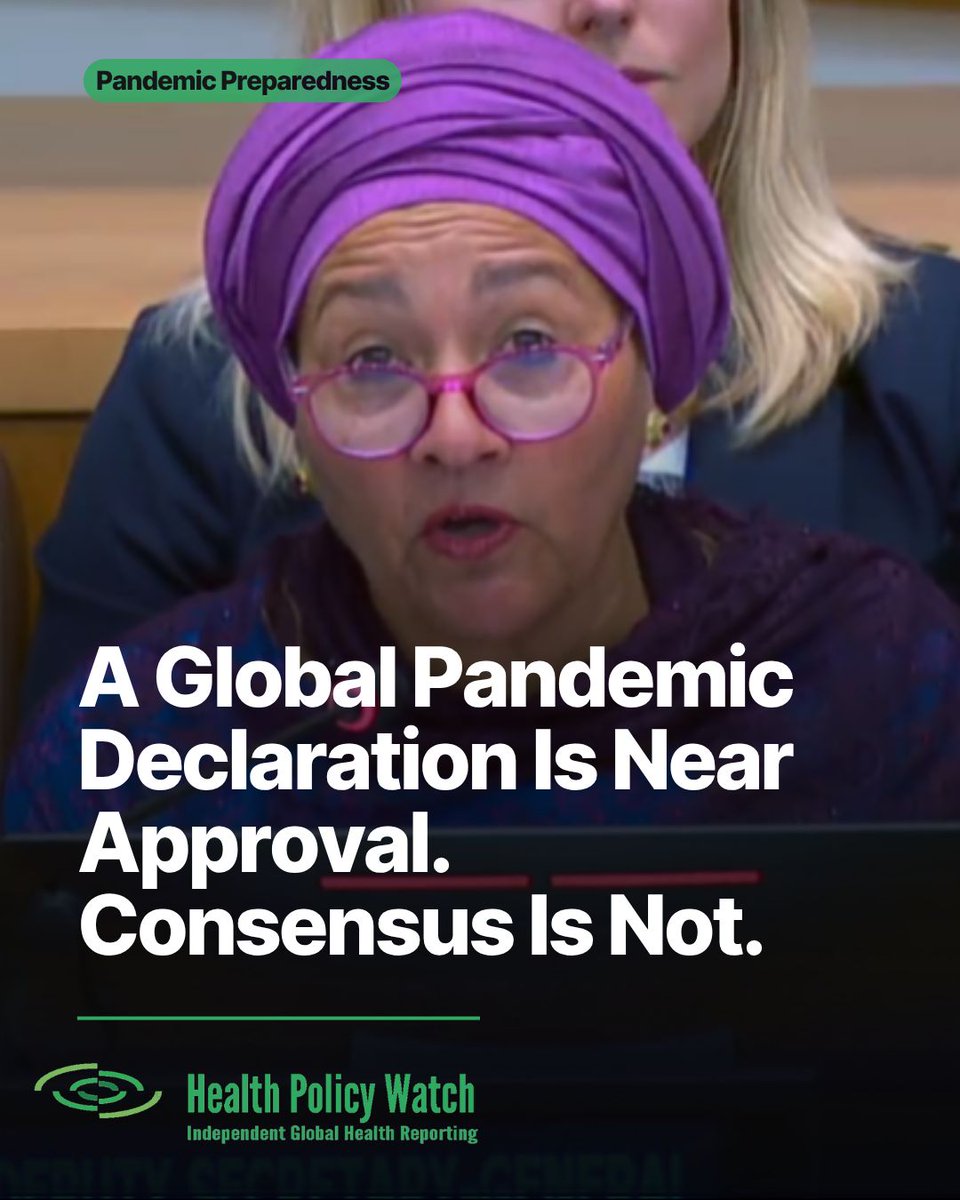
With the UN declaration delayed & the PABS agreement unfinished, governments face renewed pressure to turn pandemic preparedness commitments into action.
✍️ @RFletch1979@TheIndPanel@DNDi@AminaJMohammed@HelenClarkNZ
“We must act together in order to prepare for future pandemics.”
@DenisMukwege underlined the importance of multilateralism at the High-Level Meeting on Pandemic Prevention, Preparedness and Response at UNGA 2026.
https://t.co/B5CXpy4zfb
Pandemic preparedness is prevention. So why isn’t it treated with the same urgency as other global threats?
“They invest a ton of money in defense. Defense is prevention. The word defense means that you are really investing in preparedness for some possible threat in the future. That's what we're talking about when we're talking about preparedness for pandemics.”
Wafaa El-Sadr and @MauricioCard discuss during the recent @ColumbiaIGP event: How Do We Prevent Future Health Emergencies and Pandemics ➡️ https://t.co/RIdurA2DyM
@TheIndPanel@iCAP_ColumbiaU@ColumbiaSIPA
4/4
My latest for Bloomberg looks at the wider health consequences of an epidemic that is disrupting basic medical care for millions of people in eastern Congo:
🎁🔗👇
https://t.co/rflUNxqKgI
‘Biggest thing that needs to be said is that the #PABS Annex issues need to be resolved and it needs political leadership! Now is the time for leaders to start including themselves – @HelenClarkNZ, on getting past political impasses to treat #PandemicPPR as a global public good.