Introducing The Content and Story Matrix:
The Content and Story Matrix is a 2×2 framework that classifies movies and creative works by balancing message-driven purpose against story-driven experience on one axis, and traditional/cultural values vs progressive/universal values on the other.
A creative work is classified as one of the following:
🔹Foundation-Based
🔹Culture-Infused
🔹World-Centric
🔹Entertainment-Driven
TCSM is an AI powered framework for the 21st century to evaluate and understand creative works through purpose and objective elements. Designed for consumers, creators, and platforms.
A thread 🧵: 1/4
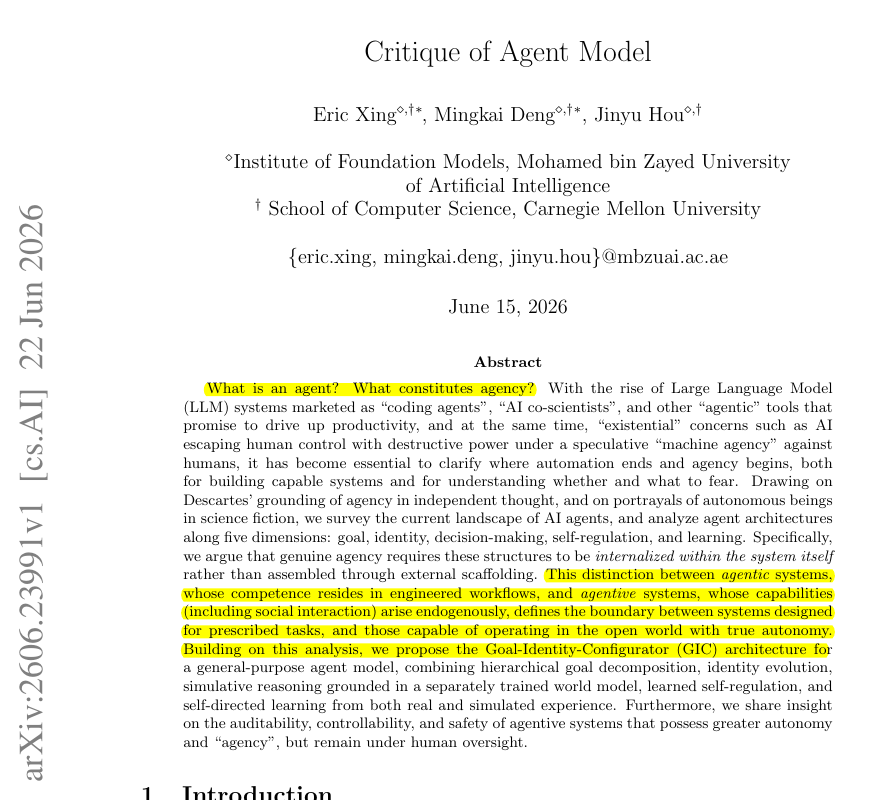
This paper pushes back on the habit of calling every capable AI system an “agent” and asks the cleaner question: what makes something an agent in the 1st place?
Explains why today’s AI agents are mostly clever tools, not truly independent agents.
The problem is that many systems called agents are really advanced workflows around LLMs, not independent actors.
Complex behavior is not the same as self-directed behavior.
A chess engine can crush a grandmaster without wanting anything, and a browser agent can complete a task without maintaining a durable sense of what it is, what it can do, or why this task matters beyond the current instruction.
They can call tools, follow steps, and complete useful tasks, but their goals, roles, limits, and update cycles still mostly come from humans.
The paper’s core idea is to separate "agentic AI" from "agentive AI", where agentic means it looks autonomous and agentive means its agency comes from inside the system.
The authors propose the Goal-Identity-Configurator model, where an AI keeps long-term goals, updates its sense of itself, predicts possible outcomes, decides how much to think, and learns from real and simulated experience.
They do not mainly test a finished system, but build an argument and architecture for what real machine agency would require.
----
Link – arxiv. org/abs/2606.23991
Title: "Critique of Agent Model"
I think you still need both, but the main lede is: technical founders now have access to business thinking
Business founders now have access to technical thinking
Net net: more startups that actually work, period
🚨WOW!!!
Tim Sparks has confirmed he purchased 80 PIZZA HUTS and brought back EVERYTHING that made them iconic!
Pac-Man is back.
Salad bar is back.
Red cups are back.
Booths for families.
"I want to rebuild places for families to connect and put their phones down..."
@FarabaughFB At the end of the day, Howard needed real competition. Rogers and Rudolph are both veterans, neither are the future. Drafting Allar will make Howard a better player simply by giving him an "equal" to compete against. Period.
I love this. Andrej Karpathy’s wiki-style approach to personal knowledge is genuinely useful .
But even great wikis have a quiet limitation: when you synthesize a lot of material, important nuance and precision tend to get smoothed over or lost.
Any solutions to this yet?
Grok 4.3 - HUGE improvement, now with native document generation .docx, .xlsx, etc.
But if you are struggling with large, uploaded documents, on https://t.co/3IADvs3Fe4 being truncated or parsing incorrectly, try this prompt: 👇
I love this. Andrej Karpathy’s wiki-style approach to personal knowledge is genuinely useful .
But even great wikis have a quiet limitation: when you synthesize a lot of material, important nuance and precision tend to get smoothed over or lost.
Any solutions to this yet?
LLM Knowledge Bases
Something I'm finding very useful recently: using LLMs to build personal knowledge bases for various topics of research interest. In this way, a large fraction of my recent token throughput is going less into manipulating code, and more into manipulating knowledge (stored as markdown and images). The latest LLMs are quite good at it. So:
Data ingest:
I index source documents (articles, papers, repos, datasets, images, etc.) into a raw/ directory, then I use an LLM to incrementally "compile" a wiki, which is just a collection of .md files in a directory structure. The wiki includes summaries of all the data in raw/, backlinks, and then it categorizes data into concepts, writes articles for them, and links them all. To convert web articles into .md files I like to use the Obsidian Web Clipper extension, and then I also use a hotkey to download all the related images to local so that my LLM can easily reference them.
IDE:
I use Obsidian as the IDE "frontend" where I can view the raw data, the the compiled wiki, and the derived visualizations. Important to note that the LLM writes and maintains all of the data of the wiki, I rarely touch it directly. I've played with a few Obsidian plugins to render and view data in other ways (e.g. Marp for slides).
Q&A:
Where things get interesting is that once your wiki is big enough (e.g. mine on some recent research is ~100 articles and ~400K words), you can ask your LLM agent all kinds of complex questions against the wiki, and it will go off, research the answers, etc. I thought I had to reach for fancy RAG, but the LLM has been pretty good about auto-maintaining index files and brief summaries of all the documents and it reads all the important related data fairly easily at this ~small scale.
Output:
Instead of getting answers in text/terminal, I like to have it render markdown files for me, or slide shows (Marp format), or matplotlib images, all of which I then view again in Obsidian. You can imagine many other visual output formats depending on the query. Often, I end up "filing" the outputs back into the wiki to enhance it for further queries. So my own explorations and queries always "add up" in the knowledge base.
Linting:
I've run some LLM "health checks" over the wiki to e.g. find inconsistent data, impute missing data (with web searchers), find interesting connections for new article candidates, etc., to incrementally clean up the wiki and enhance its overall data integrity. The LLMs are quite good at suggesting further questions to ask and look into.
Extra tools:
I find myself developing additional tools to process the data, e.g. I vibe coded a small and naive search engine over the wiki, which I both use directly (in a web ui), but more often I want to hand it off to an LLM via CLI as a tool for larger queries.
Further explorations:
As the repo grows, the natural desire is to also think about synthetic data generation + finetuning to have your LLM "know" the data in its weights instead of just context windows.
TLDR: raw data from a given number of sources is collected, then compiled by an LLM into a .md wiki, then operated on by various CLIs by the LLM to do Q&A and to incrementally enhance the wiki, and all of it viewable in Obsidian. You rarely ever write or edit the wiki manually, it's the domain of the LLM. I think there is room here for an incredible new product instead of a hacky collection of scripts.
Grok 4.3 - HUGE improvement, now with native document generation .docx, .xlsx, etc.
But if you are struggling with large, uploaded documents, on https://t.co/3IADvs3Fe4 being truncated or parsing incorrectly, try this prompt: 👇
Anytime you upload a document into the chat, you should ask if any part of that file has been truncated. You'd be surprised how often you working with incomplete data sources.
How to save Paramount and Warner Brothers? Rebrand #DavidEllison
Replace @paramountplus and @hbomax with simply HBO which stands for... Home Box Office.
HBO
Netflix
YouTube
This should be the big 3. Studios have become silos and force people to take sides. YouTube and Netflix, even Amazon, are not studios, they are brands. The names have become the product. Netflix is used for streaming like Kleenex is used for tissues.
HBO could easily be the "generic" rebrand people reach for. Already known for high-quality TV, it's simple and self explanatory without having to ask, what does Paramount own again? What does Warner Brothers own? Plus and Max descriptions are 20th century marketing. Lose them or lose the business.
IMHO 😎
@TheRabbitHole 1st Law should be to ensure human free will.
A future AI may determine the best way to prevent human harm is keep them all isolated in comfortable prison cells.
@BrianRoemmele True test will be if they are able to type on a mechanical keyboard. When they can do that... I would imagine they could do anything else.
@DerrickEvans4WV Does experience (life) make the ship? or original components? We shed skin cells and they are replaced. some creatures shed their shell/skin...
the original parts/components, "It belongs in a museum!"
Introducing SANA and SANE: A bidirectional creative AI system
🔹 Sustained coherence over extremely long generations (30k+ words/tokens) without motif, tone, ideology, or emotional drift:
🔹 A fully copyright-safe, perpetual synthetic data flywheel using only public inputs
🔹 Embedded native value-aligned restraint and behavioral governance into generation architecture (not post-hoc)
The Story and Narrative Engine (SANE) is early in development, but is currently outputting feature-length film scripts using Claude Sonnet 4.6 without drift and common AI-tells.
A generative AI narrative engine MUST have a compass. TCSM is that compass. #games#movies
“What should a story do? What direction should it take?” → TCSM’s compass is THE first principle — the starting axiom that governs everything downstream.