The Last Megawatt tracks the AI buildout by the numbers: AI labs, chips, hyperscaler and neocloud capex, the deals and financings behind them, and earnings vs guidance.
Short posts, a chart on each, sources in the reply.
Example: TSMC $TSM Q3 at $46.72B vs a $44.6–45.8B guide.
@zephyr_z9 Same logic as a tenant in a tight market: if you think rents are heading up, you sign long and early. Anthropic's S-1/A had $5.0B of Q3's $9.9B compute spend on short-term contracts. That's a tenant betting supply catches up.
@TheTranscript_ Once the capex is buildings, power and land, it starts behaving like real estate, and real estate gets financed with debt. Nobody funds a 20-year asset out of cash forever. What I'd watch at $MSFT and the others is how much lands on balance sheet vs leases and JVs.
@danielnewmanUV If Goldman is even close on memory's share of hyperscaler capex, a big chunk of the budget rides on the shortest-lived part of the rack. The building and the power will be there long after this HBM generation is swapped out. $MU bulls and data center landlords can both be right.
@Beth_Kindig Capacity and demand rising together is the tell. In industrial that's what a tight market looks like: new supply gets absorbed about as fast as it delivers. What I'd watch next for $GOOG $AMZN $META $MSFT is how far ahead they're pre-leasing space that isn't energized yet.
@TrungTPhan The spot compute point is the one I'd underwrite carefully. Spot pricing only pays whoever has energized MW right now, and a lease signed today for a 2028 delivery doesn't catch any of it. If RSI shows up on his schedule, I'd want to own whatever already has power on.
@SoberLook Worth splitting that D&A. Servers sit on 5 to 6 year useful lives at $MSFT, $GOOGL and $AMZN, while buildings and power gear depreciate over decades. If a bust comes, it hits the chip layer first, and I'd expect powered shells to hold their value a lot better.
@WeKnowCHS Right, and $VNET's headline 70.7% wholesale utilization on 1,127 MW in service hides that split. Mature sites are basically full, so demand is there. It's new halls opening ahead of move-ins that drag on returns for a few quarters.
New AI capacity news I covered this week: 6.55 GW. Signed leases: 150 MW.
• $SPCX Cochise, AZ: up to 6 GW, county vote Dec 9
• JERA Chiba: 400 MW MoU with $DELL
• $APLD: 150 MW, 18-yr lease, delivery 1H28
• $VNET: 1,095 MW signed, 797 MW in use
And signed still isn't live.
@jukan05 Same goes for the buildings. Commissioning a large AI hall still runs on electricians, switchgear deliveries and months of testing, and none of that compresses the way code does. I'd bet the physical side stays the slow part of this for a while.
@GavinSBaker From the landlord side it's a credit question too. If intelligence gets priced near cost, labs signing long-dated data center leases are weaker tenants than their valuations imply, and buildings leased to $GOOGL or $MSFT look safer. I'd want to know whose name is on the lease.
Black Friday thought from an industrial guy: plenty of dead malls and big-box stores sit on big parcels with good roads and real utility service. Most will never hold a data hall, but a few will. If you owned one, would you bet on logistics or compute for that dirt?
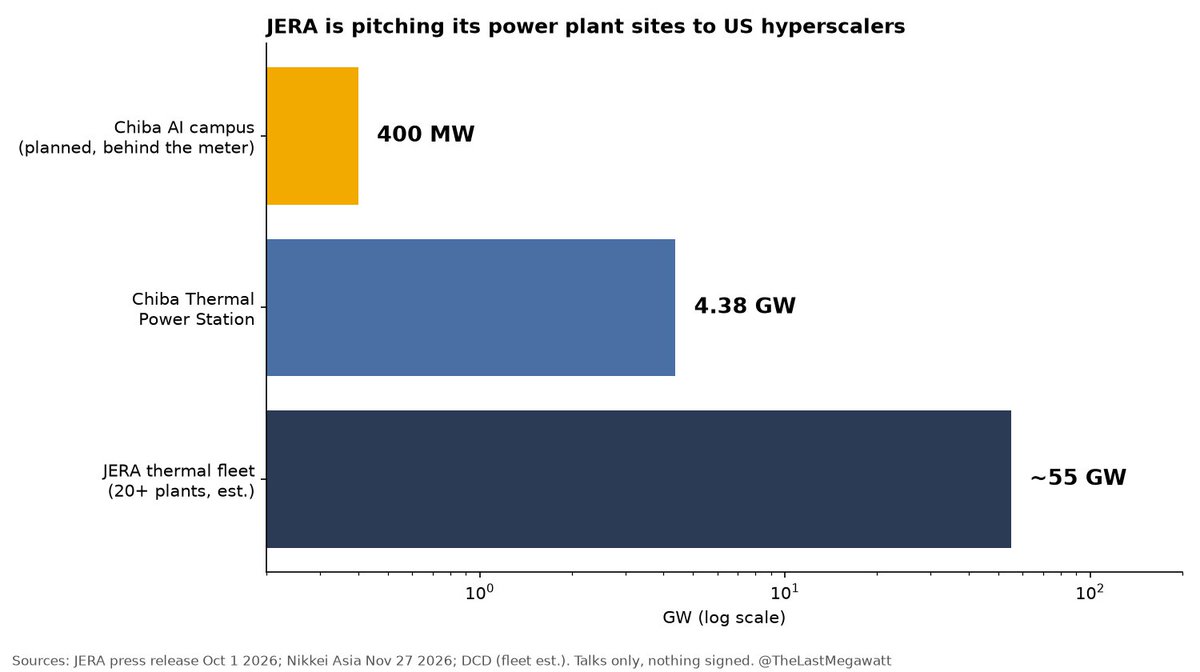
@TheCrowdWisdom Chiba isn't slated to run until 2028, so real scale is a 2030s story. The limit is plant count, not capital: each site already has land, water and fuel inside the fence. One signed $MSFT or $AMZN lease is what moves Yokohama from candidate to the next build.
JERA (~55 GW of thermal plants) is in talks with $ANT, $META, $AMZN, $MSFT and $GOOGL to build data centers inside its Tokyo-area power plants.
Template is Chiba: 400 MW behind the meter, $15B+, with $DELL.
In Japan the best AI site isn't a greenfield. It's a fenced plant.
Kani told Nikkei (Nov 27): talks with $ANT, $META, $AMZN, $MSFT and $GOOGL. Nothing signed.
Chiba (Oct 1 MoU w/ $DELL, RHAELM; $APO financing): up to 400 MW behind the meter, >$15B, ops 2028. Yokohama is a candidate.
Watch for the first signed lease.
https://t.co/aTI1WHo1iT
@SemiAnalysis_ If 2.28x perf per dollar holds beyond one benchmark, the real story is capex mix. Every Trainium rack $AMZN fills is one it isn't buying from $NVDA at Nvidia margins, in buildings and power it already controls. A neocloud running only GB300 doesn't have that lever.
Thanksgiving question with the market closed: if the AI buildout hits a soft patch, who feels it first, the developer, the lender or the landlord? In industrial my answer was always whoever had the most debt and the shortest tenant. Not sure that holds for data centers.
From SpaceX's project page and post today: up to 6 GW across 9 supercompute buildings, ~24 GWh of batteries, dry closed-loop cooling, no gas plant (backup generators only), $50B+ investment, and $3.6B of transmission/substation upgrades handed to the co-ops at no cost.
$600K/MW is my math ($3.6B / 6 GW). Arizona's AG wants the vote delayed. Announced, not approved.
https://t.co/Efwwmgvs2c
https://t.co/BHYBxmEOPb
Our supercompute site in Cochise County has been designed with Arizona in mind: no gas plant, no industrial water use, and a dry-cooling closed-loop water system. SpaceX will also invest $50B+ into the area, bringing 1,000 local permanent jobs and up to 5,500 construction jobs to the area. We will pay for our own power and pay $3.6B to upgrade the grid. Current residents will not subsidize this project – in fact, residential rates for SSVEC customers may decrease by up to 40%.
We value input from the local community, and we are looking forward to addressing questions during our planned meeting on December 9. We’re asking the Commission to keep it and let residents be heard. We think it's important these conversations happen publicly and in a timely manner. We are committed to helping build and grow the communities we live and work in for the better → https://t.co/R1KkJZUOeM
$SPCX is offering $3.6B of grid upgrades to get a 6 GW AI campus approved in Cochise County, AZ. That's ~$600K per MW just for wires, before land, buildings or chips.
Paying your own way onto the grid is the new entry fee. The Dec 9 county hearing decides if it's enough.
@BenBajarin Agree, and contract length tells you who has what. $ANT's S-1/A put $5.0B of its $9.9B Q3 compute on short-term deals. That's the capacity that reprices first if training gluts. Inference wants long-dated metro halls near users. That's the space I'd rather own.