@RobinhoodApp is going all in on AI agents trading. Tonight's summit made that clear.
We've spent the last few days building for exactly that.
Every PARE number is now a public API, no key needed:
→ /api/rates: fixed rates and the market's dividend forecast
→ /api/oracle: the dividend index for every tracked stock
→ /api/markets: every pool, price and depth
→ /api/market: the lending market on Morpho
One file tells an agent how to use all of it, addresses included: https://t.co/QCfWcIs6YT
And the headline number: the pools price Pfizer's dividend at 6.1% a year and the S&P's at 1.2%. Not an analyst's guess. Real money, real prices. https://t.co/PlH4Z1QF6F
The rails are built. Send the agents! 😎
We've just published the security review report for yet another engagement with @PareStocks 🤝
Short one, all reported issues have been resolved. Read the report below👇
https://t.co/3tqtDQp9kY
The @spicenet campaign is live 🌶️
Log in with an email, pay from almost any chain, and use PARE with no bridging and no gas. One signature.
While you're in, here's what you can actually do:
→ Buy Pfizer about 7.8% under the share price and lock in about 6.7% a year, fixed
→ Cash out your dividends today instead of waiting until 2027
→ Add liquidity to the pPFE/USDG pool: $100 a day in Merkl rewards, shared between everyone in it
→ Borrow dollars against pSPY
Try it → https://t.co/tPM64OIerr 😎
The report of our first security review for @PareStocks is now published on our Github. All important issues have been patched.
Looking forward to more security contributions to Pare 🫡
Read the report below👇 https://t.co/0wkWJXZYBd
@PashovAuditGrp has finished reviewing the next piece of PARE the Dividend Pool 🛡️
Result: 0 critical. 0 high. 0 medium.
Just 2 lows and a handful of informational notes.
All fixes have now been submitted to Pashov for final review.
Provide liquidity with your stock. Keep your dividends. Built properly.
🐋 WHALE WATCH : Robinhood introduced stocks to the blockchain.
But what about dividends ?
$PARE is creating a missing yield layer for tokenized stocks on the Robinhood chain separating the stock price from the dividends it receives.
When you deposit a stock token
@PareStocks creates two ERC20 tokens.
pAAPL pSPY pQQQ and pPFE represent non dividend stocks. They trade as equity credits and can be redeemed for the underlying stock at maturity.
In addition there are yield tokens.
yAAPL ySPY yQQQ and yPFE represent all the dividends paid by that stock until maturity and nothing more.
So instead of having a single token where the dividend is embedded in the stock value, you can separate them.
Want stock exposure? Hold the main token.
Want a dividend stream? Buy the Yield token.
Want to combine them again? Combine them for free at any time.
This free merge keeps both tokens pegged to the original stock.
Splitting a stock costs 10 basis points once. When the Yield token is redeemed Pare keeps 5% of the dividend received not the Principal.
The DeFi side is where things get even more interesting.
Both tokens are traded on Uniswap v3 quoted relative to the stock. The Principal token can also be used as collateral.
pSPY/USDG is now available on Morpho Blue.
But this requires something that traditional DeFi collateral systems dont have for these assets: a way to separate dividend payments from stock splits.
Pare created an on chain oracle that tracks every multiplier change and classifies it as either a dividend or a split. If the change cant be explained the system stops.
Without that accounting layer tokenized shares become very difficult to use as DeFi collateral.
The currently active series includes AAPL SPY and QQQ until March 2027 as well as PFE until March 2028.
PFE is particularly interesting because its longer maturity and higher dividends make the difference between equity and yield even more significant.
If youre familiar with Pendle this concept will be familiar.
Pendle separated the cryptocurrencys equity from its yield.
Pare applies the same idea to tokenized shares.
Then theres $PARE.
Its a protocol token not something required to use the product. The supply is fixed at one billion with no minting issuance or staking contracts.
Revenue comes from a 10 basis point split fee, a share of the settled dividends pool fees and finally interest on loans.
The mechanism described is simple: in each stock split $PARE is bought and burned per share.
There are still some important limitations.
Pare is not available to the US public because the underlying Robinhood stock tokens are not available. Pashovs audit is still ongoing, so the protocol has maintained these limitations until its publication.
But the main idea is simple.
The stocks have been digitized on the blockchain but their dividends remain locked within the tokens.
Pare is trying to convert that hidden yield into an independent tradable asset.
The big question is whether tokenized stocks will grow enough for the yield market to become relevant.
SEC staff clarified today: buybacks on a functioning network don't, on their own, make a token a security. Neither does continuing to build after launch.
PARE is live: split stocks into price and dividend tokens on Robinhood Chain, with fees routed to buy & burn $PARE.
We keep building. 🔨
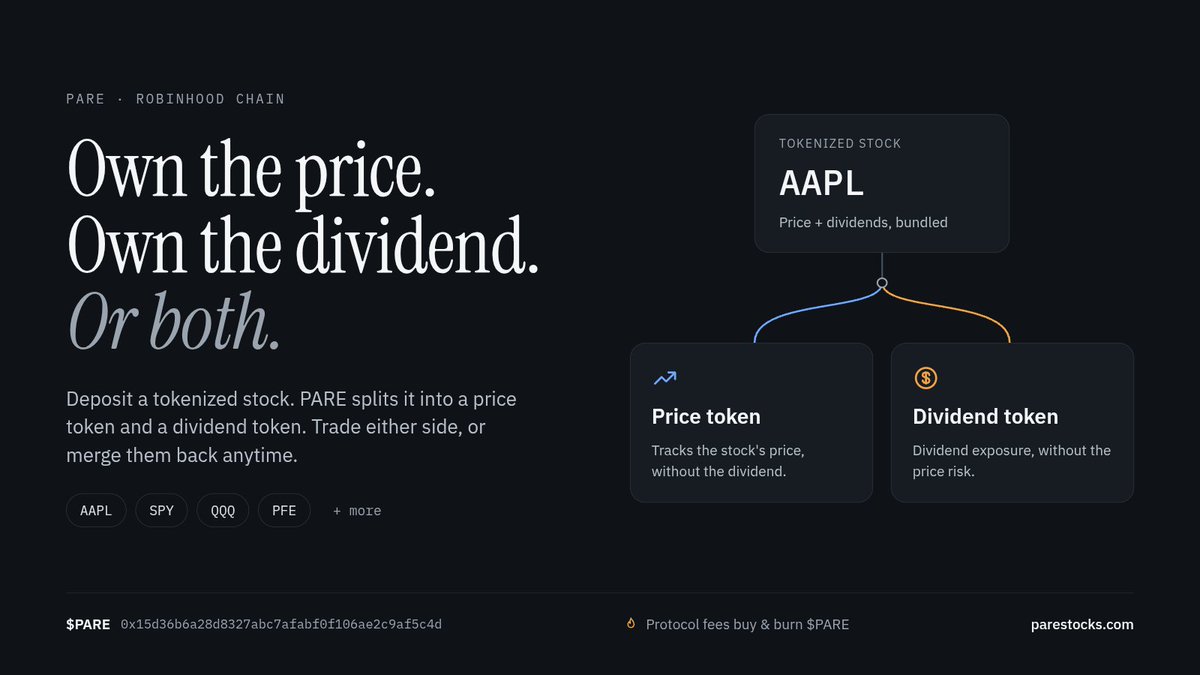
Stocks have always bundled two things: price and dividends. PARE unbundles them.
Deposit a tokenized stock and receive two independent tokens:
→ Price token: tracks the underlying's price, ex-dividend
→ Dividend token: dividend exposure, without price risk
Hold the side that fits your strategy, trade the other, or merge them back at any time.
Live on Robinhood Chain with AAPL, SPY, QQQ, PFE and more.
Protocol fees are used to buy back and burn $PARE.
Official contract:
0x15d36b6a28d8327abc7afabf0f106ae2c9af5c4d
https://t.co/pWX56bfX3l