Loop Diuretics Summary:
40 mg Furosemide = 20 mg Torsemide = 1 mg Bumetanide
Most potent: Bumetanide (≈40× furosemide).
Longest duration: Torsemide (up to 8 hours).
Combine with thiazide (metolazone) for refractory edema → “sequential nephron blockade.”
Monitor electrolytes, renal function, and volume status regularly.
Give early in the day to avoid nocturia.
IV over 1–2 minutes — avoid rapid push (risk of ototoxicity).
For poor absorption (gut edema) → switch from oral to IV route.
What else?
M-Mode Echocardiography Explained
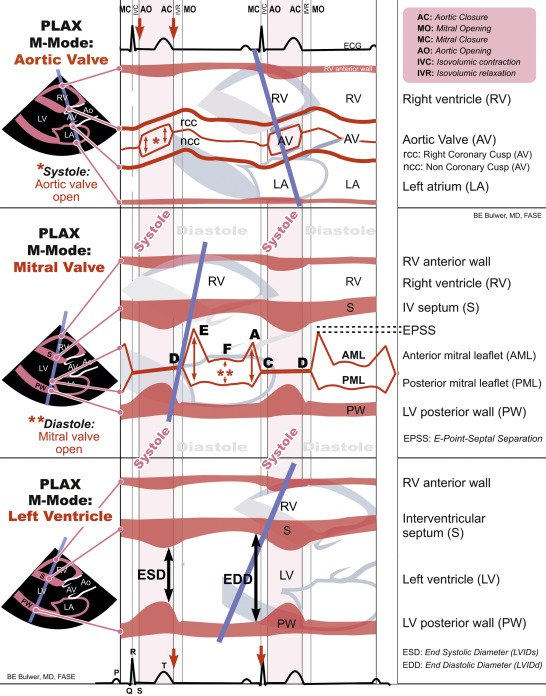
This figure demonstrates M-mode measurements from the parasternal long-axis (PLAX) view, crucial for assessing valvular & ventricular function:
🔹 Aortic Valve Motion (Top Panel)
- The right coronary cusp (RCC) and non-coronary cusp (NCC) move apart in systole (valve opens) and come together in diastole (valve closes).
🔹 Mitral Valve Motion (Middle Panel)
- The anterior mitral leaflet (AML) and posterior mitral leaflet (PML) exhibit characteristic movements:
- Diastole: AML moves towards the septum (E wave) due to rapid LV filling, then slightly back (A wave) due to atrial contraction.
- Systole: Leaflets close tightly, preventing regurgitation.
🔹 Left Ventricular Dimensions (Bottom Panel)
- End-diastolic diameter (EDD): Largest LV dimension measured before systole.
- End-systolic diameter (ESD): Smallest LV dimension after contraction.
- These values help calculate LV function (e.g., fractional shortening & ejection fraction).
📌 Courtesy of Bernard E. Bulwer, MD, FASE
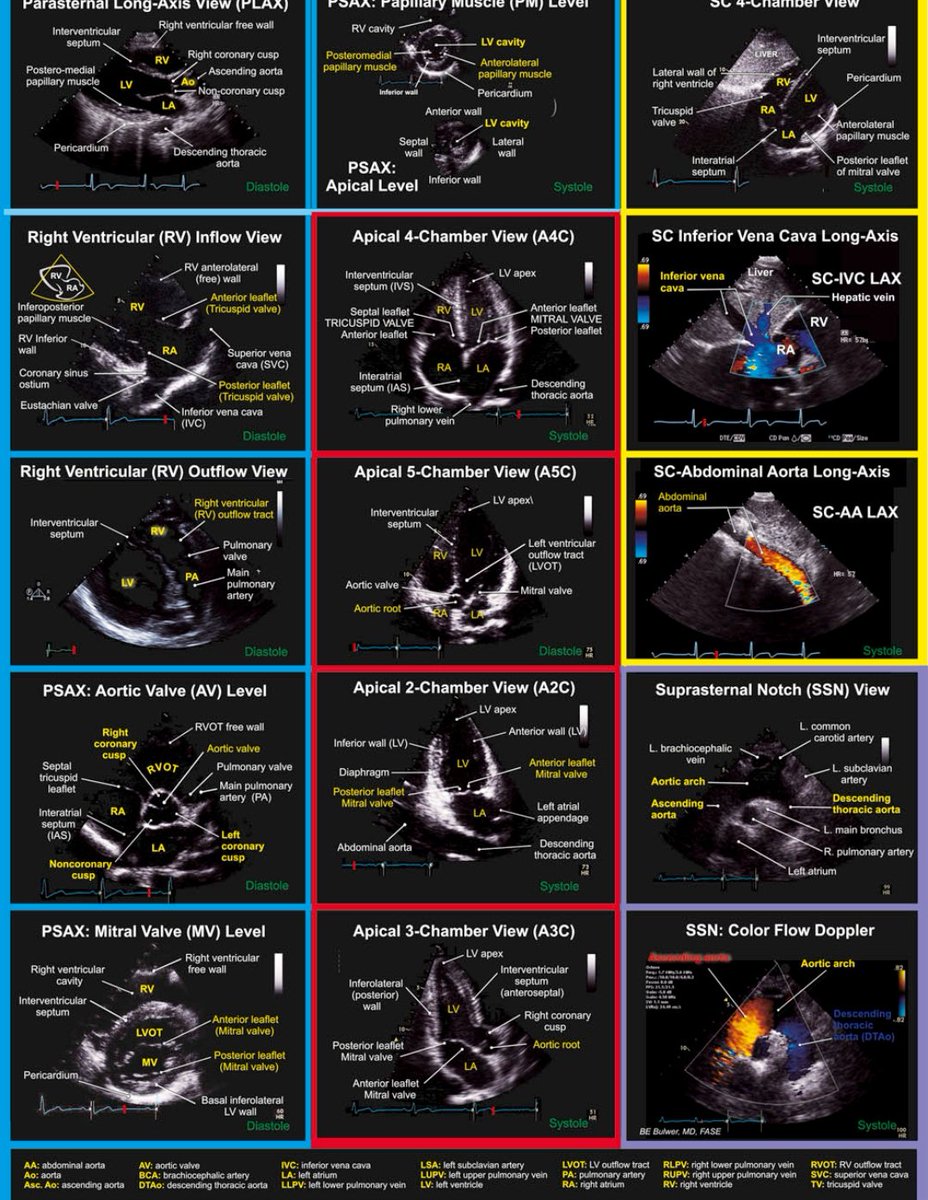
Transthoracic Echocardiographic (TTE) Views: A Complete Guide
Understanding TTE views is essential for accurate cardiac imaging. Let’s break down the 5 core views:
1️⃣ Parasternal Long Axis
2️⃣ Parasternal Short Axis
3️⃣ Apical
4️⃣ Subxiphoid
5️⃣ Suprasternal
A thread 🧵
@echo_batman I have seen this pattern in rheumatic MS when there is two different levels of obstruction - valvular and subvalvular.
Please, take a look at this @echofirst case 👇🏽