1- this show is my current obsession 🤗
2- that pizza volcano will be my birthday 'cake' this year 😍
It's so cool and pizza is bae 😋
https://t.co/YC42d4SBDs
Being a flowergirl when we were little was so teaaa. You get all new everything, kwanza fancy stuff😂 tiara, dress, tights, shoess, kale kabasket, glovesss. Hair laiddd. They would even let you ujipake lipstick, perfume and cutex😂😂 plus the glitter that would stay in your hair for dayss. The singing, everyone looking nice. Peak girlhood.
Kunakwanga na secret word kwa entrance. When we arrive we tell the ticketing guys “Matako juu juu kama brakes za Hondaa”
Bouncer akisema “So?”
Jibu “Sausage between your legs for your dinner”… you’ll never be frozen.
The pain is even the least 😞
Now lets talk about possible things that can happen when you’re ovulating that nobody ever explained to us:
→ One side of your lower stomach just feels… off. Could be left, could be right whichever ovary is on duty that month 😭
Women's nipples have holes in them that absorb our babies' saliva during breastfeeding and our bodies detect the vitamin levels of our babies. Based on those results our bodies begin to produce extra of the nutrients that our babies are lacking.
Remembrance of Patrick Mukabi
A bonfire memorial celebration will take place on Tue, 28 April, from 4pm at @KuonaArtists. Friends, family, & the wider community are welcome to share memories &inspirations. A mural painting session will also take place.
Patrick Mukabi (1969-2026) 🇰🇪🎨
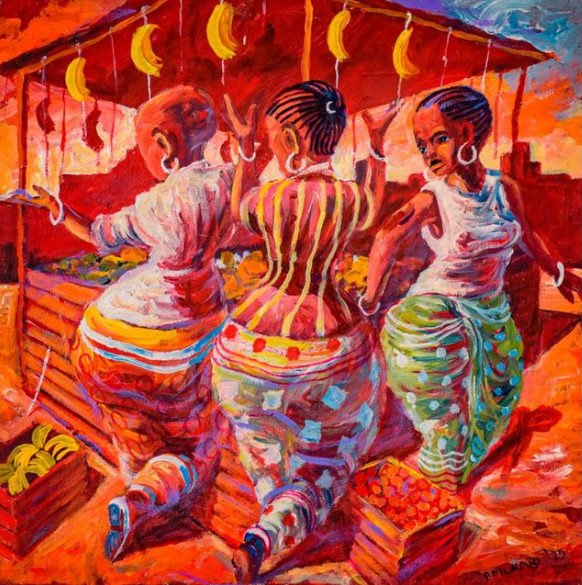
Few Kenyan institutions captured the cheerful bustle of middle-class aspiration quite like Java House. Its walls, adorned with the robust, kanga-clad women of Patrick Mukabi, offered a visual anthem to everyday resilience: market traders with baskets balanced on heads, mothers whose ample forms suggested both abundance and endurance. Mukabi, who died this month after a long battle with diabetes that culminated in amputation and intensive care, painted a Kenya that was neither idealised nor pitied but simply observed.. with warmth, volume, and unapologetic colour.
Born in Nairobi in 1969, the fourth of seven children, Mukabi (known affectionately as “Panye”) began drawing young, inspired by Catholic imagery and encouraged by a father who worked for Kenya Railways. After a certificate in graphic design at what is now the Technical University of Kenya, he returned to his first love: painting, mostly in acrylic on canvas. His focus was the human figure, above all women engaged in the ordinary commerce of life.. hawking, carrying, conversing. Layers remained visible; the process was transparent, much like the man.
His style was instantly recognisable: voluptuous forms rendered with directness and dignity, sunlight suggested rather than depicted, movement captured without fuss. Critics sometimes called it accessible; in truth, it was democratic. Art, for Mukabi, belonged not in rarefied galleries but on the walls of cafés where ordinary Kenyans met over coffee. Java House commissioned him extensively; his work also graced airports and private collections. He exhibited in more than 20 countries, yet never lost the habit of teaching.
At Dust Depo, his studio beside the old Railway Museum.. practically on the tracks of his family’s history.. he ran an open-door academy. Aspiring artists, local and foreign, found space, advice, and often materials. Children’s classes on Saturday mornings (some televised as “Uncle Supuu” on Citizen TV) introduced a generation to brushes and bold hues. Many of Kenya’s younger painters passed through his mentorship; he was, as one curator put it, the closest thing the scene had to a godfather. Generosity came naturally, sometimes to his financial detriment. He gave works away cheaply or for free, undervaluing his own output in a market that rarely rewarded seniority.
Mukabi’s own life had railway rhythms: travel, teaching, exhibition. He spoke of Michelangelo as a mentor across centuries and painted from live models in later series such as “Cover Girls,” celebrating fuller-figured women who would never grace magazine covers but possessed their own majestic presence. Barefoot in the studio, he claimed he could not think with shoes on.. a small eccentricity that fitted the man who taught toddlers to slather paint “like jam on bread.”
In recent years illness confined him to Kenyatta National Hospital. Fellow artists organised benefit exhibitions, “Mali Safi” among them, to cover mounting bills. The shows celebrated his legacy while quietly underscoring a familiar Kenyan story: a towering talent who gave more than he received.
Patrick Mukabi leaves behind a visual vocabulary that has become part of Nairobi’s everyday scenery. His women endure.. self-assured, labouring, luminous.. on café walls where new generations sip coffee and, perhaps, notice the art for the first time. In a country still learning to value its own makers, he painted abundance where others saw only survival. Kenya’s art world is poorer for his passing; its walls, richer for his brush.