A man photographed the Sun every day for three years from the same spot and at the same time.
He then combined all the images to reveal the Sun’s movement across the sky throughout the year.
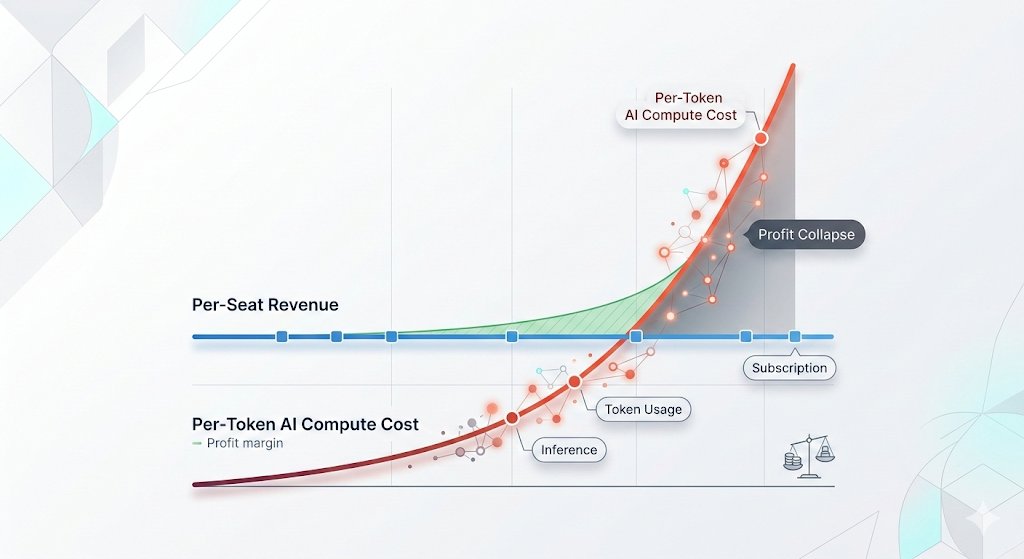
🦔Microsoft canceled its internal Claude Code licenses this week after token-based billing made the cost untenable, even for a company with effectively infinite cloud resources. Uber's CTO sent an internal memo warning the company burned through its entire 2026 AI budget in just four months. American AI software prices have jumped 20% to 37%, and GitHub (owned by Microsoft) is dropping flat-rate plans for usage-based billing across its products.
My Take
The AI subsidy era is ending in real time. The same company that put $13 billion into OpenAI and built the Azure infrastructure powering most of Anthropic's compute just looked at the bill from a competitor's coding tool and decided it was not worth paying. That is not a productivity failure on Anthropic's end. Token-based pricing is forcing every enterprise customer to confront the actual cost of running these models at scale, and the number turns out to be far higher than the flat-rate experiments suggested.
This ties directly to my Gemini Flash post yesterday. Anthropic, OpenAI, and Google all raised effective prices in the last six months. Enterprises that built workflows assuming AI costs would keep falling are now watching annual budgets evaporate in months. Two outcomes look likely from here. Either enterprises scale back AI usage to fit budgets, which slows the revenue ramp the labs need to justify their valuations ahead of IPOs, or the labs cut prices and absorb the losses, which makes the unit economics worse at exactly the wrong moment. Both paths land in the same place, the numbers stop working, and somebody has to take the writedown.
Hedgie🤗
The recent AI Impact Summit hosted by India recently brings focus on practical applications of AI. At Madukkarai in Tamil Nadu, a simple AI-based Elephant Detection System has enabled 8,679 safe elephant crossings in a little more than 2 years. Incidently it has also recorded 100 leopard alerts, 560 wild gaur alerts, and captured 14,888 deer alerts across two vulnerable railway stretches, protecting precious wildlife. In Gudalur in the Nilgiris, another AI system is working at the landscape level to generate real-time alerts for the local community, and in Hosur too, an AI system is helping elephants. These systems may not be perfect, no system ever is, but the foremost goal is protection. The future of AI lies not just in innovation, but in using technology where it matters most: solving real problems, in real places, and for real lives #AIforgood #wildlifeconservation #MadukkaraiAIProject #elephants @WWFINDIA@WWF@IUCN
The token cost to build a production feature is now lower than the meeting cost to discuss building that feature.
Let me rephrase.
It is literally cheaper to build the thing and see if it works than to have a 30 minute planning meeting about whether you should build it.
It’s wild when you think about it.
This completely inverts how you should run a software organization. The planning layer becomes the bottleneck because the building layer is essentially free. The cost of code has dropped to essentially 0.
The rational response is to eliminate planning for anything that can be tested empirically. Don’t debate whether a feature will work.
Just build it in 2 hours, measure it with a group of customers, and then decide to kill or keep it.
I saw a startup operating this way and their build velocity is up 20x. Decision quality is up because every decision is informed by a real prototype, not a slide deck and an expensive meeting.
We went from “move fast and break things” to “move fast and build everything.”
The planning industrial complex is dead.
Thank god.
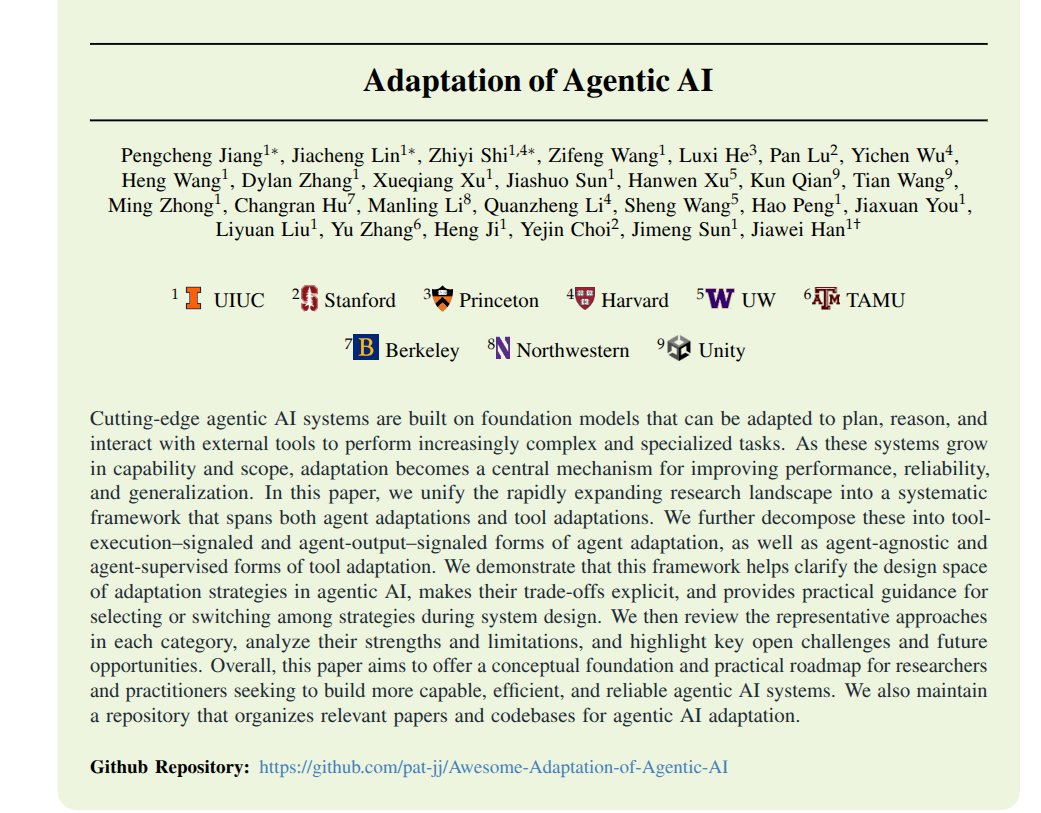
A solid 65-page long paper from Stanford, Princeton, Harvard, University of Washington, and many other top univ.
Says that almost all advanced AI agent systems can be understood as using just 4 basic ways to adapt, either by updating the agent itself or by updating its tools.
It also positions itself as the first full taxonomy for agentic AI adaptation.
Agentic AI means a large model that can call tools, use memory, and act over multiple steps.
Adaptation here means changing either the agent or its tools using a kind of feedback signal.
In A1, the agent is updated from tool results, like whether code ran correctly or a query found the answer.
In A2, the agent is updated from evaluations of its outputs, for example human ratings or automatic checks of answers and plans.
In T1, retrievers that fetch documents or domain models for specific fields are trained separately while a frozen agent just orchestrates them.
In T2, the agent stays fixed but its tools are tuned from agent signals, like which search results or memory updates improve success.
The survey maps many recent systems into these 4 patterns and explains trade offs between training cost, flexibility, generalization, and modular upgrades.
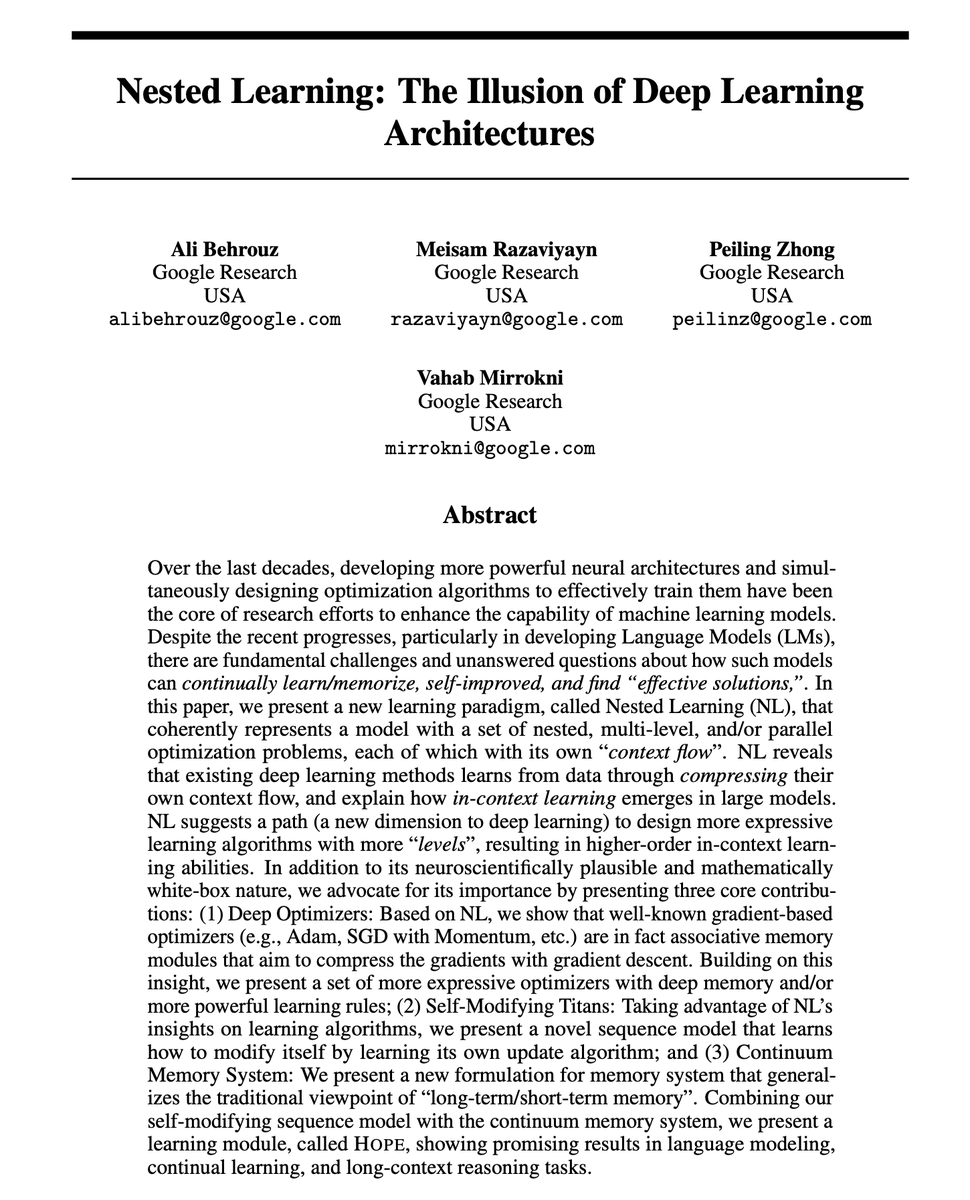
Google just dropped "Attention is all you need (V2)"
This paper could solve AI's biggest problem:
Catastrophic forgetting.
When AI models learn something new, they tend to forget what they previously learned. Humans don't work this way, and now Google Research has a solution.
Nested Learning.
This is a new machine learning paradigm that treats models as a system of interconnected optimization problems running at different speeds - just like how our brain processes information.
Here's why this matters:
LLMs don't learn from experiences; they remain limited to what they learned during training. They can't learn or improve over time without losing previous knowledge.
Nested Learning changes this by viewing the model's architecture and training algorithm as the same thing - just different "levels" of optimization.
The paper introduces Hope, a proof-of-concept architecture that demonstrates this approach:
↳ Hope outperforms modern recurrent models on language modeling tasks
↳ It handles long-context memory better than state-of-the-art models
↳ It achieves this through "continuum memory systems" that update at different frequencies
This is similar to how our brain manages short-term and long-term memory simultaneously.
We might finally be closing the gap between AI and the human brain's ability to continually learn.
I've shared link to the paper in the next tweet!
@nikestore My return was picked up on 9th September and it reached your facilities on 14th Sept, yet I haven't received my refund. This is not the Nike I have know for decades. You should "just do it", isn't it? My order no is #G10217184496
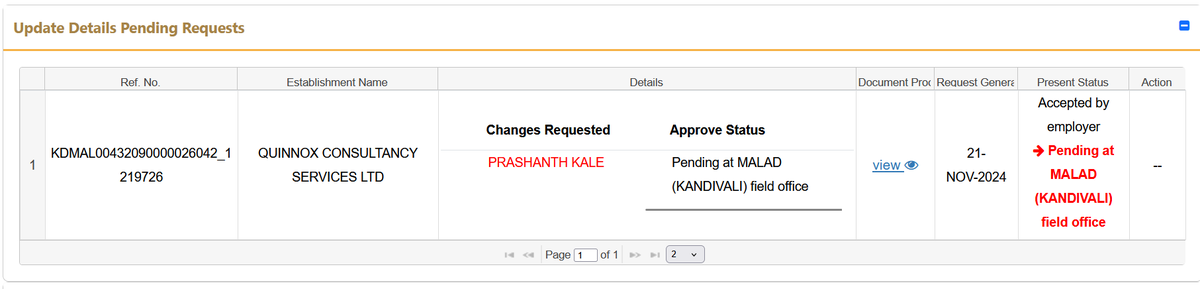
@epfokandivaliw1 My name change request has been pending for 6 months with your Field Officer. How many emails, calls, resubmits you expect for a simple name change. Could you please do it at least now. 6 months delay is crazy. Is this vikisit bharat
@mansukhmandviya@PMOIndia
🚨🇮🇷
UNDERWATER BASE
Iran just unveiled an Underwater Naval Base, three days after Trump took office.
Here's a thread of everything you need to know about the base:
(🧵 1/5)
Hi @epfochennaizo I have been following up on my name change/correction for ~2 months now. Had provided all the required documents. It is pending with #Chennai Field Office for quite some time now. Plz get it approved/change asap. #grievance#help@socialepfo#HumHaiNa#EPF#PF