@maximumpain333#Integration is the most challenging part IMO
You get the insight.
You understand the pattern.
You become aware about what needs to change.
But then comes the real work.
Integration is when a realization becomes a choice becomes a new response which has to become the new normal
You don't always have a “bad picker” problem.
Sometimes you have a familiar-feeling problem.
You keep choosing what feels familiar—even when familiar has repeatedly hurt you.
Familiarity can feel like chemistry.
#ConnectingDots#Relationship#SelfAwareness
Last night, we attended the Lucas Museum of Narrative Art. We had visited a few weeks earlier to preview the Frazetta gallery, but seeing the museum alive was something entirely different. The sheer human effort behind this place is overwhelming: thousands of hands, decisions and years of perseverance, all in service of the belief that the images that tell our stories deserve to be preserved, studied and honored.
Mellody Hobson calls it “a museum of the people’s art,” and I understood the power of that more fully last night. Even the building embodies the idea. Architect Ma Yansong and George Lucas created something massive and futuristic that still feels organic, alive and connected to nature.
We had seen the museum store designed a few weeks ago, before the merchandise was there. Seeing it finished and seeing the Frazetta merchandise we collaborated on, along with work from so many other artists, finally presented with the class, care and elegance it deserves was awe-inspiring.
Naturally I thought about my grandfather throughout the night. He always wanted to be in California, and standing there, seeing some of his greatest paintings hanging in a museum of this magnitude, in California, felt surreal.
It also felt hopeful: for physical art, for artists and for the children who will walk through these galleries and understand that images have carried our stories across generations.
Nothing this meaningful is created by one person alone. Artists, architects, builders, curators, craftspeople and dreamers all contributed to something larger than themselves. But someone has to believe in the idea long enough to bring all those people together.
George Lucas did.
He held onto the vision and built a place for the storytellers. We’ll be grateful for the rest of our lives to have been part of this profound historical moment.
For 50 years, sports physiologists wrote papers proving the human body could not run a mile under 4 minutes. Roger Bannister did it in May 1954. Within 18 months, 23 other runners had broken the same barrier that had held for half a century.
Roger Bannister was a medical student. He trained on his lunch breaks. Two years before the record he had come fourth at the Olympics and been shredded by the British press for it.
Here is the myth you have probably heard.
Doctors spent decades proving a man's heart would burst if he ran that fast. Then Bannister proved them wrong, and once the spell broke, twenty-something runners flooded through the barrier within a year, freed by nothing but belief.
Almost none of that is true.
Start with the wall. It was not ancient. The record had sat at 4 minutes 1.4 seconds since 1945, set by a Swede named Gunder Hägg. Before the war, the mile had been dropping steadily, year after year, runner after runner. Then most of the fastest men on the planet spent five years in a war instead of on a track. Progress did not stop because it was impossible. It stopped because the people who would have made it were carrying rifles.
The "it will kill you" part was real, but it lived in newspapers and locker rooms, not in the science. Bannister was studying medicine while he trained. He said it plainly. It is the brain, not the heart or lungs, that is the critical organ. He knew there was no physical wall. He had read the physiology himself.
Now the flood everyone talks about.
Forty-six days after Oxford, an Australian named John Landy ran 3:57.9 in Finland. Two months after that, the two of them lined up together in Vancouver and both went under four minutes in the same race, the first time that had ever happened. That part is real and it is thrilling.
But the swarm never came. Landy was the only other man to break four for the rest of 1954. Three more did it in 1955, and all three came out of the same single race. Two and a half years after Bannister, the total number of humans who had run a sub-four mile was about ten. Not twenty-three in a year. Ten in thirty months.
So was it a mental barrier at all?
Here is the detail that quietly settles it. The mile has a metric cousin, the 1500 meter, and the two distances line up almost perfectly.
If four minutes had been a mental cage, runners would have been flying past their matching 1500 times while still choking at the mile. They were not. The two tracked each other the entire way.
People were stuck at four minutes at the exact moment they were stuck at the matching 1500 time. There was no magic in the number. There was a hard record and a war that had frozen a decade of progress.
None of this shrinks Bannister. He beat a record that had held for nine years, on a wet track in a crosswind, while carrying a full medical degree, using interval training he built himself because the old methods bored him.
Then he retired that same year to become a neurologist and spent the rest of his life studying the nervous system.
The lesson people take from this is backward. The story gets sold as proof that belief breaks walls. Look closer and it says the opposite.
A whole generation talked itself into treating a barrier as sacred and superhuman, when the real thing standing in the way was a paused stopwatch and a sentence everyone kept repeating.
The wall was never four minutes.
The wall was the certainty that four minutes was a wall.
Shiva Sutras – Chapter 3, Sutra 39
“चित्तस्थितिवत् शरीरकरणबाह्येषु” — Citta-sthitivat Śarīra-karaṇa-bāhyeṣu
“The stability established in consciousness should extend to the body, the senses, and the external world.”
Spiritual realization is complete only when inner awareness transforms outer living. In Kashmir Shaivism, the peace discovered in meditation should naturally express itself through the body, the senses, our actions, and our interactions with the world.
This sutra reminds us that awakening is not confined to the mind—it is embodied. A stable consciousness is reflected in calm speech, mindful actions, balanced emotions, and compassionate relationships. Inner realization becomes meaningful when it shapes the way we live every day.
Psychologically, this teaching emphasizes the importance of integrating inner awareness with outward behavior. True growth is not measured by spiritual experiences alone, but by how consistently our thoughts, emotions, and actions remain aligned.
Neuroscience also shows that repeated mindful actions strengthen neural pathways through neuroplasticity, allowing awareness to become a natural way of living rather than an occasional practice.
@Sunitasriv True!
Making sacrifice is a choice, and choices often have consequences - sometimes lifelong for the person who made them.
People do not figure those out in advance nor do they accept/bear the consequences, creating ripples for everyone around them....
The etheric body is sustained from the physical/biological side (probably via microtubules & mitochondria) and the astral/spirit side (via sleep, thoughts, feelings, and natural lifeforce influx).
So you can tackle it from either direction or both.
If the damaging source has been removed (like after doing a detox protocol) it will heal on its own as long as environmental/internal aggravators don’t exceed the ability for natural repair.
So reduce stress, eat well, get enough sleep (most important), have contact with nature, breathe more or do breathing exercises that are known to increase vital energy.
You can also tap into your spirit/astral complex and invoke feelings of goodwill & love, then direct that toward your whole body. Joe Dispenza has an exercise called Blessing of the Energy Centers that’s along the lines of what I mean.
If you’re a person of faith, especially Christian, you can ask the angels & Holy Spirit to cleanse & repair you. Can do that every night before going to bed.
What is the Bhagavad Gita Really About?
Bhagavad Gita is one of the deepest explorations of the human mind, consciousness, emotion, purpose, and inner conflict ever written.
Set on the battlefield of Kurukshetra, the Gita is a dialogue between Lord Krishna and Arjuna at a moment of intense psychological collapse where Arjuna is overwhelmed by fear, confusion, emotional attachment, anxiety, and moral conflict, something deeply relatable even today.
But the battlefield is symbolic too. Kurukshetra represents the inner battlefield every human being faces:
• discipline vs comfort,
• clarity vs confusion,
• awareness vs ego,
• purpose vs fear.
The Bhagavad Gita is not merely about war, rather it's about the war within consciousness.
Structurally, the Gita unfolds through 18 chapters and 700 verses, gradually guiding the mind from emotional chaos toward wisdom, self-awareness, detachment, devotion, meditation, and inner stability.
From a modern perspective, the Bhagavad Gita can be understood as:
• a manual for emotional resilience
• a guide to conscious action
• a philosophy of self-mastery
• and a science of inner transformation
Psychologically, Arjuna’s breakdown resembles overthinking, burnout, nervous system overwhelm, identity crisis and emotional paralysis.
Lord Krishna’s teachings resemble deep psychological reframing observe the mind, act without attachment, master attention and reconnect with your deeper nature beyond fear and ego.
Even neuroscience today echoes many of these ideas like meditation, attention training, breath awareness, and emotional regulation, all of which are central themes in the Bhagavad Gita — are now known to influence stress response, cognition, nervous system balance, and mental clarity.
At its core, the Bhagavad Gita teaches one timeless insight:
"Human suffering begins when we become unconsciously attached to thoughts, emotions, outcomes, and ego-based identity and liberation begins when awareness awakens."
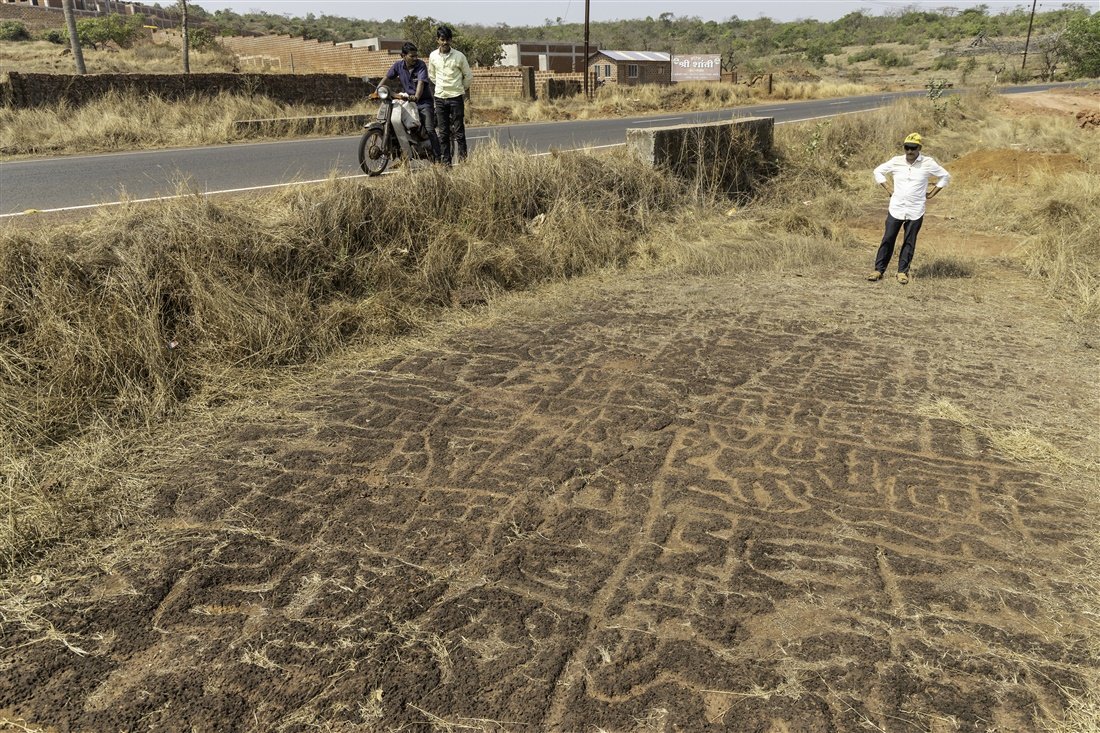
1990. Road widening work uncovers petroglyphs at Nivli Fata, Ratnagiri.
Officials from the Directorate of Archaeology AND Archaeological Survey of India are immediately notified.
This becomes the first reported petroglyph site in Konkan.
Scholars rush in. Books are published. Comparisons drawn to Harappan civilization. An entire academic field of Konkan petroglyph studies is born from this one discovery.
The site itself?
Still half-buried under road construction. 36 years later.
Not neglected by accident.
Not lost to time.
Not awaiting discovery.
Reported to two official bodies in 1990.
Documented in RTI responses.
Still under asphalt.
We widened the road. ✅
We triggered an academic renaissance. ✅
We preserved the site that started it all. ❌
The first petroglyph that launched a thousand studies remains buried under the road we chose to finish.
Who decided tarmac matters more than the stone that rewrote Konkan's prehistory? 🛣️🪨
🦷 Scientists Develop a Gel That Can Regrow Tooth Enamel
Researchers at the University of Nottingham have created a new protein-based gel that can actually help regrow real tooth enamel — a breakthrough that could change the future of dentistry.
The gel works by pulling calcium and phosphate ions from saliva and organizing them into new enamel crystals. According to lead author Abshar Hasan, it “promotes the growth of crystals in an integrated and organized manner,” allowing the new enamel to merge naturally with the tooth.
Lab tests on extracted human molars showed that new enamel started forming within a week, and continued to strengthen over the next few weeks. The regenerated layer stayed strong even after simulated brushing, chewing, and exposure to acids.
Clinical trials are expected to begin later this year, and the technology is planned for commercialization through the startup Mintech-Bio.
Would you use a gel that helps repair your teeth naturally? 🤔