This is real footage from 120 years ago.
None of the people in it knew that the city around them had four days left...
What you are watching is a cable car gliding down Market Street in San Francisco, filmed on the 14th of April, 1906.
The camera was mounted on the front of the car, so you see the city exactly as it was: the crowds, the horse-drawn carriages, the early automobiles weaving through traffic, the men in hats, the great buildings rising on either side. An ordinary spring afternoon in a thriving American city.
Four days later, on the morning of the 18th of April, a magnitude 7.9 earthquake struck. The shaking lasted under a minute, but it ignited fires that burned through the city for days...
By the time it was over, more than 3,000 people were dead and roughly 80 percent of San Francisco had been destroyed. Almost every building you see in this footage was gone.
And the film itself nearly went with it.
The negative was placed on a train bound for New York on the 17th of April, the day before the earthquake. Had it left a single day later, it would have burned in the fire along with the studio that made it.
This entire moving record of a lost city survives because of one day...
Today, we’re announcing Runlayer has raised $30M from Felicis and Khosla Ventures to help companies go all in on AI.
Runlayer is the golden path for AI: enablement, security, and control in one platform.
So, how does it give your team the right tools for AI? 🧵
If you use Claude Desktop, Cursor, or other MCP-native tooling, this gives your agent direct access to the same subscription graph you already maintain for yourself.
Very interested in what the coming era of highly bespoke software might look like.
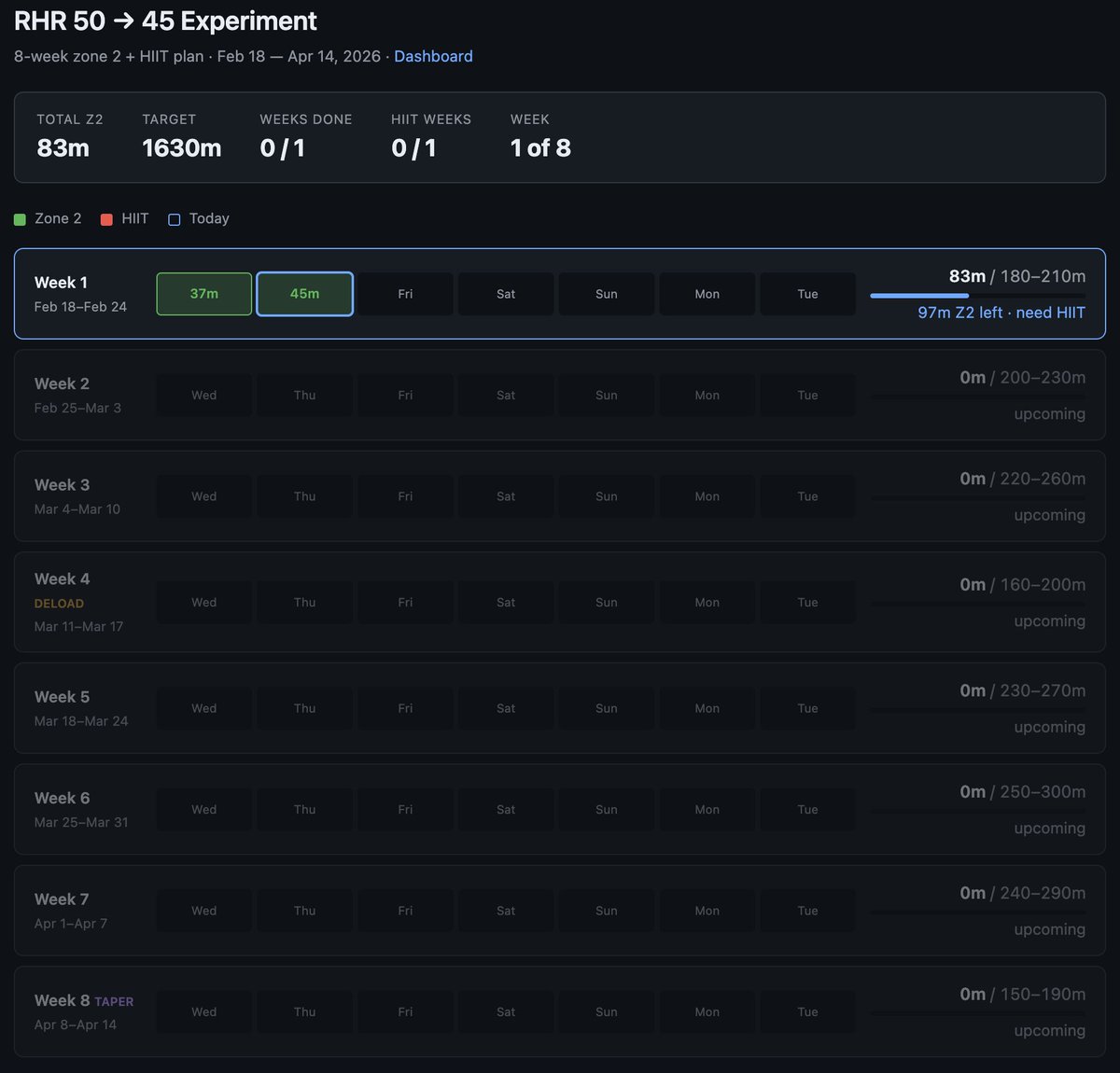
Example from this morning - I've become a bit loosy goosy with my cardio recently so I decided to do a more srs, regimented experiment to try to lower my Resting Heart Rate from 50 -> 45, over experiment duration of 8 weeks. The primary way to do this is to aspire to a certain sum total minute goals in Zone 2 cardio and 1 HIIT/week.
1 hour later I vibe coded this super custom dashboard for this very specific experiment that shows me how I'm tracking. Claude had to reverse engineer the Woodway treadmill cloud API to pull raw data, process, filter, debug it and create a web UI frontend to track the experiment. It wasn't a fully smooth experience and I had to notice and ask to fix bugs e.g. it screwed up metric vs. imperial system units and it screwed up on the calendar matching up days to dates etc.
But I still feel like the overall direction is clear:
1) There will never be (and shouldn't be) a specific app on the app store for this kind of thing. I shouldn't have to look for, download and use some kind of a "Cardio experiment tracker", when this thing is ~300 lines of code that an LLM agent will give you in seconds. The idea of an "app store" of a long tail of discrete set of apps you choose from feels somehow wrong and outdated when LLM agents can improvise the app on the spot and just for you.
2) Second, the industry has to reconfigure into a set of services of sensors and actuators with agent native ergonomics. My Woodway treadmill is a sensor - it turns physical state into digital knowledge. It shouldn't maintain some human-readable frontend and my LLM agent shouldn't have to reverse engineer it, it should be an API/CLI easily usable by my agent. I'm a little bit disappointed (and my timelines are correspondingly slower) with how slowly this progression is happening in the industry overall. 99% of products/services still don't have an AI-native CLI yet. 99% of products/services maintain .html/.css docs like I won't immediately look for how to copy paste the whole thing to my agent to get something done. They give you a list of instructions on a webpage to open this or that url and click here or there to do a thing. In 2026. What am I a computer? You do it. Or have my agent do it.
So anyway today I am impressed that this random thing took 1 hour (it would have been ~10 hours 2 years ago). But what excites me more is thinking through how this really should have been 1 minute tops. What has to be in place so that it would be 1 minute? So that I could simply say "Hi can you help me track my cardio over the next 8 weeks", and after a very brief Q&A the app would be up. The AI would already have a lot personal context, it would gather the extra needed data, it would reference and search related skill libraries, and maintain all my little apps/automations.
TLDR the "app store" of a set of discrete apps that you choose from is an increasingly outdated concept all by itself. The future are services of AI-native sensors & actuators orchestrated via LLM glue into highly custom, ephemeral apps. It's just not here yet.
Nemotron 3 Nano runs nicely with mlx-lm on an M4 Max.
Could be a great model for local use on Mac: MoE + hybrid attention make it fast even for very long context.
Generating in realtime with 4-bit model:
🚨 XR Builders — Contest Alert! 🚨
Build the best XR app on the Decart API Platform and win:
🥇 Apple Vision Pro + Meta AI Glasses + 500K API credits
🥈 Meta AI Glasses + 200K API credits
🥉 100K API credits
⏳ Deadline: Oct 7, 23:59 PDT (San Francisco time)
Notion is set to unveil Personalized AI Agents during their September 18 keynote.
These agents will allow users to tailor AI workflows inside Notion, enhancing productivity across tasks like writing, organizing, and planning.
Importantly, Notion Builders will be able to create and share agent templates via the Notion Marketplace, opening the door for a community-driven ecosystem of custom AI assistants.
discord
/dĭs′kôrd″/
noun
-Lack of agreement among persons, groups, or things. synonym: conflict. Similar: conflict
-Tension or strife resulting from a lack of agreement; dissension.
-A confused or harsh sound or mingling of sounds.
Transforming human knowledge, sensors and actuators from human-first and human-legible to LLM-first and LLM-legible is a beautiful space with so much potential and so much can be done...
One example I'm obsessed with recently - for every textbook pdf/epub, there is a perfect "LLMification" of it intended not for human but for an LLM (though it is a non-trivial transformation that would need human in the loop involvement).
- All of the exposition is extracted into a markdown document, including all latex, styling (bold/italic), tables, lists, etc. All of the figures are extracted as images.
- All worked problems get extracted into SFT examples. Any referenced made to previous figures/tables/etc. are parsed and included.
- All practice problems are extracted into environment examples for RL. The correct answers are located in the answer key and attached. Any additional information is added as "answer key" for a potential LLM judge.
- Synthetic data expansion. For every specific problem, you can create an infinite problem generator, which emits problems of that type. For example, if a problem is "What is the angle between the hour and minute hands at 9am?" , you can imagine generalizing that to any arbitrary time and calculating answers using Python code, and possibly generating synthetic variations of the prompt text.
- All of the data above could be nicely indexed and embedded into a RAG database for later reference, or maybe MCP servers that make it available.
Then just as a (human) student could take a high school physics course, an LLM could take it in the exact same way. This would be a significantly richer source of legible, workable information for an LLM than just something like pdf-to-text (current prevailing practice), which simply asks the LLM to predict the textbook content top to bottom token by token (umm - lame).
As just a quick and crappy example of synthetic variations of the above example, GPT-5 gave me this problem generator (see image), which can now generalize that problem template to many variations:
- When the time is 11:07 a.m., what is the degree measure of the angle between the hands? (Answer: 68)
- Determine the angle in degrees between the clock’s hands at 4:14 a.m.. (Answer: 43)
- What angle do the clock hands form when the time reads 11:47 a.m.? (Answer: 71)
- At 7:02 a.m., what angle separates the hour hand and the minute hand? (Answer: 161)
- At 4:14 a.m., calculate the angle made between the two hands. (Answer: 43)
- What angle is formed by the hands of a clock at 4:45 p.m.? (Answer: 127)
- What is the angle between the hour and minute hands at 8:37 p.m.? (Answer: 36)
(infinite practice problems can be created...)