Reminder:
1. Porn is from hell, send it back to where it belongs
2. Pray your Rosary every day. No excuses
3. Do mental prayer for a minimum of 15 minutes a day
4. Do some spiritual reading
5. Stop by church for a quick 5-10 minutes with Our Lord.
Boomers Start To Die Out: What's Going To Happen To All Those Houses?
The early Boomers are turning 80 so there's going to be a hell of alot less of them over the next 10 - 15 years
And they own so MANY Single Family Homes in Canada
What will be the outcome of this transition?
This painting shows the most heartbreaking reunion in all of literature. To understand it, you have to know who the dog is...
His name is Argos, and he belongs to Ulysses, the Greek hero also known as Odysseus. Before Ulysses sailed away to fight in the Trojan War, he had raised Argos from a puppy, a fast and beautiful hunting dog. Then the war called, and Ulysses left.
He would not come home for twenty years.
When Ulysses finally set foot on his own island again, he came in disguise, dressed as a beggar, so that no one would know him. His house was full of men trying to steal his wife and his kingdom. To survive, he had to remain a stranger in his own home.
No one recognized him. Not his loyal servants. Not the people who had known him all his life. But lying in the dirt by the gate, old and forgotten, covered in ticks, too weak to stand, was a dog. Argos had waited twenty years. And the moment he saw him, he knew. He was the only one. Nearly blind, half dead, he lifted his head and pricked up his ears, and he wagged his tail for the master he had never stopped waiting for.
Ulysses saw him. And because he was in disguise, surrounded by enemies, he could not run to him, could not kneel down, could not say his name. He could only look at his old friend and, turning his face away so no one would see, let a single tear fall.
And then, in Homer's own words, "the dark shadow of death closed down on Argos' eyes, the instant he had seen Odysseus, twenty years away."
He had held on to life for one reason only: he was waiting to see him come home. And the moment he did, he could finally let go...
It is such a beautiful painting, and the look on that dog's face is so universal, so instantly understood by anyone who has ever loved and waited, that it is enough to bring a grown man to tears.
Crows are pecking and eating the shedding velvet (soft skin) from a Sika Deer's antlers in a mutualistic interaction ~ the birds get nutrients, and the Deer gets cleaned.
This video is from Nara Park in Japan, known for free-roaming Deer and such behaviors.
🎦 Credit: Unknown (DM for credit.
Sultan Ahmed Square (the Hippodrome) - The photograph was taken by James Robertson around 1853–1854....
This rare 19th Century view of Sultan Ahmed Square in Constantinople (modern-day Istanbul) shows two of the surviving monuments of the ancient Byzantine Hippodrome. The taller monument on the right is the Obelisk of Theodosius, originally erected by Pharaoh Thutmose III in Egypt around 1450 BC and transported to Constantinople by Emperor Theodosius I in AD 390. On the left stands the Walled Obelisk, a Byzantine structure believed to date to the 10th Century.
The Hippodrome was the social and political center of the Byzantine Empire, capable of seating an estimated 100,000 spectators for chariot races, public ceremonies, and imperial events. Construction began under Emperor Septimius Severus around AD 203 and was greatly expanded by Emperor Constantine the Great in the 4th century.
By the late 19th Century, when this photograph was taken, the Hippodrome itself had long since disappeared, but several of its monuments remained standing as reminders of Constantinople's imperial past.
The Obelisk of Theodosius is one of the oldest human-made objects still standing in Istanbul, having been carved nearly 3,500 years ago during Egypt's 18th Dynasty.
#archaeohistories
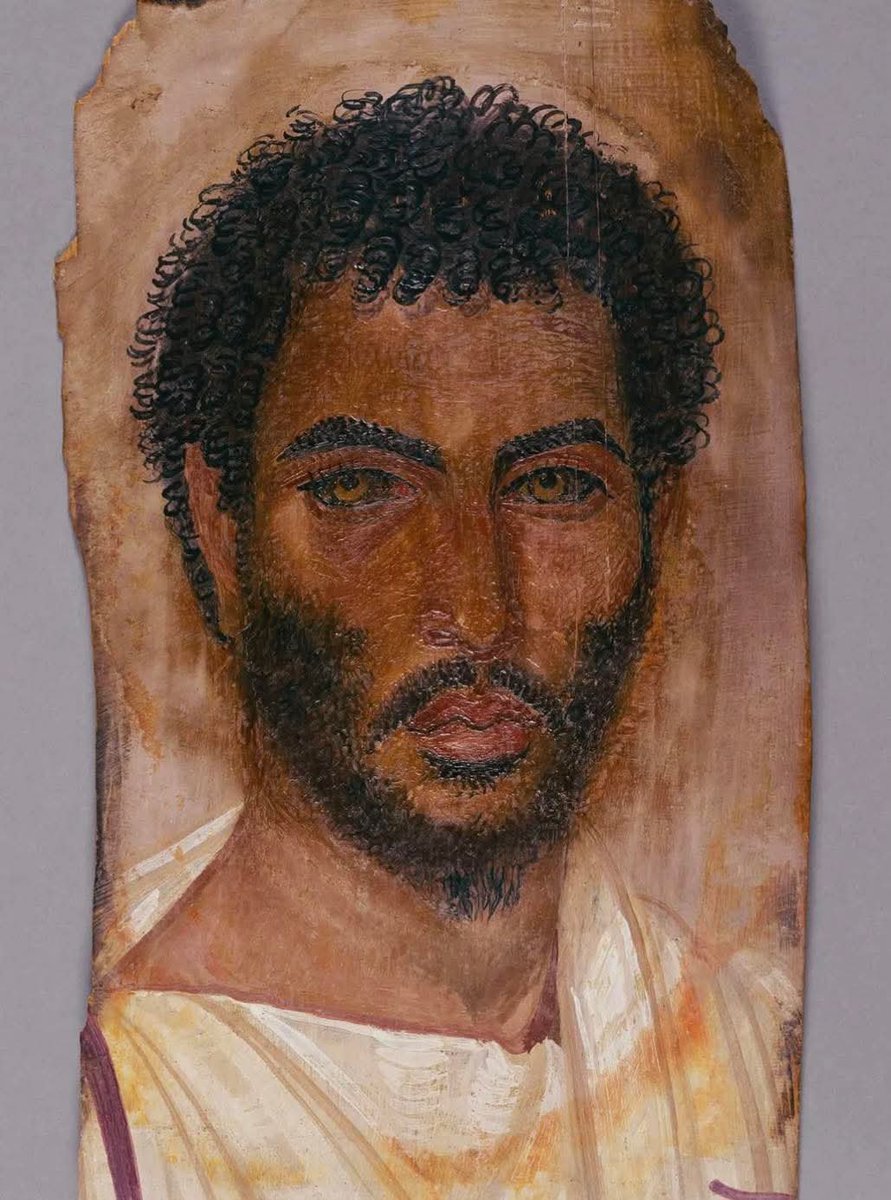
Portrait of an unidentified man that was placed over the face and upper torso of his mummy. Dated to 150–170 AD, it is painted in encaustic on a panel of linden wood, and it was originated in Roman Egypt.
This remarkable portrait belongs to a group of artworks known as the Fayum mummy portraits, a tradition that flourished in Roman Egypt between the 1st and 3rd centuries AD. Unlike the stylized depictions of faces seen in earlier Egyptian funerary art, these portraits were painted in a strikingly naturalistic style, giving us lifelike glimpses of people who lived nearly 2,000 years ago.
Painted in encaustic, a technique using hot wax mixed with pigment, the colors remain vivid even after centuries. The medium gave artists the ability to capture depth, texture, and warmth, preserving the humanity of their subjects with astonishing realism. In this particular piece, the curly hair, sharp eyebrows, and direct gaze make the man seem almost alive, as though he could step out of history and into the present.
The portrait was originally placed over the face and chest of the deceased’s mummified body, merging Egyptian burial practices with Roman artistic sensibilities. These works represent more than individual likenesses—they reflect the cultural blending of Greek, Roman, and Egyptian traditions in a society at the crossroads of the ancient Mediterranean world.
What makes the Fayum portraits so moving is the intimacy they provide. Unlike statues of emperors or gods, these images show ordinary people: merchants, soldiers, mothers, and children. Each one is a reminder that behind the ruins and relics of antiquity were lives full of stories, emotions, and identities. This man’s name may be lost to time, but his face survives as one of history’s most hauntingly personal echoes.
#archaeohistories
A woman at Spring Lake Beach gestures toward a sign as she explains to a lifeguard why she was sunbathing topless, only to learn the rule applied to men. New Jersey, 1939.
Just a few years earlier, men in many U.S. cities risked fines or arrest for appearing shirtless in public.
By the late 1930s, however, many beaches had started permitting men to swim without shirts, leading to signage like the one shown in the photograph.
While shirtless bathing for men quickly became widely accepted, women were still expected—both legally and socially—to keep their chests covered for decades afterward.
In many parts of the United States, rules surrounding female toplessness have only begun to change in recent decades through court decisions and local policy reforms.
Rome's Forgotten Pool
Around 200 AD, at the peak of the Roman Empire, engineers in Cappadocia enclosed a natural spring inside a rectangular stone pool measuring 23 by 66 meters.
From there, water traveled through underground clay pipes for 2.5 km, then along an arched aqueduct for the final 1.5 km into the city of Tyana.
The pool still holds spring water today. The aqueduct still stands, one of the longest and best preserved in Türkiye.
The town's modern name, Kemerhisar, literally means "Aqueduct Fort." The Romans left, but their waterworks named the town.
Facial reconstruction of a 3,600-year-old man from the Dnieper steppe, Novoalekseevka, Ukraine, Kurgan 6/6
The Srubnaya culture was an Iranic-speaking culture related to the largely Corded Ware-descended Proto-Indo-Iranic Sintashta and Andronovo complexes. It largely replaced the earlier Yamnaya, Catacomb, and Poltavka cultures across the Pontic–Caspian steppe.
The culture takes its name from its characteristic timber-lined grave constructions used in burial pits. Its cemeteries typically consisted of groups of five to ten kurgans. Burials often included animal skulls and forelimbs, along with ritual hearth offerings. In some cases, stone cists were also used. Srubnaya settlements were made up of semi-subterranean dwellings, often featuring two-room layouts. The presence of bronze sickles, grinding stones, and the remains of domestic cattle, sheep, and pigs indicates a mixed economy combining agriculture with animal husbandry.
The Srubnaya individuals from the Dnieper Steppe had an average cranial capacity of 1488 cm³ for males and 1331 cm³ for females. Males had a large average cranial length of 192.9 mm, a medium-small cranial breadth of 136.6 mm, a medium cheekbone breadth of 134.0 mm, and a medium-large bigonial breadth of 102.2 mm.
The male Srubnaya population from the Dnieper Steppe was tall by global standards, with an average stature of 174.2 cm, while females averaged 157.7 cm, placing them slightly above average (S. I. Kruts, 1984).
If anyone wants to know how truly despicable Ryan Reynolds, Blake Lively and their lawyers are, look no further than this well written article perfectly summarizing the events leading up to and around the case. https://t.co/aLjSD8XyWf