ज़िंदगी में मुश्किलें आएँ तो घबराना मत, क्योंकि वही मुश्किलें हमें मजबूत बनाती हैं। 💪
बस खुद पर भरोसा रखो, मेहनत करते रहो और वक्त
को अपना काम करने दो।
आज की मेहनत ही कल की पहचान बनेगी। ❤️🔥
हार मत मानो… आपकी मंज़िल आपका इंतज़ार कर रही है। 🚩
https://t.co/uKku6hEObK
دوست ملتے ہیں یہاں دل کو دلاسا دینے
درد بڑھ جائے تو جینے کی دعا دیتے ہیں
سچی دوستی کا کوئی نعم البدل نہیں ہوتا
یہ وہ رشتہ ہے جو ہر حال میں ساتھ دیتا ہے♥️
@My_life_te7@Tanhae_pasand@Omair_5050
https://t.co/ZP5kaq57pQ
https://t.co/HEbmmqWD0H
🔥 Let’s make this Space a place for real growth! 🚀
🎙️ Join the Space
❤️ Like & support
🔁 Repost to reach more people
💬 Stay active & engage
🤝 Follow and connect with new friends
Let’s support each other, grow together, and build a stronger community on 𝕏! 💙📈✨
Everyone is welcome! 🚀
Media trials are one of the worst things to have happened in this country. What if he is ultimately proven not guilty? Will the media restore the reputation and dignity that were damaged?
A similar incident happened with IPS officer Uday Krishna Reddy, who was accused of physical abuse by his girlfriend. Due to the relentless media trial, he reportedly reached the point of attempting suicide.
The media can destroy a person’s reputation in minutes, but no verdict can undo the damage once it is done. Trial by media is just prejudice dressed up as journalism.
Let the courts decide guilt or innocence. The media should report, not convict.
IPS trainee Rahul Bansal, who gave emotional gyaan about corruption in his civil services mock interview, now charged with accepting ₹1 crore bribe in cyberfraud case. https://t.co/CLcOcgUIiT
The real issue is character- and character cannot be reliably tested, picked, or eliminated through a competitive exam. You can select for competence, but you can't guarantee integrity. The only practical safeguard is severe institutional checks, constant accountability, and increasingly harsh consequences for abusing power. At the end of the day, the fear of consequences often succeeds where the test of character fails.
Imagine what was happening, at what level, and with what kind of arrangements.
No one knows how many candidates got into MBBS colleges through these means before they were caught.
NEET has never been neat.
It’s less about the ₹50 and more about the principle of not paying a premium for something that should be basic and freely available. He’ll spend generously on food and drinks, but bottled water feels like an unnecessary charge and somehow, that distinction is universally understood.
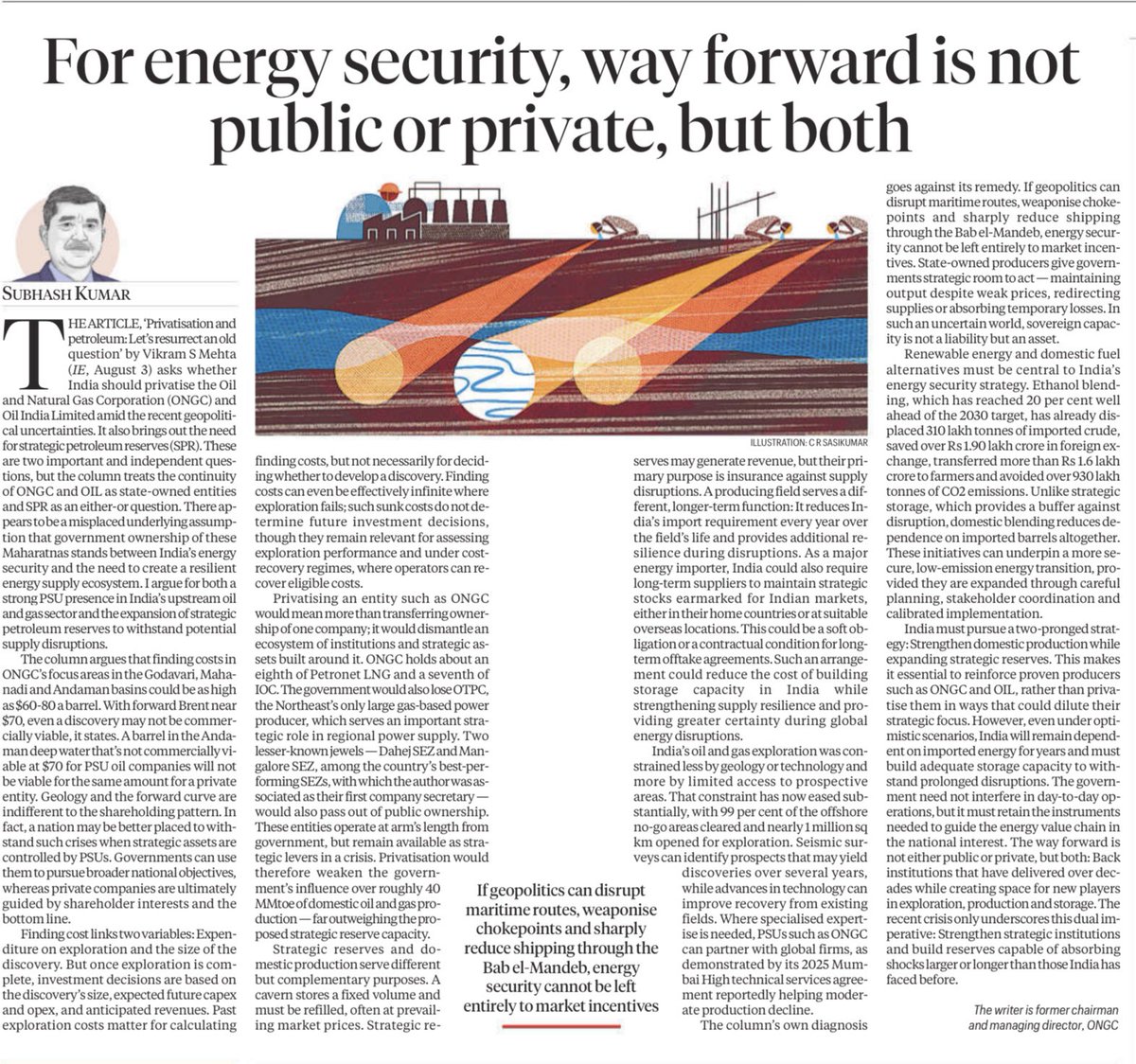
India’s energy security cannot be achieved by choosing between the public and private sectors. With geopolitical tensions, import dependence and possible supply disruptions, India needs a balanced approach- strong strategic institutions, greater domestic production, adequate reserves and private-sector participation.
Understand this article in 🖐🏻 Key Points:-
1. 🛢️ Don’t weaken strategic PSUs - ONGC and OIL are not merely commercial entities; their decades of expertise make them important to India’s energy security.
2. 💰 Cost isn’t everything - Oil exploration involves geological and financial risks. Short-term commercial viability should not alone determine long-term strategic decisions.
3. 🛡️ Build stronger strategic reserves - Reserves provide a crucial buffer against geopolitical crises, supply disruptions and sudden price shocks.
4. 🌍 Reduce import vulnerability - India will remain dependent on imports, so domestic production, renewables, ethanol and diversified import sources all have a role.
5. ⚖️ Public + Private = the way forward - India needs private investment and competition, but also strong public institutions capable of serving strategic national interests.
Bottom line: 🇮🇳 India’s energy security needs both market efficiency and strategic state capacity- not one at the expense of the other.
3.5 YEARS OF UPSC PREP - WHAT I LEARNT
I’m a UPSC aspirant. I’ve given 3.5 years to this prep.
In these years, I’ve roamed around Karol Bagh, taken classes from a premium institute, changed strategies, collected books/PDFs, followed toppers, made notes, remade notes- and spent a lot of time “preparing to prepare.”
The biggest lesson I learned.
UPSC doesn’t reward how much you suffered. It rewards how systematically you prepared.
This exam demands:
limited sources + PYQs + revision + practice + consistency + “the ability to apply what you know.”
Yet many serious aspirants get stuck in a loop:
New strategy then new teacher then new book then new current affairs source then new timetable then repeat.
You work hard, but your effort doesn’t accumulate?
You read, but don’t revise enough….true?
You take tests, but don’t analyse mistakes.
You make notes, but don’t revisit them.
You study for 10 hours, but 4 of those hours are spent consuming Telegram/YouTube content…..true?
And months disappear.
After giving 3.5 years, I genuinely believe:
“Nothing replaces self-prep.”
Coaching can give you direction. Teachers can simplify things. Test series can expose weaknesses.
But nobody can revise for you.
Nobody can build your recall.
Nobody can write your Mains answers for you.
Nobody can develop your Prelims elimination skills for you.
Coaching is support. Self-study is the actual preparation.
So keep it boring and simple:
>Know the syllabus.
>Study PYQs.
>Limit sources.
>Revise repeatedly.
>Write answers.
>Solve MCQs.
>Analyse mistakes.
>Keep current affairs linked to the syllabus.
>And stop changing your strategy every 15 days.
> put blinders and work harder & harder.
Most importantly, stop confusing busyness with preparation.
10 distracted hours ≠ 10 productive hours.
You don’t need another strategy video.
You need to sit at home, close the tabs, put the phone away, open the syllabus, and execute.
Because ultimately:
You can give everything to UPSC and still not clear it if you don’t give it systematically.
Hard work matters.
But direction × consistency × revision × practice > raw hours.