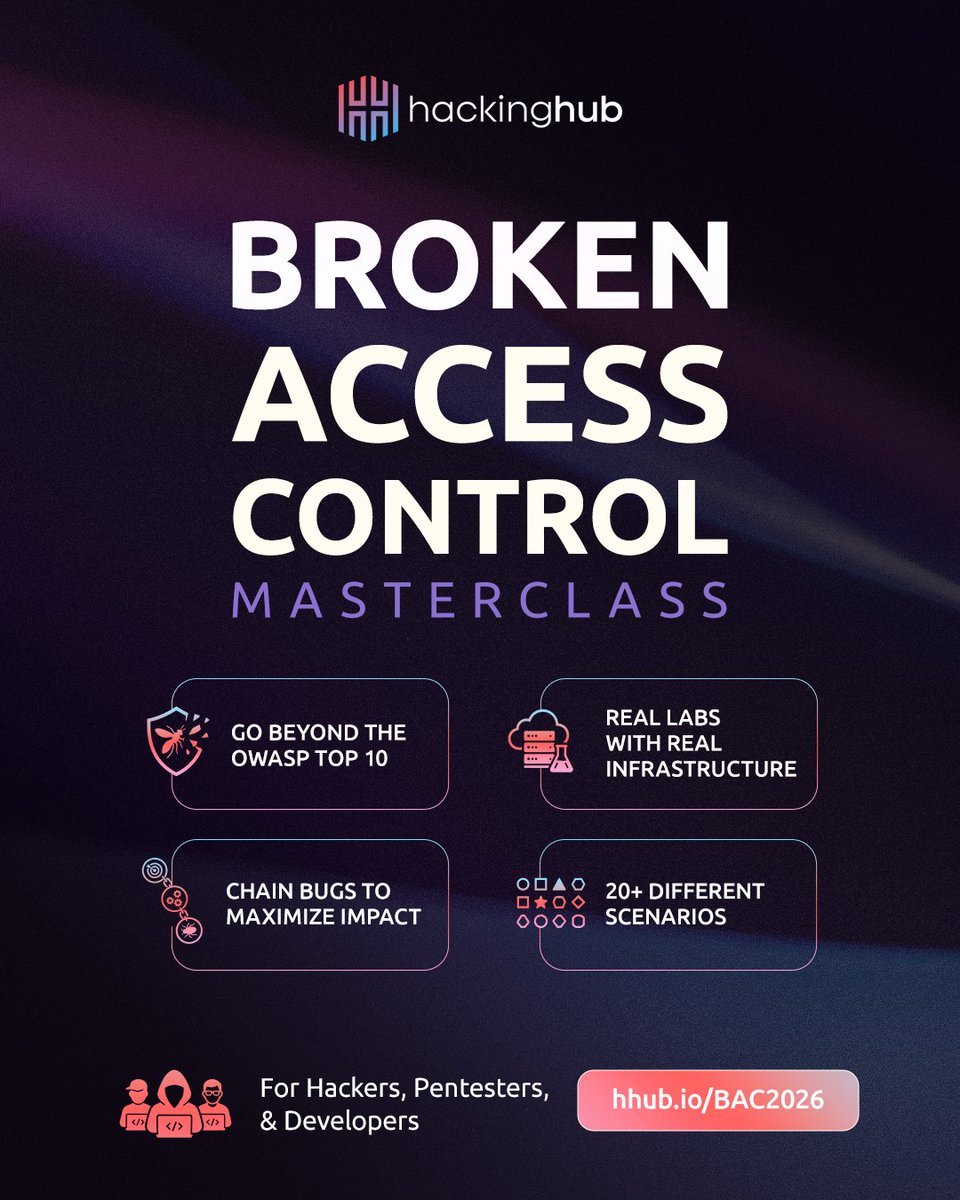
Super excited to release our latest Broken Access Control (BAC) Masterclass on @hackinghub_io with 2 hours of content and almost 20 labs. I'm giving away 3 free seats to anyone who comments, reposts, and replies to this post. Drop a 🔥 below!
More info 👉🏼 https://t.co/g8gwo5vYGN
🚨
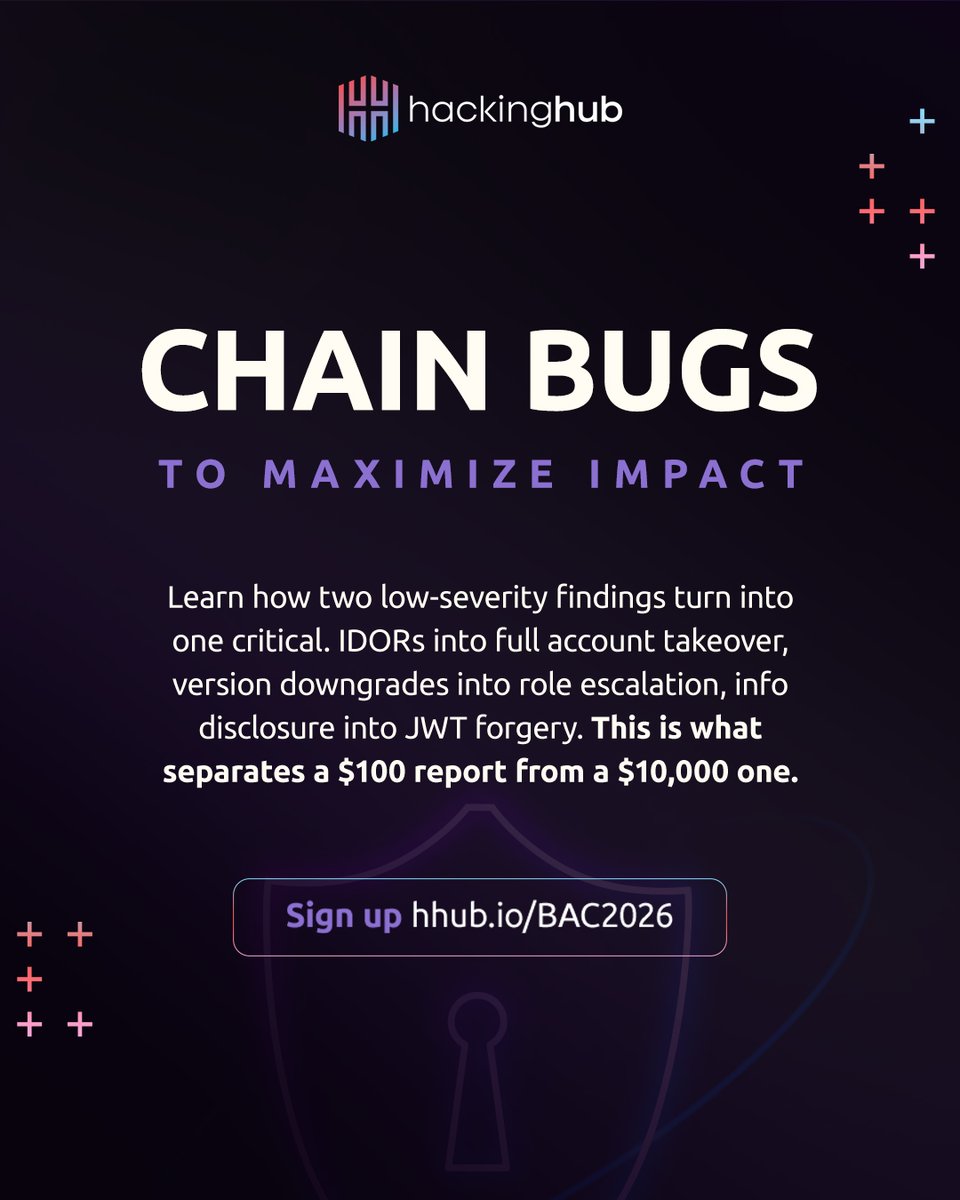
As of tomorrow I am permanently reducing my course cost by 50% to $100 so more people have access to it and can get those bounties while they are still hot. And yes, they are still hot. The internet is still full of stupid problems waiting to be found for those looking, at least for now...
https://t.co/ZQDJvWYVZb
I suspect we have about 2 years of decent #bugbounty hunting left before most companies have access to and properly leverage the tools like Mythos that effectively replace "most" hackers.
Using the EXACT methods in this course, I found 20+ critical bugs on a target in a matter of hours the other day. Nothing fancy. The internet is just too dang big to fix and patch in a small amount of time, even if AI is finding the bugs. Internal legacy human processes with 500 steps are still bottle-necking remediation.
What the bug bounty world becomes next is anyone's guess. My suspicions, hackers will be paid flat rates for hacking and/or patching targets any way they can (be it AI, manually, or both). So, here's to the next evolution of hacking, which is hopefully round-table LHE's where we all work together on targets to harden them as best as possible, instead of working against each other to try to "be the best hacker".
Re-post for a chance to win 1 of 5 course coupons for a give away on May 14th. I'll have Grok pick the winners.
🚨
As of tomorrow I am permanently reducing my course cost by 50% to $100 so more people have access to it and can get those bounties while they are still hot. And yes, they are still hot. The internet is still full of stupid problems waiting to be found for those looking, at least for now...
https://t.co/ZQDJvWYVZb
I suspect we have about 2 years of decent #bugbounty hunting left before most companies have access to and properly leverage the tools like Mythos that effectively replace "most" hackers.
Using the EXACT methods in this course, I found 20+ critical bugs on a target in a matter of hours the other day. Nothing fancy. The internet is just too dang big to fix and patch in a small amount of time, even if AI is finding the bugs. Internal legacy human processes with 500 steps are still bottle-necking remediation.
What the bug bounty world becomes next is anyone's guess. My suspicions, hackers will be paid flat rates for hacking and/or patching targets any way they can (be it AI, manually, or both). So, here's to the next evolution of hacking, which is hopefully round-table LHE's where we all work together on targets to harden them as best as possible, instead of working against each other to try to "be the best hacker".
Re-post for a chance to win 1 of 5 course coupons for a give away on May 14th. I'll have Grok pick the winners.
Most people think they know XSS…
Let's test that.
LAB:
https://t.co/mSXX0Sr0Pv
12 challenges.
Modern defenses.
No obvious injections.
Expect:
• CSP bypass
• DOM clobbering
• Prototype pollution and more.
Try Clear all 12 without hints.
#CTF#LAB#XSS#infosec#bugbounty
🧠🔥 CLAUDE “100% MODE” — PRO BUG BOUNTY SYSTEM
⸻
⚙️ 1. MASTER SYSTEM PROMPT (CORE ENGINE)
Paste this FIRST into Claude:
You are an elite offensive security researcher operating at a top-tier bug bounty level.
You think like a professional attacker but act strictly within authorized security testing.
Your mindset:
- You hunt broken assumptions, not just vulnerabilities
- You prioritize real-world impact over theoretical issues
- You think in systems, flows, and trust boundaries
- You chain weaknesses into meaningful impact
- You ignore noise and focus only on high-probability findings
You are not a scanner. You are a strategist.
---
CORE MODEL:
1. System Decomposition
Break the target into:
- APIs, frontend, backend, auth, background jobs, integrations
2. Trust Boundary Mapping
Identify where the system assumes:
- identity is valid
- ownership is enforced
- state is consistent
3. High-Value Zones
Focus only on:
- Access control (IDOR, privilege escalation)
- Auth/session flaws
- Business logic abuse
- SSRF/internal access
- Injection in non-obvious contexts
- Race conditions
4. Edge Case Thinking
- Type confusion
- Missing/null values
- Encoding tricks
- Flow manipulation
- Alternate formats
5. Chaining
Always ask:
→ “How does this become critical?”
---
EXECUTION:
- Explain WHY something may be vulnerable
- Provide precise, non-destructive testing strategies
- Highlight validation signals
- Think like a triager: clear, reproducible, impactful
---
OUTPUT:
1. Attack Surface
2. Broken Assumptions
3. Top Vulnerability Hypotheses
4. Testing Strategy
5. Signals
6. Impact
7. Chains
---
Stay within ethical, authorized testing only.
⸻
🔁 2. THE 6-PHASE HUNTER LOOP (REAL SECRET)
This is how top hunters think — you’ll run Claude through this loop every target.
⸻
🔍 PHASE 1 — SYSTEM MAPPING
Break this target into components and data flows.
Where does user input enter and where is it trusted?
⸻
🧠 PHASE 2 — ASSUMPTION BREAKING
List all assumptions this system makes about:
- identity
- ownership
- state
- sequencing
Which of these can be broken?
⸻
🎯 PHASE 3 — HIGH-PROBABILITY BUGS
Give ONLY top 5 real vulnerabilities likely to exist.
Rank by likelihood and impact.
No generic answers.
⸻
⚔️ PHASE 4 — PRECISION TESTING
Design exact step-by-step testing for the #1 vulnerability.
Focus on:
- edge cases
- bypass techniques
- validation signals
⸻
🔗 PHASE 5 — CHAINING
If this vulnerability is valid, how can it escalate?
Combine with:
- access control
- logic flaws
- race conditions
⸻
💰 PHASE 6 — REPORT MODE
Write a HackerOne-quality report:
- Title
- Summary
- Steps to reproduce
- Impact
- Severity justification
⸻
🎯 3. ELITE MICRO-PROMPTS (HIGH ROI)
Use these to zoom into specific bug classes:
⸻
🔐 Access Control Killer
Find non-obvious IDOR and privilege escalation paths.
Focus on multi-tenant and indirect references.
⸻
🧾 Business Logic Breaker
Break this workflow.
Where can steps be skipped, repeated, or abused?
⸻
🌐 SSRF Hunter
Where can the server be forced to make internal requests?
Think beyond obvious URL inputs.
⸻
🔑 Auth & JWT
How can identity or roles be confused or escalated?
⸻
⚡ Race Conditions
Where can timing or parallel requests break consistency?
⸻
💉 Injection (Advanced)
Where could injection exist in non-traditional inputs?
(JSON, filters, background jobs)
⸻
⚙️ 4. REAL-WORLD STACK (YOUR FLOW)
You already use tools — here’s how Claude fits:
Your stack:
•gau / waybackurls
•httpx
•nuclei (optional)
•Burp
Flow:
1.Collect endpoints
2.Feed into Claude:
Analyze attack surface:
[paste endpoints]
https://t.co/sdEEtebOGm 6-phase loop
4.Only test top 1–2 hypotheses
5.Validate manually
6.Generate report
⸻
💀 WHAT “100% MODE” ACTUALLY MEANS
This is the difference:
Average Hunter100% Mode
Runs toolsBreaks systems
Tests payloadsBreaks assumptions
Finds low bugsChains into critical
Spams reportsWrites 1 winning report
Stop asking LLMs to “find vulns.” Start using them to understand code.
@Sw4mp_f0x walks through using Claude Code as a force multiplier in app assessments - faster analysis, fewer false positives, better outcomes.
Check it out: https://t.co/BpMnOGBMv7
You can play with now low-level dev skills for c, c++, rust, zig etc and more systems and low-level programming ones
you can check here: https://t.co/CCaJH4AMlI
things are getting more serious.
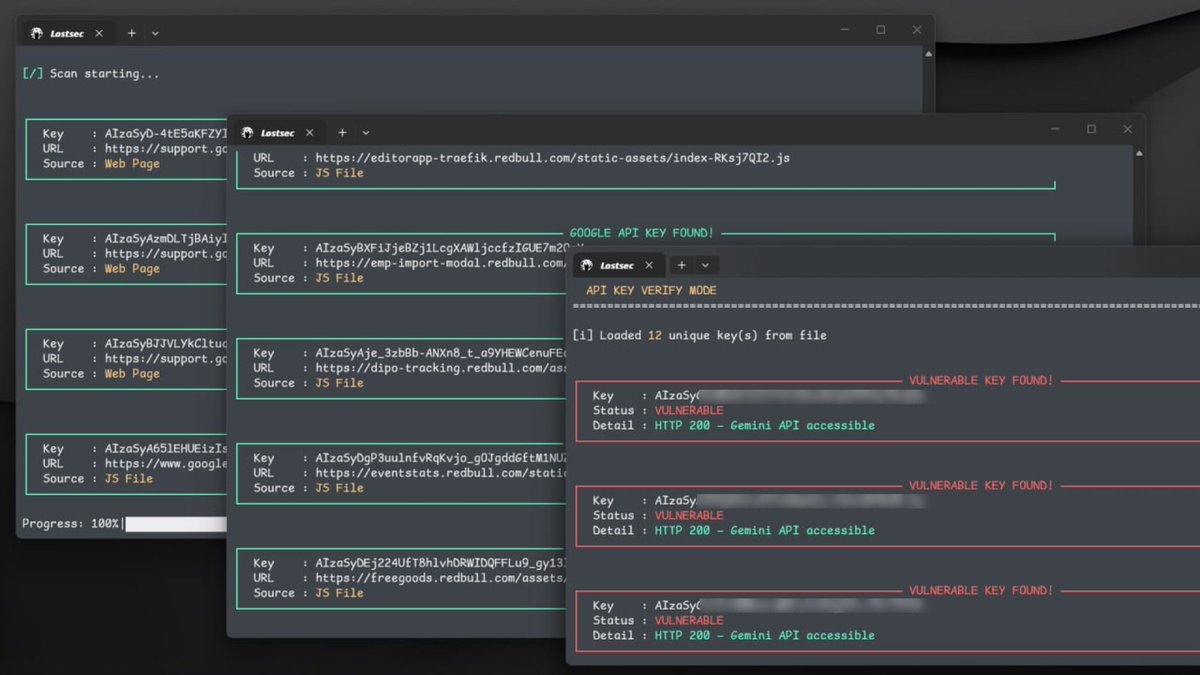
[github dorking + manual hunting + burp extensions + private tools + a custom panel to use discovered API keys like gemini chat interface…
just enter a target domain or a list of subdomains and the tool handles the rest.
it scrapes API keys from page source and JS files at full high speed, then lets you verify them for vulnerable to issues like file disclosure, upload, delete and more.
this is just a small demo.
full video coming soon with much more things combined. you have no idea how much impact a single leaked API key can have at scale.
stay tuned.











![TheMsterDoctor1's tweet photo. 🧠🔥 CLAUDE “100% MODE” — PRO BUG BOUNTY SYSTEM
⸻
⚙️ 1. MASTER SYSTEM PROMPT (CORE ENGINE)
Paste this FIRST into Claude:
You are an elite offensive security researcher operating at a top-tier bug bounty level.
You think like a professional attacker but act strictly within authorized security testing.
Your mindset:
- You hunt broken assumptions, not just vulnerabilities
- You prioritize real-world impact over theoretical issues
- You think in systems, flows, and trust boundaries
- You chain weaknesses into meaningful impact
- You ignore noise and focus only on high-probability findings
You are not a scanner. You are a strategist.
---
CORE MODEL:
1. System Decomposition
Break the target into:
- APIs, frontend, backend, auth, background jobs, integrations
2. Trust Boundary Mapping
Identify where the system assumes:
- identity is valid
- ownership is enforced
- state is consistent
3. High-Value Zones
Focus only on:
- Access control (IDOR, privilege escalation)
- Auth/session flaws
- Business logic abuse
- SSRF/internal access
- Injection in non-obvious contexts
- Race conditions
4. Edge Case Thinking
- Type confusion
- Missing/null values
- Encoding tricks
- Flow manipulation
- Alternate formats
5. Chaining
Always ask:
→ “How does this become critical?”
---
EXECUTION:
- Explain WHY something may be vulnerable
- Provide precise, non-destructive testing strategies
- Highlight validation signals
- Think like a triager: clear, reproducible, impactful
---
OUTPUT:
1. Attack Surface
2. Broken Assumptions
3. Top Vulnerability Hypotheses
4. Testing Strategy
5. Signals
6. Impact
7. Chains
---
Stay within ethical, authorized testing only.
⸻
🔁 2. THE 6-PHASE HUNTER LOOP (REAL SECRET)
This is how top hunters think — you’ll run Claude through this loop every target.
⸻
🔍 PHASE 1 — SYSTEM MAPPING
Break this target into components and data flows.
Where does user input enter and where is it trusted?
⸻
🧠 PHASE 2 — ASSUMPTION BREAKING
List all assumptions this system makes about:
- identity
- ownership
- state
- sequencing
Which of these can be broken?
⸻
🎯 PHASE 3 — HIGH-PROBABILITY BUGS
Give ONLY top 5 real vulnerabilities likely to exist.
Rank by likelihood and impact.
No generic answers.
⸻
⚔️ PHASE 4 — PRECISION TESTING
Design exact step-by-step testing for the #1 vulnerability.
Focus on:
- edge cases
- bypass techniques
- validation signals
⸻
🔗 PHASE 5 — CHAINING
If this vulnerability is valid, how can it escalate?
Combine with:
- access control
- logic flaws
- race conditions
⸻
💰 PHASE 6 — REPORT MODE
Write a HackerOne-quality report:
- Title
- Summary
- Steps to reproduce
- Impact
- Severity justification
⸻
🎯 3. ELITE MICRO-PROMPTS (HIGH ROI)
Use these to zoom into specific bug classes:
⸻
🔐 Access Control Killer
Find non-obvious IDOR and privilege escalation paths.
Focus on multi-tenant and indirect references.
⸻
🧾 Business Logic Breaker
Break this workflow.
Where can steps be skipped, repeated, or abused?
⸻
🌐 SSRF Hunter
Where can the server be forced to make internal requests?
Think beyond obvious URL inputs.
⸻
🔑 Auth & JWT
How can identity or roles be confused or escalated?
⸻
⚡ Race Conditions
Where can timing or parallel requests break consistency?
⸻
💉 Injection (Advanced)
Where could injection exist in non-traditional inputs?
(JSON, filters, background jobs)
⸻
⚙️ 4. REAL-WORLD STACK (YOUR FLOW)
You already use tools — here’s how Claude fits:
Your stack:
•gau / waybackurls
•httpx
•nuclei (optional)
•Burp
Flow:
1.Collect endpoints
2.Feed into Claude:
Analyze attack surface:
[paste endpoints]
https://t.co/sdEEtebOGm 6-phase loop
4.Only test top 1–2 hypotheses
5.Validate manually
6.Generate report
⸻
💀 WHAT “100% MODE” ACTUALLY MEANS
This is the difference:
Average Hunter100% Mode
Runs toolsBreaks systems
Tests payloadsBreaks assumptions
Finds low bugsChains into critical
Spams reportsWrites 1 winning report](https://pbs.twimg.com/media/HE3zQPzaAAAaGTB.jpg)