PhD candidate at Ruhr-Universität Bochum working on the history of online commenting. Software engineer at Vu-BugZoo. Software archaeologist on the internet.
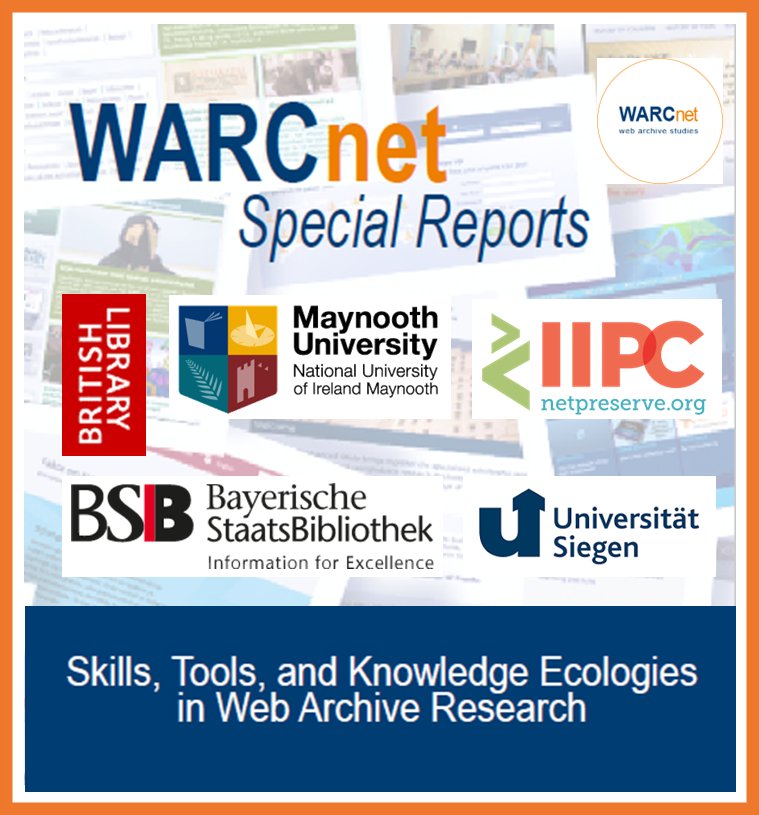
The WARST team are delighted to announce the publication of a WARCnet Special Report, titled: Skills, Tools and Knowledge Ecologies in Web Archive Research. The study sought to identify and document the skills, tools, and knowledge in web archive research.
https://t.co/euQZjKf6aG
My first single-authored paper explores The Digital City (De Digitale Stad, DDS) archives. I argue that web-based artefacts should be considered as software and show how time-related metadata inherent to software can be used to gain historical insights.
https://t.co/zCzWKUCgEe
We have a new article out on the self-presentation of Disqus. This is part of our larger project on online commenting as part of @sfb1472. w/ @J_Passmann@silvertje
https://t.co/1k2eCetMlc
Big thanks to the @unleasharchives team for organising a great event in Vancouver. The discussion and networking opportunities between the cohorts really show the value of the cohort program and in person meetings. Feeling re-energised to work with web archives!
Darin auch ein kollaborativer Beitrag unseres @sfb1472 Teilprojekts zur Geschichte des Online-Kommentars: Paßmann, Gerzen, Helmond, Jansma: "Formular und digitaler Paratext. Geschichte des Facebook-Accountnamens".
@silvertje, @TheSmootyboy
Interested in research with #webarchive data? Come have a look at the work currently being done by the @unleasharchives Cohorts. I'll be telling about some of the challenges of looking for commenting systems in web archives.
Interested in learning about #research projects that use #webarchive data?
@unleasharchives Cohort researchers share their projects & experiences at the next @internetarchive Library as Laboratory session!
16 Mar 2022 @ 11am PT / 2pm ET
Register: https://t.co/mlpm4quBm1
@keesone The offline aspect makes me think of the XS4ALL (then Hack-Tic) guys needing to sleep next to the servers because they did not have locks on the door. Taking digital security offline.
At the first #SFB1472#TransformationenDesPopulären annual conference. Finally meeting a lot of colleagues physically (at 1.5m distance) as opposed to the, by, now too familiar Zoom.
In a new open access publication, the Vu-BugZoo team and I present our approach that makes learning software testing more effective, offers an adequate assessment instrument and adds more excitement to the learning process by using runnable buggy code https://t.co/fpnirjJO9p
Staring today at @UniSiegen in the project @Pop_UniSiegen, studying the history of online commenting technologies and practices. Excited to work together with @J_Passmann, @silvertje and the rest of the team.
Very happy to announce that I have finally finished my master thesis on software archaeology with a whopping 9.5 as a final grade. It took a lot longer than planned, but the result was definitely worth it. On to new exciting things, or perhaps old exciting things.
@odinnmelsted That is exactly the danger. Although it is marginal, it is so wel preserved that in scale it overshadows the archives of others. This can give the false impression that it was relatively larger than other in fact larger domains that are preserved less well.
The first version of my metadata dating tool is online. Discover the age of your files and the steps taken on your system with metadata dating.
https://t.co/yGb5M50w2W