Tweets from Rob Scott, Founder and CEO of Source Music. Obsessed with great music, media, communications & ideas for a more creative and sustainable future
Within hours of being announced as the nominee to be the U.S. Director of the CIA, I received a hand-delivered message on MI6 stationery congratulating me on my nomination. It was signed simply "C" in green ink. Legendary. I shared it with my son and even he thought I was now cool!
More than that, this note, from Sir Alex Younger, Chief of the Secret Intelligence Service of the United Kingdom, confirmed what I already believed: the work that the CIA and MI6 did together mattered, that the partnership was critical, and that two leaders focused on the mission could save lives and provide tools for our nations to deter our adversaries.
Alex's passing this week brought back so many memories of our time in service together. He flew to Langley to see me the day I was confirmed. We brought our two senior teams together in the UK to plan and coordinate and build in the first several weeks of my time on duty: making clear to them all that this relationship was more than special - it was critical for the security of our two countries.
Alex was a remarkable intelligence partner. When we needed help, it wasn't "let me see;" it was "this matters to you and America we'll get it done." And he and his team always did. I think he knew we would do the same for him and his team and his nation. Many Americans are alive today because of his leadership of MI6, I never knew how to thank him enough.
Alex became a friend as well. In the years since we both left office we would see each other from time to time. He was always so kind, so thoughtful, so smart. His deep love of his country was surpassed only by his deep commitment and love of his family. Decent and proper - and funny as hell - Alex was "C." As espionage requires, he was quiet, not attention seeking. He knew what evil was and he was ruthless in his efforts to crush it with every legal tool at his command. And he knew who his friends were and committed himself to supporting them.
I miss Sir Alex Younger. He was a role model for me and a man with whom every minute I spent was valued and savored. Blessings to you Alex. Praying for you and for your family. Well done and may you rest in peace in His hands.
So here’s a lesson in how parts of the Murdoch media machine work.
For those outside South Australia, some context.
For decades Adelaide’s major north-south transport corridor, South Road, has been a bottleneck. Successive governments talked about fixing it. The current Labor government is finally building the final section: a 10.5km tunnel system under the city.
To avoid demolishing heritage-listed buildings, schools, churches, pubs and thousands of homes, the project is being built underground. From day one, the government said it would be the most expensive infrastructure project in South Australian history.
Naturally, state debt has increased as construction ramps up. That’s what happens when you build a once-in-a-generation piece of infrastructure. The government has also repeatedly stated that debt levels are expected to stabilise once the project is completed.
Cue the predictable headlines: “Debt out of control”, “Labor spending spree”, “Burden on future generations”. The usual suspects piled in.
Then came the next angle.
The paper started floating the idea that the tunnel should be a toll road.
Never mind that South Australia hasn’t had a toll road since the 1850s. Never mind that the Premier has repeatedly ruled it out. Never mind that the Treasurer has repeatedly ruled it out.
A Facebook poll was launched asking whether the tunnel should be tolled to help deal with Labor’s spending.
Predictably, the comments exploded. “Labor planned this all along.” “Users should pay.” “Vote One Nation and this wouldn’t happen.”
The poll scraped out a narrow majority in favour of tolls.
The government responded exactly as it had before: there will be no toll. There was never going to be a toll. The road will be free to use. The project is on schedule.
So after running stories about debt, then stories about spending, then stories suggesting a toll road was needed, the paper found a new headline:
“Government out of touch with voters.”
Apparently the same toll road that the government never proposed, never planned and repeatedly rejected is now something the government is being criticised for not delivering.
Create the problem. Amplify the outrage. Poll the outrage. Then report the outrage as news.
And people wonder why trust in media keeps falling.
Professor Omar Yaghi, a chemist at the University of California, Berkeley and winner of the 2025 Nobel Prize in Chemistry, has developed an innovative atmospheric water generator capable of producing up to 1,000 liters of clean drinking water per day directly from dry air.
Using reticular chemistry and advanced metal-organic frameworks (MOFs), the system efficiently captures moisture even in arid desert conditions with very low humidity. The compact, shipping-container-sized units developed by Yaghi’s company, Atoco, operate entirely off-grid using only ultra-low-grade ambient thermal energy or sunlight, requiring no electricity from the grid.
This sustainable technology offers a promising alternative to energy-intensive desalination plants, which often harm marine ecosystems through brine discharge. It is particularly valuable for remote communities, drought-prone regions, and areas affected by natural disasters such as hurricanes in the Caribbean, where centralized water infrastructure may fail.
Yaghi’s personal experience growing up with water scarcity in a refugee community in Jordan has deeply influenced his work. He advocates for scaling decentralized, resilient solutions to address the global water crisis through scientific innovation.
[Atoco official website and related coverage in Interesting Engineering, Food & Wine, and Nobel Prize announcements (2025–2026)]
Invasive species are doing huge damage to our continent's incredible biodiversity. Cats alone kill over two billion reptiles, birds and mammals per year. Add in foxes, cane toads, carp and other invasives, and native species are under massive pressure.
We have the resources and tools to protect native species - all that's missing is political will and investment.
https://t.co/0MhxlQxQ09
#TonyAbbott currently receives a $500,000 salary for sitting on the board of US-based FOX NEWS which pushed Trump into office. Abbott is also an adviser for the right-wing advocacy group, ADVANCE. This group is bankrolled by GINA RINEHART.
Join the dots…..🤔
#auspol
Anonyme : Je suis pompier et ce que j’ai vu hier dans les rues de Paris m’a brisé le cœur.
On est intervenus vers 22h, après l’appel pour un feu de poubelles qui dégénérait. On pensait à un simple incident de soirée. On est arrivés sur place et c’était l’enfer. Paris, ma ville, celle où j’ai grandi, où j’ai fait mes premières gardes, était devenue une zone de guerre. Des fumées noires partout, des cris, des explosions de mortiers. Des groupes de jeunes, souvent issus de l’immigration, cagoulés, organisés, qui chargeaient les forces de l’ordre comme sur un champ de bataille.
J’ai vu des collègues policiers se faire lyncher à coups de barre de fer. J’ai vu une voiture de police caillassée alors qu’on sortait juste pour éteindre un feu qui menaçait des familles. On a été pris à partie par des émeutiers qui nous hurlaient dessus, nous traitant de “chiens”. On essayait juste de sauver des vies, et on devenait des cibles.
J’ai ramassé un gamin de 14 ans, le visage en sang, qui pleurait en disant qu’il avait suivi “les grands” pour “s’amuser”. J’ai vu une mère de famille, volets fermés, qui nous suppliait de protéger ses enfants pendant que ça cassait tout en bas. Les vitrines défoncées, les commerces pillés, les voitures brûlées… tout ça sous prétexte de “fêter” quelque chose.
Fêter, ce n’est pas casser.
C’est ça, la France en 2026 ? Un pays où on ne peut plus sortir le soir sans risquer sa vie ? Un pays où des quartiers entiers sont livrés à des clans qui ne respectent ni nos lois, ni notre histoire, ni nos pompiers, ni nos policiers ? Où on regarde impuissant notre capitale, symbole de lumière et de culture, transformée en terrain de jeu pour des barbares qui crachent sur la main qui les nourrit ?
Cette nuit, en rentrant chez moi à 6h du matin, encore couvert de suie et de sueur, j’ai pleuré comme un gosse. Pas de fatigue. De rage et de tristesse. Pour mes enfants. Pour mes collègues blessés. Pour ce pays que j’aime et qui se laisse mourir.
Réveillez-vous. S’il vous plaît. Avant qu’il ne reste plus rien à sauver.
Gene drive technology has the potential to be a game-changer for invasive species management, helping address the physical, ecological and economic damage caused by pests like rabbits. If the science continues to stack up, it could fundamentally reshape how we protect landscapes and biodiversity.
18 months ago, I was able to negotiate an additional $10 mil investment in gene drive research. The govt needs to back this work with sustained investment so promising technologies can be developed safely & as quickly as possible.
https://t.co/OyY39TiWkt
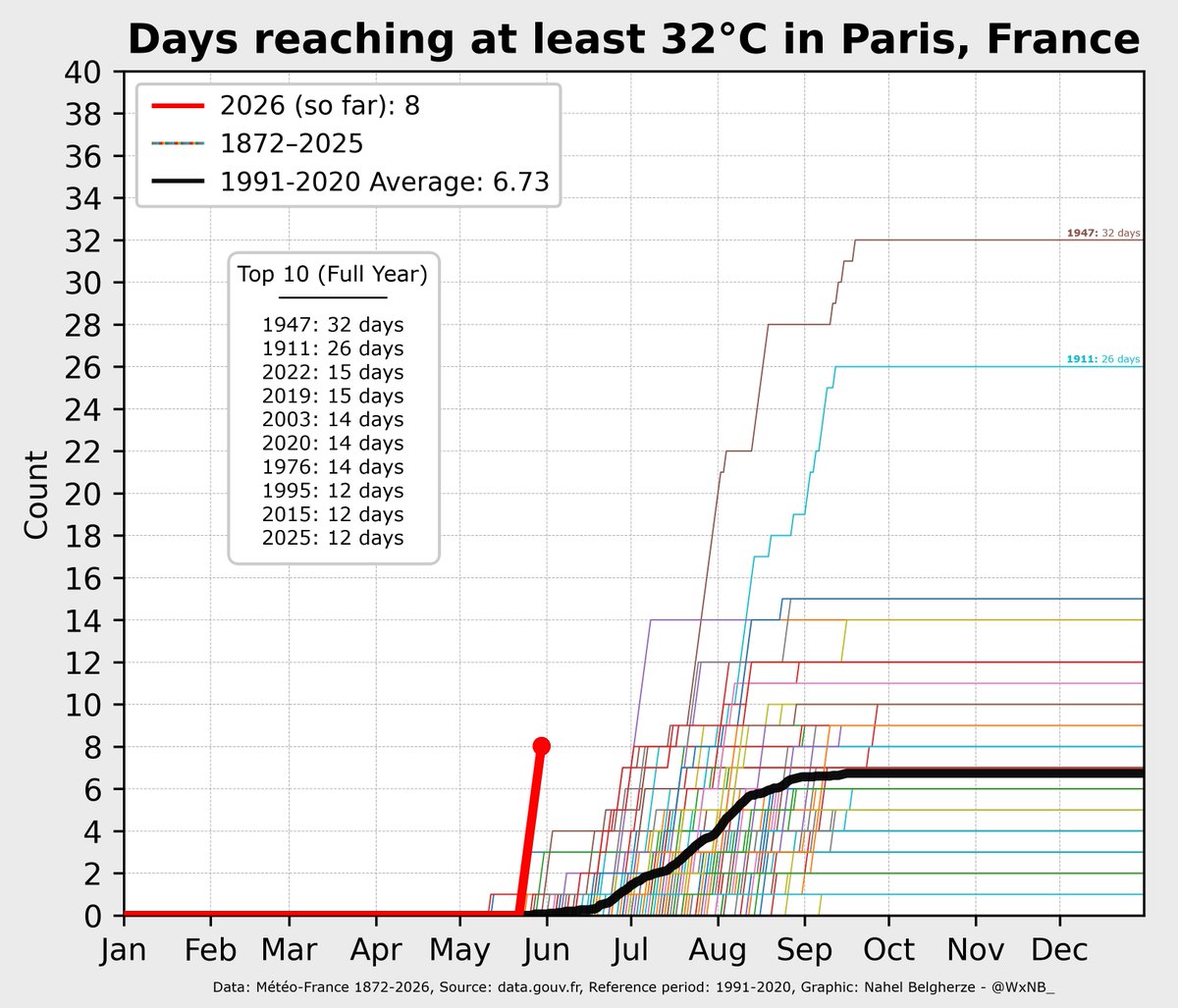
Hard to believe I’m even writing this.
Meteorological summer hasn’t even begun, yet Paris, France has already logged more days above 32°C (89.6°F) than its annual average.
Abbott was booted out of one of the safest Liberal seats in the country before he went on to advise and mentor Dutton, who then led the Liberals to their biggest electoral disaster ever
Liberals aren’t just entitled and moronic; they’re clearly masochistic
Congratulations @HonTonyAbbott on being elected Federal President of the Liberal Party of Australia.
A proud Liberal, a former Prime Minister and one of the great campaigners of Australian politics. Tony’s energy, experience and unwavering commitment to our values will help drive the next chapter of our Party’s renewal. 🇦🇺
Canada strongly condemns Russia’s launch of large-scale missile and drone attacks on civilian targets in Kyiv tonight.
For more than four years since Russia’s illegal invasion, it has greatly underestimated the courage, determination, and strength of the Ukrainian people — even as Putin’s regime has relentlessly bombed Ukrainian energy infrastructure, schools, hospitals, and homes.
We call on Russia to immediately cease these strikes and end this illegal war of aggression. They prolong human suffering and do nothing to change the fact that Russia will lose this war.
Canada will continue working closely with international partners to secure a just and lasting peace for Ukraine and Europe.
"A ten-year-old started screaming about a wave no one could see—and 100 people lived because her parents believed her.
December 26, 2004. Mai Khao Beach, Phuket, Thailand. Christmas holiday. Perfect weather. The Smith family walked along the sand on their first overseas vacation together.
Then Tilly noticed something wrong.
The water wasn't behaving normally. ""It wasn't calm and it wasn't going in and then out,"" she later recalled. ""It was just coming in and in and in.""
The sea had turned frothy—""like you get on a beer,"" she said. ""It was sort of sizzling.""
Any other ten-year-old might have thought it strange. Tilly knew exactly what it meant.
Two weeks earlier, her geography teacher Andrew Kearney had shown the class footage of the 1946 tsunami that devastated Hawaii. He taught them the warning signs: sea receding unusually far, frothy bubbling water, ocean behaving strangely.
Tilly was watching those exact warning signs unfold in front of her.
She started screaming at her parents. ""There's going to be a tsunami!""
They didn't believe her. They couldn't see any wave. The sky was clear. The beach was calm.
But Tilly wouldn't stop. She became more insistent, more frantic.
""I'm going,"" she finally said. ""I'm definitely going. There is definitely going to be a tsunami.""
Her father Colin heard the urgency in her voice. He decided to trust his daughter.
By coincidence, a Japanese man nearby overheard Tilly use the word ""tsunami."" He'd just heard news of an earthquake in Sumatra. ""I think your daughter's right,"" he said.
Colin alerted hotel staff. They began evacuating immediately.
Tilly's mother Penny was one of the last to leave. She had to sprint as the water began rushing in behind her. ""I ran,"" she recalled, ""and then I thought I was going to die.""
They made it to the second floor with seconds to spare.
Then the wave hit. Thirty feet tall.
Everything on the beach—beds, palm trees, debris—was swept into the pool and beyond. ""Even if you hadn't drowned,"" Penny later said, ""you would have been hit by something.""
The 2004 Indian Ocean tsunami killed over 230,000 people across 14 countries. Entire beaches in Phuket were wiped out.
But at Mai Khao Beach, not a single person died.
Because a ten-year-old girl paid attention in geography class.
Tilly was hailed as the ""Angel of the Beach."" She received awards, spoke at the United Nations, met Bill Clinton. Her story is now taught in schools worldwide.
Her father Colin still thinks about what could have happened. ""If she hadn't told us, we would have just kept on walking,"" he said. ""I'm convinced we would have died.""
Tilly still credits her teacher. ""If it wasn't for Mr. Kearney,"" she told the UN, ""I'd probably be dead and so would my family.""
Two weeks. One lesson. One hundred lives.
That's the power of education.
La Chine vient peut-être de créer l’un des matériaux les plus importants des prochaines années.
Des chercheurs de l’Université forestière de Nanjing ont développé un plastique fabriqué à partir de bambou.
Et le plus fou c’est qu’il est aussi résistant que le plastique classique.
Sauf qu’au lieu de rester dans la nature pendant des centaines d’années…
il peut se dégrader en environ 50 jours.
Quand on sait que le monde produit plus de 400 millions de tonnes de plastique chaque année, ça paraît presque irréel.
Le détail qui surprend le plus, c’est que ce matériau ne vient pas du pétrole.
Il vient du bambou.
Une plante capable de pousser jusqu’à 1 mètre par jour et connue pour absorber d’énormes quantités de CO₂.
Les chercheurs expliquent aussi que ce nouveau plastique pourrait être utilisé pour :
Des emballages, des objets du quotidien, des composants industriels, et même certaines pièces automobiles.
Donc on ne parle pas d’un “plastique écologique fragile”.
Les tests montrent une résistance impressionnante, supérieure à certains plastiques déjà utilisés aujourd’hui.
Et même après recyclage…
Le matériau conserverait encore environ 90 % de sa solidité.
Évidemment, il reste encore des défis.
Les 50 jours de dégradation dépendent de conditions précises et les tests à grande échelle sont encore en cours.
Mais une chose est sûre :
Le simple fait qu’un matériau biodégradable puisse rivaliser avec le plastique pétrolier aurait semblé impossible il y a encore quelques années.
Et si le futur du plastique venait finalement… du bambou ?
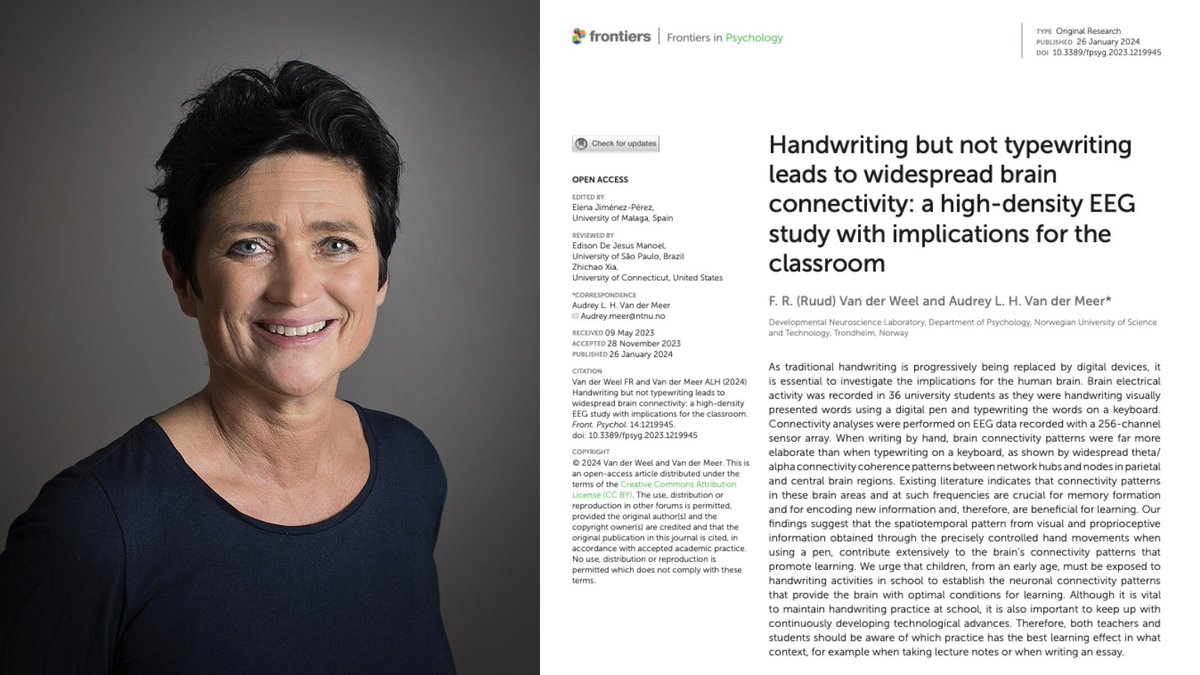
A Norwegian neuroscientist spent 20 years proving that the act of writing by hand changes the human brain in ways typing physically cannot, and almost nobody outside her field has read the paper.
Her name is Audrey van der Meer.
She runs a brain research lab in Trondheim, and the paper that closed the argument was published in 2024 in a journal called Frontiers in Psychology. The finding is brutal enough that it should have changed every classroom on Earth.
The experiment was simple. She recruited 36 university students and put each one in a cap with 256 sensors pressed against their scalp to record brain activity. Words flashed on a screen one at a time.
Sometimes the students wrote the word by hand on a touchscreen using a digital pen, and sometimes they typed the same word on a keyboard. Every neural response was recorded for the full five seconds the word stayed on screen.
Then her team looked at the part of the data most researchers had ignored for years, which is how different parts of the brain were communicating with each other during the task.
When the students wrote by hand, the brain lit up everywhere at once.
The regions responsible for memory, sensory integration, and the encoding of new information were all firing together in a coordinated pattern that spread across the entire cortex. The whole network was awake and connected.
When the same students typed the same word, that pattern collapsed almost completely.
Most of the brain went quiet, and the connections between regions that had been alive seconds earlier were nowhere to be found on the EEG.
Same word, same brain, same person, and two completely different neurological events.
The reason turned out to be something nobody had really paid attention to before her work. Writing by hand is not one motion but a sequence of thousands of tiny micro-movements coordinated with your eyes in real time, where each letter is a different shape that requires the brain to solve a slightly different spatial problem.
Your fingers, wrist, vision, and the parts of your brain that track position in space are all working together to produce one letter, then the next, then the next.
Typing throws all of that away. Every key on a keyboard requires the exact same finger motion regardless of which letter you are pressing, which means the brain has almost nothing to integrate and almost no problem to solve.
Van der Meer said it plainly in her interviews.
Pressing the same key with the same finger over and over does not stimulate the brain in any meaningful way, and she pointed out something that should scare every parent who handed their kid an iPad.
Children who learn to read and write on tablets often cannot tell letters like b and d apart, because they have never physically felt with their bodies what it takes to actually produce those letters on a page.
A decade before her, two researchers at Princeton ran the same fight using a completely different method and ended up at the same answer. Pam Mueller and Daniel Oppenheimer tested 327 students across three experiments, where half took notes on laptops with the internet disabled and half took notes by hand, before testing everyone on what they actually understood from the lectures they had watched.
The handwriting group won by a wide margin on every question that required real understanding rather than surface recall.
The reason was hiding in the transcripts of what the two groups had actually written down.
The laptop students typed almost word for word, capturing more total content but processing almost none of it as they went, while the handwriting students physically could not write fast enough to transcribe a lecture in real time, which forced them to listen carefully, decide what actually mattered, and put it in their own words on the page.
That single act of choosing what to keep was the learning itself, and the keyboard had quietly skipped the choosing and skipped the learning along with it.
Two studies. Two countries. Same answer.
Handwriting makes the brain work. Typing lets it coast.
Every note you have ever typed instead of written went into your brain through a thinner pipe. Every meeting, every book highlight, every idea you captured on your phone instead of on paper was processed at half depth.
You did not forget those things because your memory is bad. You forgot them because typing never woke the part of the brain that would have made them stick.
The fix is the thing your grandmother already knew.
Pick up a pen. Write the thing down. The slower road is the faster one.
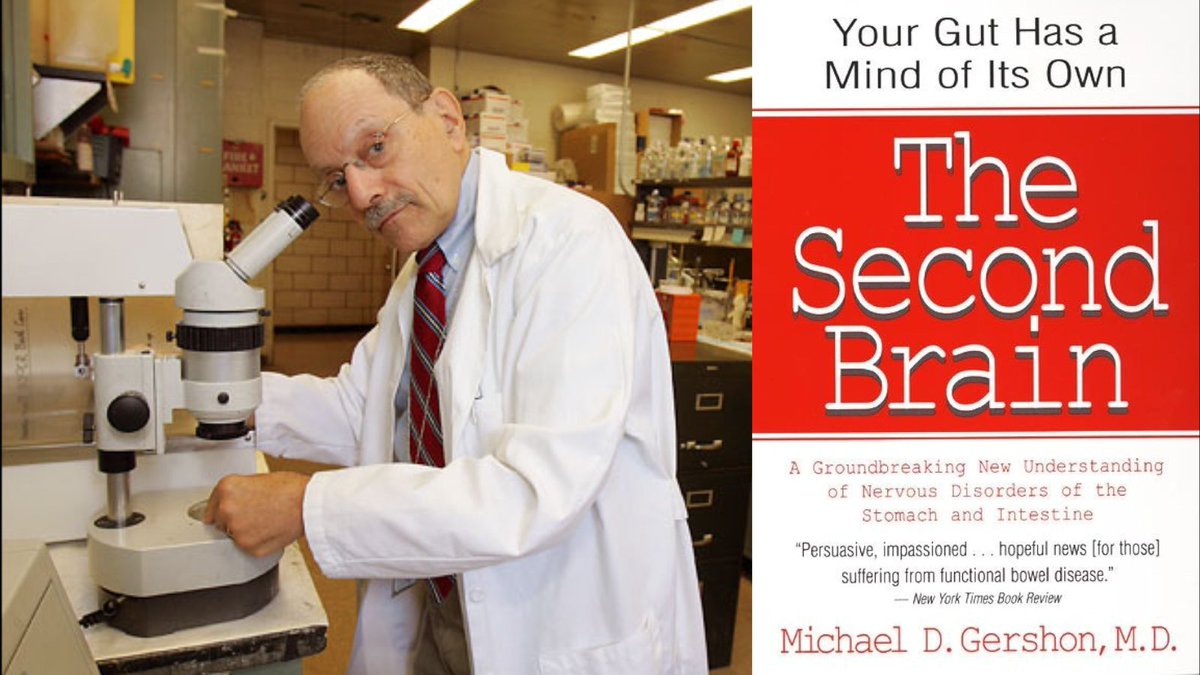
A neurobiologist at Columbia spent 30 years proving that the gut has its own brain, and the day he finally published the book that named it, almost every psychiatrist in America stopped returning his calls.
His name is Michael Gershon.
He runs the Department of Anatomy and Cell Biology at Columbia University Medical Center in New York, and the field he built from the ground up is called neurogastroenterology in short brain-gut axis.
The book that announced it to the world was published in 1998, and the title alone tells you everything about what he was up against. He called it The Second Brain.
The claim sounded like science fiction in the 1990s. Gershon was saying that the human gut contains its own fully functional nervous system, with around 100 million neurons embedded in the walls of the alimentary canal, which is the nine-meter tube running from your esophagus to your anus.
That is more neurons than your entire spinal cord, and more than your entire peripheral nervous system put together. The gut was not just digesting food. It was running its own intelligence, with its own reflexes, its own memory, and its own way of deciding what to do without asking the brain in your head for permission.
The medical establishment treated this as borderline heretical when he first started publishing it. The brain was supposed to be the command center. Everything else was supposed to be the periphery. A second brain in the belly did not fit the architecture anyone had been taught.
Then the data started piling up, and it was impossible to argue with.
The first finding that broke the old model was about serotonin. You might have heard Andrew Huberman talking about it on his podcasts. Serotonin is the neurotransmitter associated with mood, well-being, sleep, and depression. Every antidepressant on the market targets it.
The assumption for decades was that serotonin was a brain chemical, produced in the brain, regulated in the brain, and responsible for what happened inside the brain.
Gershon's lab showed that 90 to 95 percent of the body's serotonin is not produced in the brain at all. It is produced in the gut, by specialized cells called enterochromaffin cells embedded in the intestinal lining.
Your stomach and intestines are the largest serotonin factory in the human body, and the brain in your skull is producing only a tiny fraction of what is circulating below your neck.
The second finding was even harder to swallow. The vagus nerve is the longest cranial nerve in the body, running from the base of the brain down through the neck, the chest, and into the abdomen, where it branches into the gut. For most of the 20th century, doctors assumed the vagus was the brain's way of giving orders to the digestive system, in the same way the brain gives orders to the rest of the body.
The actual measurements showed almost the opposite. Roughly 90 percent of the fibers in the vagus nerve are carrying signals upward, from the gut to the brain, and only a small fraction are carrying signals downward. Your gut is sending nine times more information to your head than your head is sending to your gut.
The bandwidth is wildly asymmetrical, and almost all of it is going in a direction the medical textbooks had quietly been wrong about for decades.
The implication of those two findings together is what changed psychiatry.
If most of your serotonin is being produced in your gut, and most of the information flowing through your vagus nerve is moving from your gut to your brain, then your mood is being shaped from the bottom up far more than it is being directed from the top down.
The feeling of dread before a difficult meeting. The sudden clarity after a good meal. The low-grade anxiety that will not go away no matter how much you talk through it. All of it is downstream of signals that started below your diaphragm.
A 2019 study at McMaster University put the final piece in place. Researchers gave mice oral antidepressants and watched what happened. The drugs activated the vagus nerve from the gut side, and the gut-to-brain signaling was what produced the antidepressant effect.
When they cut the vagus nerve and tried the same drugs, the antidepressant effect disappeared completely. The drug was not working on the brain directly. It was working on the gut, and the gut was working on the brain.
The follow-up research on the microbiome made the connection even tighter. Mice raised in completely sterile environments with no gut bacteria produced about 60 percent less serotonin in their intestines than normal mice. When the bacteria were reintroduced, serotonin production returned to normal.
The trillions of microorganisms living in your digestive tract are not passengers. They are running the factory that makes the chemical your antidepressant is trying to manipulate.
The most haunting line from Gershon's interviews is the one I keep coming back to.
He said the second brain does not do philosophy or poetry, and it cannot help you write a novel. But it is the brain that decides whether you wake up in the morning feeling like the day is full of possibility or feeling like something is wrong before anything has even happened.
The mood you assume your conscious mind is generating from your thoughts is mostly being generated underneath you, by a nervous system you cannot feel and cannot consciously access, in an organ you have spent your entire life thinking about as a digestion machine.
The decision your gut makes about how you are going to feel arrives in your head a fraction of a second before your brain catches up to it. The conscious thought is the explanation your mind invents for a verdict that has already been reached somewhere lower.
You did not feel uneasy because you were thinking dark thoughts.
You started thinking dark thoughts because your gut was already uneasy.
A neurobiologist at Columbia spent 30 years proving that the gut has its own brain, and the day he finally published the book that named it, almost every psychiatrist in America stopped returning his calls.
His name is Michael Gershon.
He runs the Department of Anatomy and Cell Biology at Columbia University Medical Center in New York, and the field he built from the ground up is called neurogastroenterology in short brain-gut axis.
The book that announced it to the world was published in 1998, and the title alone tells you everything about what he was up against. He called it The Second Brain.
The claim sounded like science fiction in the 1990s. Gershon was saying that the human gut contains its own fully functional nervous system, with around 100 million neurons embedded in the walls of the alimentary canal, which is the nine-meter tube running from your esophagus to your anus.
That is more neurons than your entire spinal cord, and more than your entire peripheral nervous system put together. The gut was not just digesting food. It was running its own intelligence, with its own reflexes, its own memory, and its own way of deciding what to do without asking the brain in your head for permission.
The medical establishment treated this as borderline heretical when he first started publishing it. The brain was supposed to be the command center. Everything else was supposed to be the periphery. A second brain in the belly did not fit the architecture anyone had been taught.
Then the data started piling up, and it was impossible to argue with.
The first finding that broke the old model was about serotonin. You might have heard Andrew Huberman talking about it on his podcasts. Serotonin is the neurotransmitter associated with mood, well-being, sleep, and depression. Every antidepressant on the market targets it.
The assumption for decades was that serotonin was a brain chemical, produced in the brain, regulated in the brain, and responsible for what happened inside the brain.
Gershon's lab showed that 90 to 95 percent of the body's serotonin is not produced in the brain at all. It is produced in the gut, by specialized cells called enterochromaffin cells embedded in the intestinal lining.
Your stomach and intestines are the largest serotonin factory in the human body, and the brain in your skull is producing only a tiny fraction of what is circulating below your neck.
The second finding was even harder to swallow. The vagus nerve is the longest cranial nerve in the body, running from the base of the brain down through the neck, the chest, and into the abdomen, where it branches into the gut. For most of the 20th century, doctors assumed the vagus was the brain's way of giving orders to the digestive system, in the same way the brain gives orders to the rest of the body.
The actual measurements showed almost the opposite. Roughly 90 percent of the fibers in the vagus nerve are carrying signals upward, from the gut to the brain, and only a small fraction are carrying signals downward. Your gut is sending nine times more information to your head than your head is sending to your gut.
The bandwidth is wildly asymmetrical, and almost all of it is going in a direction the medical textbooks had quietly been wrong about for decades.
The implication of those two findings together is what changed psychiatry.
If most of your serotonin is being produced in your gut, and most of the information flowing through your vagus nerve is moving from your gut to your brain, then your mood is being shaped from the bottom up far more than it is being directed from the top down.
The feeling of dread before a difficult meeting. The sudden clarity after a good meal. The low-grade anxiety that will not go away no matter how much you talk through it. All of it is downstream of signals that started below your diaphragm.
A 2019 study at McMaster University put the final piece in place. Researchers gave mice oral antidepressants and watched what happened. The drugs activated the vagus nerve from the gut side, and the gut-to-brain signaling was what produced the antidepressant effect.
When they cut the vagus nerve and tried the same drugs, the antidepressant effect disappeared completely. The drug was not working on the brain directly. It was working on the gut, and the gut was working on the brain.
The follow-up research on the microbiome made the connection even tighter. Mice raised in completely sterile environments with no gut bacteria produced about 60 percent less serotonin in their intestines than normal mice. When the bacteria were reintroduced, serotonin production returned to normal.
The trillions of microorganisms living in your digestive tract are not passengers. They are running the factory that makes the chemical your antidepressant is trying to manipulate.
The most haunting line from Gershon's interviews is the one I keep coming back to.
He said the second brain does not do philosophy or poetry, and it cannot help you write a novel. But it is the brain that decides whether you wake up in the morning feeling like the day is full of possibility or feeling like something is wrong before anything has even happened.
The mood you assume your conscious mind is generating from your thoughts is mostly being generated underneath you, by a nervous system you cannot feel and cannot consciously access, in an organ you have spent your entire life thinking about as a digestion machine.
The decision your gut makes about how you are going to feel arrives in your head a fraction of a second before your brain catches up to it. The conscious thought is the explanation your mind invents for a verdict that has already been reached somewhere lower.
You did not feel uneasy because you were thinking dark thoughts.
You started thinking dark thoughts because your gut was already uneasy.


![Rainmaker1973's tweet photo. Professor Omar Yaghi, a chemist at the University of California, Berkeley and winner of the 2025 Nobel Prize in Chemistry, has developed an innovative atmospheric water generator capable of producing up to 1,000 liters of clean drinking water per day directly from dry air.
Using reticular chemistry and advanced metal-organic frameworks (MOFs), the system efficiently captures moisture even in arid desert conditions with very low humidity. The compact, shipping-container-sized units developed by Yaghi’s company, Atoco, operate entirely off-grid using only ultra-low-grade ambient thermal energy or sunlight, requiring no electricity from the grid.
This sustainable technology offers a promising alternative to energy-intensive desalination plants, which often harm marine ecosystems through brine discharge. It is particularly valuable for remote communities, drought-prone regions, and areas affected by natural disasters such as hurricanes in the Caribbean, where centralized water infrastructure may fail.
Yaghi’s personal experience growing up with water scarcity in a refugee community in Jordan has deeply influenced his work. He advocates for scaling decentralized, resilient solutions to address the global water crisis through scientific innovation.
[Atoco official website and related coverage in Interesting Engineering, Food & Wine, and Nobel Prize announcements (2025–2026)]](https://pbs.twimg.com/media/HJuxBASWUAA9qkv.jpg)