Are aliens real?
Almost certainly.
Has the US govt been covering up aliens visiting earth?
Probably.
If aliens are real does that mean God doesn't exist?
Why would it?
#DisclosureDay#movie#moviereview
https://t.co/eTP3fMbFjB
@Nerdrotics Man what's up with this hate on Supergirl? There's no race-swapping, no misandry, no gay stuff crammed in, no nothing like that, yet for some reason it's been lumped in with movies like that. But this is just good wholesome old-school Supergirl like she's always been.
@cosmicbooknews She didn't say Christians suck. She said some of the people who were saying nasty things about her online had "Christian Dad" in their bio, which she thought in light of their behavior was absurd.
@MericaCulture She didn't say Christians suck. She said some of the people who were saying nasty things about her online had "Christian Dad" in their bio, which she thought in light of their behavior was absurd.
@ParaN_rmal Those are called demons, and we've known about them for a very long time.
And there's measures you can take to protect against them by the way...
@gracieback2 3. This is no different than when Christians discovered Native Americans. Their beliefs were unbiblical, but that didn't make them demons. They're just people living somewhere else with antichrist beliefs.
4. Some therapist's opinion on aliens is not evidence that they're demons
@gracieback2 1. The existence of God and the existence of aliens are not contradictory or necessarily mutually exclusive.
2. Yes satan is the prince of the air, but that doesn't mean everything we see in the sky is evil, like clouds, or stars, or airplanes.
@AwakenedOutlaw This wouldn't be the first time in history Christians discovered different kinds of people living in a place we didn't know existed. It doesn't bother me at all.
@howertonjosh Why would we assume they're demons? It certainly wouldn't be the first time in history that we discovered different kinds of people living in a place we didn't know existed.
@RcgWho47810@Protestia What the heck does "understanding they are attractive" even mean? People aren't robots, attraction isn't an intellectual evaluation. And sexual desire is not the same as lust. You're making odd arbitrary distinctions.
"If I told you there was one free thing you could do every Sunday that would make your kids happier, healthier, smarter, and closer to you, you'd think I was selling something."
Take your kids to church regularly. I don't care if you believe. The data is so lopsided that skipping it is the parenting equivalent of refusing vegetables because you don't like the taste.
Grades. Religious teens get As at almost twice the rate of nonreligious teens. In a class of 100, that's 24 A-students instead of 14. Church gives a kid the same academic boost as being born rich instead of poor.
College. Working-class religious kids earn bachelor's degrees at double the rate of their nonreligious peers. Middle-class kids do it at 1.5x the rate. For families without a trust fund, this is one of the most powerful forms of upward mobility social scientists have measured.
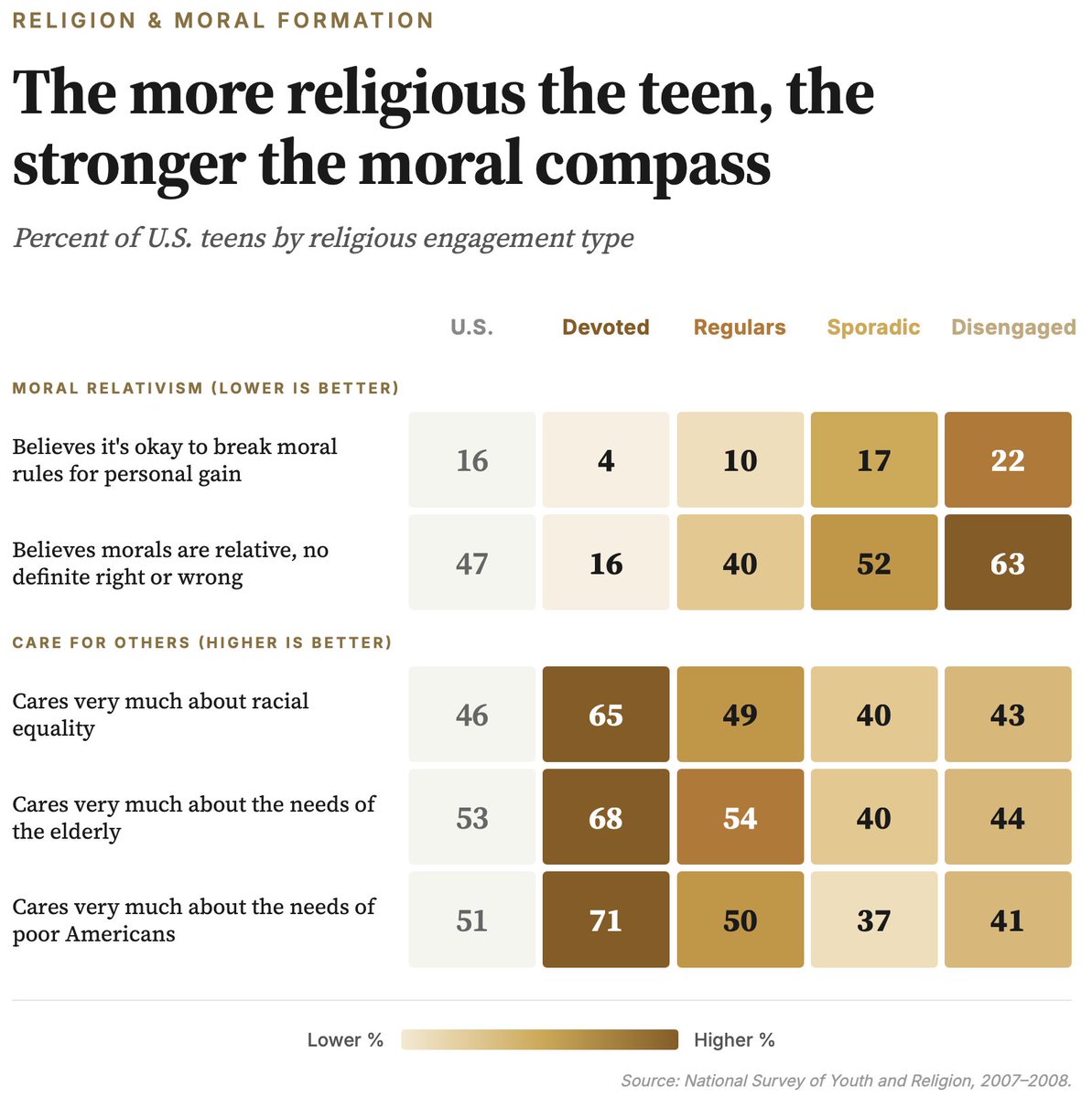
Character. Religious teens are far less likely to lie, cheat, or do things they hope their parents never find out about. They're more likely to care about racial equality, the elderly, and the poor. They reject the idea that morality is whatever works for you in the moment. That kind of kid doesn't happen by accident. It's built.
Closeness. 60% of parents of religious teens say they feel "extremely close" to their kid, compared to 50% of nonreligious parents. The kids report the same thing back. They get along better with their parents, talk about hard stuff, and actually want to spend time with their family.
Despair. Religious teens are dramatically less likely to be depressed, anxious, lonely, or feel that life is meaningless. 90% of devoted religious teens never binge drink, compared to 41% of the disengaged. Economists named the modern epidemic "deaths of despair." Regular church attendance is one of the strongest known buffers against it. Parents are spending fortunes trying to solve teen mental health. The most evidence-backed intervention is free.
Purpose. Religious young adults report higher purpose, gratitude, life satisfaction, and resilience. These are the exact traits every parent says they want their kid to have.
Here's why it works. Affluent families already surround their kids with networks of stable, accomplished adults through neighborhoods, schools, and parents' colleagues. Working and middle-class families usually don't. A congregation is often the last institution in American life that puts your kid in weekly contact with dozens of stable, employed, sober adults who know their name. It used to be called "a village." Now it barely exists outside of churches.
"But I don't believe." Your kid doesn't need your theology. They need you to show up.
"But church is boring." So is sitting through a kindergarten music recital. Parenting is the deliberate choice to be bored on purpose for someone you love.
There's a church within 15 minutes of nearly every American home. You don't need money, connections, or credentials to walk in. Nothing else in this country will surround your kid with engaged adults, teach them moral seriousness, and give them a stable weekly rhythm at zero cost.
You already drive them to practices that produce far less. The free thing on Sunday produces more, on more dimensions, than almost anything else you do as a parent.
You don't have to believe anything. You just have to take them.