DC is turning streetlights into EV chargers.
That sounds small until you look at the problem it actually solves.
Voltpost plans up to 16 Level 2 chargers on existing streetlights and utility poles. The grant pool is $609,500, split across three companies, and it comes from Volkswagen settlement money.
This is not a Supercharger story.
Tesla already made long distance EV travel feel normal.
The harder city problem is different:
what happens when you live in an apartment, park on the street, and cannot plug in overnight?
For those drivers, the killer feature is not the fastest charger.
It is a charger already on the block, using infrastructure the city already owns.
That is where EV adoption gets real:
road trips need fast charging.
city ownership needs curbside charging.
Just spent two hours hand washing and polishing our Tesla with my wife. Funny how this is the first car we’ve ever actually treated like it deserves a spa day. It is a robot on wheels that keeps us safe and somehow makes road trips effortless instead of draining. Team Tesla ❤️
@MarketPalmer_ Wild to see how dominance shifts. IBM ruled the 80s, Exxon owned the 90s, GE had its moment, and then Microsoft started taking over. Makes you wonder which company will own the next era.
@SawyerMerritt@DirtyTesLa 5,000 robotaxis in Vegas is going to change how the city moves. Curious to see how fast the approval comes through and how locals react once these hit the streets.
@bindureddy I wouldn’t underestimate Demis Hassabis and Google DeepMind. They’ve been methodically building toward long term breakthroughs. If they decide to push a new iteration focused on agentic loops, the landscape could shift fast.
@bcherny Huge win for anyone pushing big projects. Doubling the 5 hr rate limit makes Claude Cowork feel like an actual teammate ready to take on the messy stuff.
@CathieDWood The SpaceX IPO is going to grab all the headlines, but the real story is how much value is being created in private markets right now. Companies are scaling huge before ever going public. Investors who wait for the listing might already be late.
@The_AI_Investor The demand for memory chips is only going to get heavier as AI scales. If the US can’t ramp up high volume fabs fast enough, companies like Micron might end up holding even more leverage in the market.
@Teslarati Cold gas thrusters on a production car is such a wild crossover of Tesla and SpaceX energy. Can’t wait to see if they actually pull off that kind of launch feel on the Roadster.
@Leooweb3 Feels like when everything is crashing the best move might be patience. Sometimes the smartest buy is waiting for the real bottom to show itself.
@chamath@wholemars If Google and Anthropic are locking in $2B a month for compute, that’s not a small bet. Question is how long they hold that burn before they want more than just capacity in return.
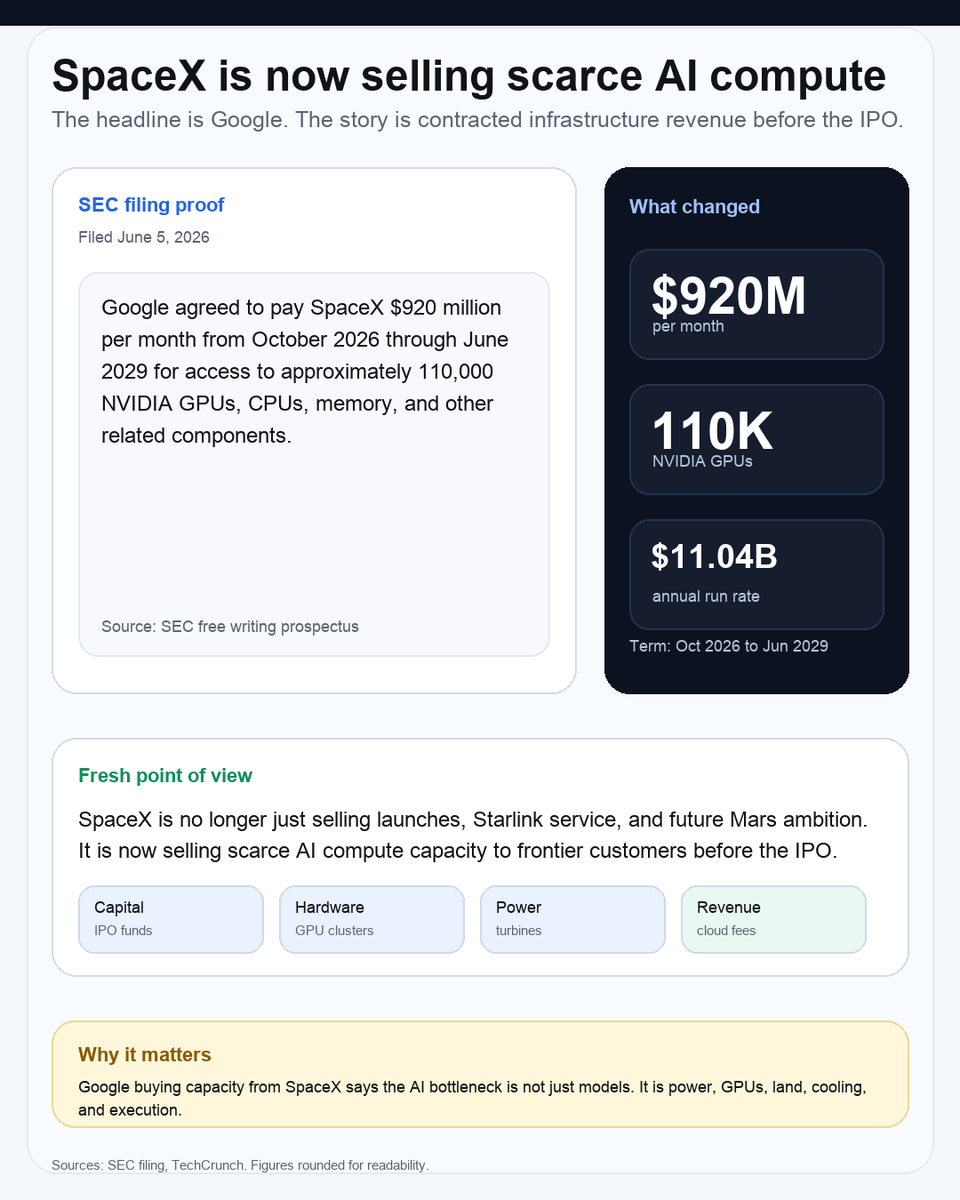
Everyone is posting this as SpaceX just got a giant Google check.
That is true.
But the more important read is this:
SpaceX is turning compute into a contracted infrastructure business right before the IPO.
The SEC filing says Google will pay SpaceX $920 million per month from October 2026 through June 2029 for access to about 110,000 NVIDIA GPUs plus CPUs, memory and related components.
At full rate, that is $11.04 billion a year.
Google said this is bridge capacity for surging Gemini Enterprise demand.
That line matters.
Google is already one of the biggest AI compute owners on Earth.
If Google still needs outside capacity from SpaceX, the bottleneck is not just models.
It is power, GPUs, land, cooling, networking and execution speed.
The caveat is important too.
After Dec 31, 2026, either side can terminate with 90 days notice.
So this is not permanent guaranteed revenue.
But it is still a huge signal.
SpaceX already disclosed Anthropic at $1.25 billion per month through May 2029.
Now Google adds another $920 million per month.
At full rate, those two outside compute deals point to more than $2.1 billion per month of AI infrastructure demand.
That changes the IPO story.
SpaceX is not just rockets.
It is not just Starlink.
It is not just Mars.
It is becoming a physical infrastructure layer for the AI race.
Launch capacity got SpaceX here.
Compute capacity may be the next business Wall Street has to price.
@TedPillows Feels like cash is just hiding under a mattress right now. When every asset class is bleeding, it’s either pure fear or people are just sitting on the sidelines waiting for a spark.
This chart is why the SpaceX IPO matters.
It is not just another liquidity event.
It is the moment public markets may finally put a direct price on one of Elon Musk’s biggest compounding engines.
Forbes has Elon around $822 billion today.
SpaceX has filed IPO terms at 555,555,555 Class A shares and $135 per share, implying a valuation around $1.75 trillion.
If you apply that valuation to Elon’s estimated SpaceX stake, the math pushes his paper wealth toward roughly $1.06 trillion.
That number is not the real story though.
The real story is how the wealth was built.
Tesla made EVs scalable.
SpaceX made rockets reusable.
Starlink turned launches into global internet infrastructure.
xAI is now tied into the same machine.
Energy, robotics, autonomy, satellites, AI, and launch economics are all compounding at once.
Most billionaires get rich from one dominant asset.
Elon is building multiple infrastructure layers that can reinforce each other for decades.
That is why this chart looks absurd.
It is not a spike.
It is stacked execution.
Elon just said Starlink is over 10,000 satellites in orbit.
The important part is not the number.
It is what the number turns into.
Every launch adds capacity.
Every launch adds coverage.
Every launch adds redundancy.
Every launch makes the network harder to copy.
This matters now because SpaceX has already filed concrete IPO terms.
555,555,555 Class A shares.
$135 per share.
About $74.4 billion in net proceeds.
Nasdaq ticker SPCX.
Pricing expected June 11.
Trading expected June 12.
Public markets are not just valuing rockets.
They are valuing the machine that turns launches into infrastructure.
Telecom companies build towers, lease spectrum, lay fiber, and negotiate country by country.
SpaceX launches its own infrastructure into orbit.
That is the difference.
Starlink is becoming a global connectivity layer that gets denser every time Falcon 9 flies.
Home internet was the first market.
Then mobility.
Then aviation.
Then maritime.
Then defense.
Then direct to cell.
This is why 10,000 satellites matters.
Every Falcon 9 launch is not just a mission.
It is another layer of enterprise value for SpaceX.
The next question is not whether Starlink works.
The question is how much of global connectivity eventually moves above the ground.
@markgurman Feels like Apple is testing the waters without fully jumping in. Calling it “beta” makes sense, but a waitlist for Siri upgrades is going to frustrate people who just want to try it now. Curious how long they’ll keep it in this half step before committing.