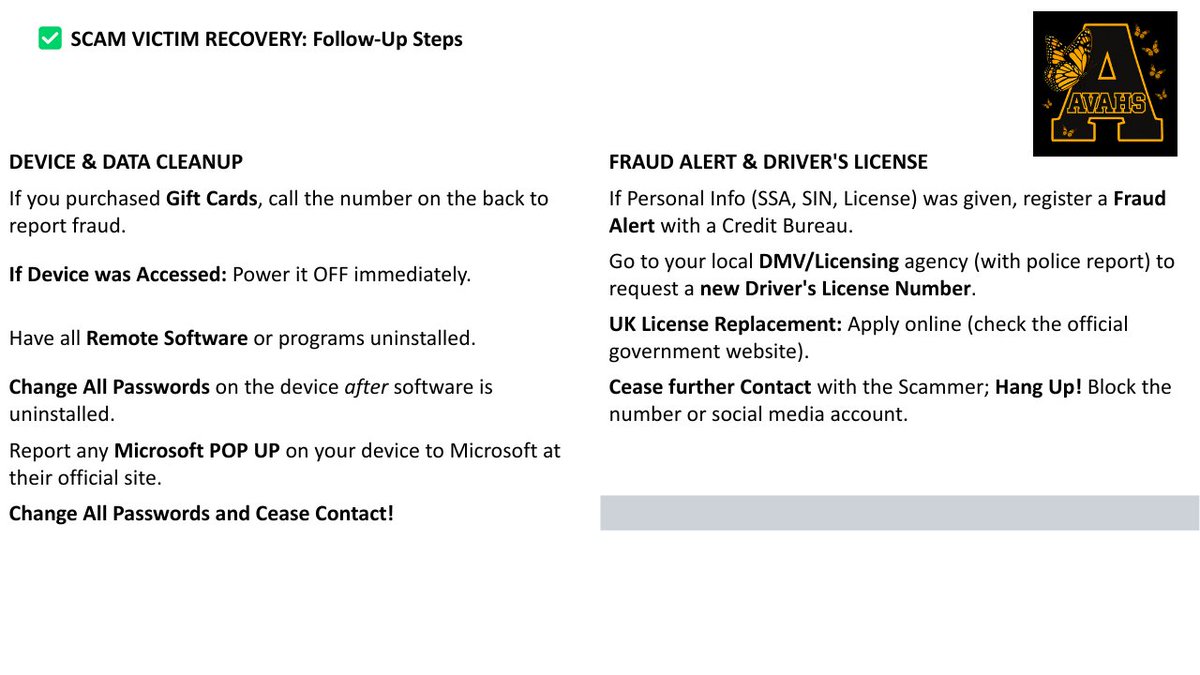
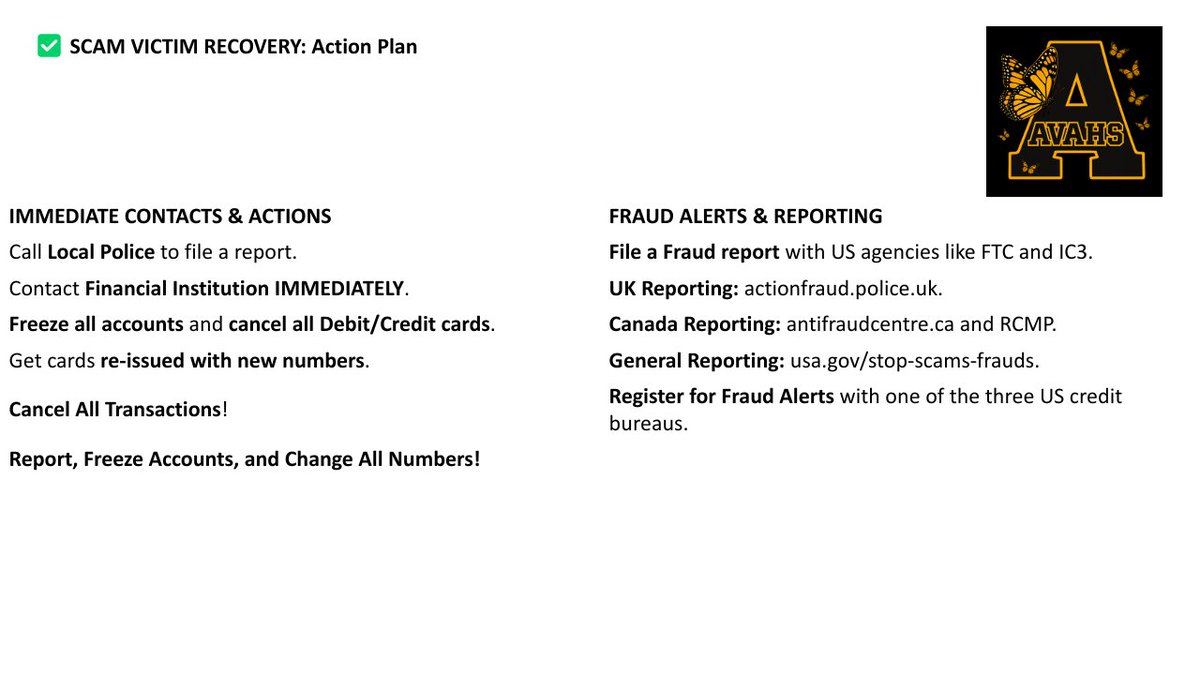
If You've been scammed, document, block, file police and IC3 (or countries equivalent) report, and contact your bank. Questions? DM myself or @cagneyavah
• If cryptocurrency was used, act immediately — recovery is rare but possible if funds are traced before they are moved. Report all wallet addresses and transaction IDs to IC3 (https://t.co/JOBOOHSkiQ) and contact the exchange involved right away, as they can sometimes freeze accounts. Do NOT send any more money even if told it will unlock or recover funds — that is almost always a secondary scam. If a forensic report is needed for law enforcement or legal proceedings, reputable blockchain intelligence firms include Chainalysis, TRM Labs, and Elliptic.
Many accounts on social media claim they can recover your funds/accounts after a grandparent or emergency scam. They are scammers preying on victims. The only ones who can help are your bank or wire service through their official fraud departments — contact them directly, never through anyone who reaches out to you first.
Need Help?
AVAHS Outreach
(Anti-Victimization Advocacy and Help Services) is a group of certified victim advocates offering free support to scam victims. They can guide you on the steps to take.
Visit: https://t.co/u47ojJCrt6
[email protected]
Or reach out to them here,
@CagneyAvah@DianaPrinceAVAH
Stay informed
Check https://t.co/oboUyE8kSb for scam alerts and ask your employer about cybersecurity or scam awareness training to spot red flags like fake emails or calls.
AVAHS YouTube channel: https://t.co/vHOuFSWX0i
Useful links
IC3 Report (FBI): https://t.co/nretATQWFs
Seraph Secure: Scans for and removes remote access software that scammers may use to monitor or steal information from your computer. Note: Windows includes pre-installed remote access software, so finding one doesn’t always indicate a scam. Available on Windows 10/11 and Mac 10.15+.
https://t.co/lkKV1K4Uw2
Malwarebytes: A reliable virus scanner.
https://t.co/RfviylRvqk
● Stay safe, and check out the attached images for more info!
Day 4
Watch out for these scams!
Hi Everyone!
Today we’re covering Grandparent and Family Emergency Scams.
Grandparent and Family Emergency Scams
Grandparent and family emergency scams are a devastating form of impersonation fraud. While exact 2025 subcategory numbers vary, these emotional scams contribute to the hundreds of millions lost annually in confidence/romance and impersonation categories (FBI IC3 reported $929M in Confidence/Romance and $798M in Government Impersonation losses in 2025 — up from $672M and $406M respectively in 2024). FTC Consumer Sentinel data captures this directly: the Family & Friend Imposters subcategory recorded 26,032 reports and $82.6 million in losses, while Government Imposters added 299,587 reports and $773.9 million — making impersonation fraud one of the most reported and costly categories in 2025.
Scammers call or text claiming to be a grandchild, child, or other family member in trouble—often using AI-generated voices cloned from social media videos or public recordings. Common stories: 'I was in a car accident and hurt someone,' 'I’m in jail and need bail,' 'My phone was stolen and I’m stranded,' or 'I’m kidnapped.'
They create urgency so you don’t verify, then quickly hand off to a 'lawyer,' 'police officer,' or 'kidnapper' demanding immediate wire transfer, gift cards, or crypto. They may reference real family details from data breaches or social media to sound convincing.
Social Engineering Tactics
Scammers manipulate fear, love, and urgency to bypass critical thinking. Here’s how:
• Create Urgency: Claim a loved one is in immediate danger, arrested, or needs money 'right now' before it’s too late.
• Impersonate Authority or Family: Use voice cloning, spoofed numbers, or pose as police/lawyers to gain compliance.
• Exploit Research: Pull names, ages, locations, and family details from social media, data breaches, or public records.
• Build False Trust: Friendly or panicked voices, specific personal details, and professional 'authorities' lower your guard.
Stay Safe: Pause and verify. Never send money or gift cards based on a single call or text claiming emergency. Use a pre-agreed family code word or callback to a known number. Keep social media private and limit personal details shared online.
Tips to Avoid
• Establish a family code word or verification question that only real family would know. Use it in any 'emergency' call.
• If you get a suspicious call claiming a family emergency, hang up and immediately call the person directly on their known number (or another trusted family member) to verify.
• Keep social media accounts private or friends-only. Avoid posting real-time location, vacation photos, or detailed family info publicly.
• Protect against data brokers: Request removal of your info from people-search sites or use services like Incogni, Aura, or DeleteMe.
• Be especially cautious if the caller uses AI-sounding voices, pressure, or refuses to let you call back the 'victim' directly.
If You’re a Victim
• Document everything: Call logs with numbers/times, any texts, payment methods used (gift card numbers, wire details, crypto tx hashes).
• Block the scammer’s number and any follow-up contacts immediately.
• File a police report and submit an IC3 report with the FBI—include all details and transaction info.
• Contact your bank, wire service (Western Union, MoneyGram), or gift card issuer immediately to report and request holds/chargebacks where possible.
*Check the first reply for more information.
You are correct. Only through official support channels is there any hope of getting an account back, or money returned.
I glanced through your profile and noticed you said you have been scammed. If you don't know what to do, please reach out to me or one of the victim advocates with AVAHS Outreach @CagneyAvah or @DianaPrinceAVAH so we can walk you through what steps you should take.
Useful links
IC3 Report (FBI): https://t.co/nretATQWFs
Seraph Secure: Scans for and removes remote access software that scammers may use to monitor or steal information from your computer. Note: Windows includes pre-installed remote access software, so finding one doesn’t always indicate a scam. Available on Windows 10/11 and Mac 10.15+.
https://t.co/lkKV1K4Uw2
Malwarebytes: A reliable virus scanner.
https://t.co/RfviylRvqk
Day 3
Watch out for these scams!
Hi Everyone!
Today we’re covering Prize, Sweepstakes, and Lottery Scams.
Prize, Sweepstakes, and Lottery Scams
In 2025, 5,623 people in the US reported $194.1 million in losses to prize, sweepstakes, and lottery scams according to the FBI IC3 Annual Report (up from $102.2 million across 3,690 complaints in 2024). FTC Consumer Sentinel data shows an even broader picture: 58,728 Prizes, Sweepstakes & Lotteries reports totaling $257.1 million across all 52 jurisdictions — with Q1 the worst quarter at 17,253 reports and $89 million. These scams remain common and often target older adults with promises of big winnings they never entered.
Scammers contact you by phone, email, text, or social media claiming you’ve won a large cash prize, car, or vacation from Publishers Clearing House, a lottery, or a sweepstakes you 'entered.' They may use official-sounding names or spoof caller ID.
To 'claim' your prize, they demand you pay 'taxes,' 'processing fees,' 'shipping,' or provide banking info 'for verification.' Once paid, they disappear or demand more. Some use fake checks that bounce after you deposit and send money back.
Social Engineering Tactics
Scammers use excitement, greed, and authority to cloud judgment in prize and lottery scams. Here’s how:
• Create Excitement: Promise life-changing winnings like cash, cars, or trips to trigger emotional decisions.
• Impersonate Authority: Pose as reputable companies (Publishers Clearing House, lottery officials, or government) to seem legitimate.
• Exploit Research: Use details from data breaches or social media to reference your name, location, or interests.
• Build False Trust: Professional emails, calls with fake IDs, or official-looking documents mimic real organizations.
Stay Safe: If you didn’t enter a contest, you didn’t win. Legitimate winners are almost always notified by mail or in person, not by unsolicited phone calls or emails demanding payment. Never pay anything to claim a prize.
Tips to Avoid
• If you didn’t enter, it’s a scam. Delete or hang up—do not engage.
• The odds of winning big lotteries legitimately are extremely low. Be skeptical of any 'you won' notification you didn’t expect.
• You should never have to pay taxes, fees, or shipping to claim legitimate winnings. Real lotteries deduct taxes automatically or handle it properly.
• Verify any claim independently by contacting the official organization through their verified website or phone number (found yourself, not from the message).
• Watch for fake checks or 'overpayment' scams where they send more than owed and ask you to wire back the difference.
If You’re a Victim
• Document everything: Save all emails, texts, call logs, any checks received, and payment records.
• Block the scammer’s number, email, and accounts immediately.
• File a police report and submit an IC3 report with the FBI.
• Contact your bank or payment platform immediately to dispute any payments and request chargebacks.
• If you deposited a fake check, contact your bank right away—they can advise on next steps (you may be liable for the amount if it bounces).
There are many accounts claiming they can help recover your 'winnings' or money—they are scammers preying on victims.
Need Help?
AVAHS Outreach
(Anti-Victimization Advocacy and Help Services) is a group of certified victim advocates offering free support to scam victims. They can guide you on the steps to take.
Visit: https://t.co/u47ojJCrt6
[email protected]
Or DM them here at
@CagneyAvah@DianaPrinceAVAH
Stay informed
Check https://t.co/oboUyE8kSb for scam alerts and ask your employer about cybersecurity or scam awareness training to spot red flags like fake emails or calls.
AVAHS YouTube channel: https://t.co/vHOuFSWX0i
Stay safe, and check out the attached images and my rely for more info and useful links!
Scammers pretending to be famous people are a big problem. Here are some stats from days 20, then 10 of a series of scam informational posts I am working on.
"AI-generated deepfakes and voice cloning are rising fast — in 2025 the FBI IC3 tracked AI-related cybercrime as its own category for the first time, recording 22,364 complaints and $893 million in losses. FTC data shows the primary vehicle: Miscellaneous Investments & Investment Advice — the category most exploited by AI-generated content — generated 96,126 reports and a staggering $6.47 billion in losses, the single largest FTC fraud loss category by far, peaking in Q3 at $1.76 billion. Scammers use deepfakes and voice cloning in grandparent scams, romance fraud, investment pitches, and to impersonate executives for business email compromise."
More targeted information from romance scams,
"In 2025, Romance scams caused $929 million in losses across 23,159 complaints per the FBI IC3 (up from $672 million in 2024). FTC Consumer Sentinel data shows an even broader picture: 50,854 romance scam reports with $1.287 billion in losses across all 52 jurisdictions — peaking in Q3 ($358.8M). Scammers build long-term relationships (often on dating apps, social media, or email) to gain trust before requesting money for "emergencies," "investments," or travel."
It's a big problem.
@Kevin_is_human Was watching a Livestream today, and warned them about what happened. People replied they hadn't heard anything about this... We need the word spread more!!
Today is day 1 of sending my Senators @SenAdamSchiff and @AlexPadilla4CA each a letter to let them know that I DO NOT want them to vote in favor of the NDAA with §219 or any other provision merging Israel with US forces in any way
Go to https://t.co/csMZBt6isl to do the same
If You’re a Victim
• Document everything: Screenshots of ads, websites, chats, transaction hashes/IDs, wallet addresses, and all communications.
• Block the scammer and any related accounts immediately.
• File a police report and submit a detailed IC3 report at https://t.co/JOBOOHSkiQ (include all transaction details and wallet addresses).
• Contact your bank immediately if fiat currency was used. For cryptocurrency: act fast — recovery is rare but possible if funds are traced before they are moved or cashed out. Immediately report all wallet addresses and transaction IDs to IC3 at https://t.co/JOBOOHSkiQ and the FTC, and contact the exchange involved (Coinbase, Binance, etc.) as they can sometimes freeze accounts if notified quickly. The faster you act, the better your chances. If a forensic report is needed for law enforcement or legal proceedings, reputable blockchain intelligence firms include Chainalysis, TRM Labs, and Elliptic.
• Do not engage with anyone claiming they can recover your funds.
AI is heavily used in these scams (deepfakes, fake sites, personalized lures). The IC3 reported over $632 million in AI-related investment fraud losses in 2025 alone.
Many accounts on social media claim they can recover your lost investments or accounts — they are scammers preying on victims. The only ones who can help are your financial institution and law enforcement through their official channels. Report all recovery scam attempts to the FTC at https://t.co/oedWX74QD2.
Need Help?
AVAHS Outreach
(Anti-Victimization Advocacy and Help Services) is a group of certified victim advocates offering free support to scam victims. They can guide you on the steps to take.
Visit: https://t.co/u47ojJCrt6
[email protected]
Or reach out to them on here at
@CagneyAvah@DianaPrinceAVAH
Stay informed
Check https://t.co/oboUyE8kSb for scam alerts and ask your employer about cybersecurity or scam awareness training to spot red flags like fake emails or calls.
AVAHS YouTube channel: https://t.co/vHOuFSWX0i
Useful links
IC3 Report (FBI): https://t.co/nretATQWFs
Seraph Secure: Scans for and removes remote access software that scammers may use to monitor or steal information from your computer. Note: Windows includes pre-installed remote access software, so finding one doesn’t always indicate a scam. Available on Windows 10/11 and Mac 10.15+.
https://t.co/lkKV1K4Uw2
Malwarebytes: A reliable virus scanner.
https://t.co/RfviylRvqk
● Stay safe, and check out the attached images for more info!
Day 2
Watch out for these scams!
Hi Everyone!
Today we’re covering Investment Scams.
Investment Scams
During 2025, investment-related fraud was the largest category of cybercrime losses in the US, totaling over $8.65 billion according to the FBI IC3 Report (part of record $20.8+ billion total losses) — up from $6.57 billion across 47,919 complaints in 2024. FTC Consumer Sentinel data reinforces this: Miscellaneous Investments & Investment Advice generated 96,126 reports and $6.47 billion in losses — the single largest FTC fraud loss category — plus Stocks & Commodity Futures Trading added 1,609 reports and $34.1 million, and Pyramids & MLM scams added 2,856 reports and $54.8 million. Investment fraud losses were consistently high across all four quarters, peaking in Q3 at $1.76 billion. Cryptocurrency investment scams are a major and growing subset.
Scammers run sophisticated ads on YouTube, social media, and search engines posing as wealthy investors, financial 'gurus,' or experts with 'hot tips' or 'exclusive opportunities.' They also send unsolicited emails, texts, or DMs promising huge returns with little risk, often pushing cryptocurrency, forex, or fake investment platforms.
Fake websites and apps show your 'investment' growing in real-time to build confidence and encourage adding more money. When you try to withdraw, they block access, demand extra 'fees,' 'taxes,' or 'unlock' payments, or simply disappear. Many use AI-generated content, deepfake videos, and fake testimonials.
Social Engineering Tactics
Scammers manipulate greed, FOMO (fear of missing out), and trust in investment scams. Here’s how:
• Impersonate Experts: Pose as successful traders, hedge fund managers, or celebrities/influencers to seem credible.
• Create Urgency: Push 'limited-time' deals, 'insider tips,' or 'last chance' opportunities to rush decisions.
• Exploit Research: Reference your interests, location, or online activity from social media/data breaches to personalize pitches.
• Build False Trust: Professional-looking dashboards showing fake profits, fake regulatory badges, and staged testimonials.
Stay Safe: There is no such thing as a guaranteed get-rich-quick investment. Always verify platforms independently through official regulators (SEC, FINRA, state regulators). Never send money or crypto based on unsolicited offers. Be extremely wary of anything promising high returns with low or no risk.
Tips to Avoid
• Research any investment platform thoroughly on official regulator sites (https://t.co/rvo0uQV99Q, https://t.co/nHSKvG8fPX, https://t.co/P5Cx00jdsR) before sending money or connecting wallets.
• Avoid unsolicited investment offers via social media, YouTube ads, texts, or cold calls—legitimate opportunities don’t usually work this way.
• If a text or message from a stranger starts friendly and then pivots to investments, be highly skeptical; this is a common grooming tactic.
• Never share private keys, seed phrases, or give wallet access. Legitimate platforms never ask for these.
• Check for red flags: pressure to act fast, requests to send crypto to 'test' wallets, or demands for extra fees to withdraw.
If you have fallen victim to this scam, please see my comment below for help, along with victim advocates you can reach out to. ↓
This may be the most important video I've ever made.
Please watch like and share so more people can see it.
America is under attack.
https://t.co/Eum28LCTyb
If you are against the merging of Israeli and American militaries, intelligence, cybersecurity, weapons and defense, please, RIGHT NOW, go to https://t.co/1okOSn7tYv , Put in your zip code, and find your US HOUSE REPRESENTATIVE.
Email or call them ASAP. The vote is Wednesday.
Need Help?
AVAHS Outreach
(Anti-Victimization Advocacy and Help Services) is a group of certified victim advocates offering free support to scam victims. They can guide you on the steps to take.
Visit: https://t.co/u47ojJCrt6
[email protected]
You can also reach out on X here
@CagneyAvah@DianaPrinceAVAH
Stay informed
Check https://t.co/oboUyE8kSb for scam alerts and ask your employer about cybersecurity or scam awareness training to spot red flags like fake emails or calls.
AVAHS YouTube channel: https://t.co/vHOuFSWX0i
Useful links
IC3 Report (FBI): https://t.co/nretATQWFs
Seraph Secure: Scans for and removes remote access software that scammers may use to monitor or steal information from your computer. Note: Windows includes pre-installed remote access software, so finding one doesn’t always indicate a scam. Available on Windows 10/11 and Mac 10.15+.
https://t.co/lkKV1K4Uw2
Malwarebytes: A reliable virus scanner.
https://t.co/RfviylRvqk
● Stay safe, and check out the attached images for more info!
Day 1
Watch out for these scams!
Hi Everyone!
Today we’re covering Tech Support Scams.
Tech Support Scams
During 2025, tech and customer support scams caused over $2.13 billion in losses in the US according to the FBI IC3 Report (part of record $20.8+ billion total cybercrime losses) — up from $1.46 billion across 36,002 complaints in 2024. FTC Consumer Sentinel data adds further context: the Malware & Computer Exploits category (which overlaps heavily with tech support scams) drew 75,596 reports and $95.5 million in losses, while the broader Tech Support Scams FTC subcategory recorded 44,976 reports and $159.1 million across all 52 jurisdictions — with losses climbing every quarter through Q3.
Scammers often pose as representatives from trusted companies like Microsoft, Amazon, Geek Squad, or your internet provider. They use fake ads that look like real search results, pop-ups claiming your device has a virus or is locked, or unsolicited calls/emails directing you to fraudulent websites with their contact info.
Once they have you on the phone or remote access, they may 'diagnose' fake problems, pressure you to pay for unnecessary 'repairs' or software, or install malware/remote access tools to steal data, passwords, or money. AI is increasingly used to make voices and interactions more convincing.
Social Engineering Tactics
Scammers exploit fear, trust, and urgency in tech support scams. Here’s how:
• Impersonate Trusted Brands: Pose as Microsoft, Amazon, Geek Squad, or tech giants to seem legitimate.
• Create Urgency: Fake pop-ups, calls, or ads claim your device is infected or hacked, pushing quick action without thinking.
• Exploit Research: Use data from breaches or social media to reference your devices, software, or recent activity.
• Build False Trust: Professional-sounding scripts, fake IDs, or remote access 'demonstrations' mimic real support.
Stay Safe: Verify support numbers and websites directly on the official company site (type it yourself, don’t click links from pop-ups or ads). Never give remote access to unsolicited callers. Use official app stores and avoid 'free' virus scans from unknown sources.
Tips to Avoid
• Check the URL carefully before clicking. On Google, watch for a small 'Ad' label next to links and slight misspellings (e.g., Micros0ft vs Microsoft).
• Never call numbers from pop-ups or unsolicited messages. Go directly to the official company website or app for support.
• Be skeptical of any unsolicited contact claiming your device is compromised—legitimate companies rarely initiate this way
• Enable built-in security features (Windows Defender, macOS XProtect, etc.) and keep software updated.
• If something feels off, hang up, close the browser, and contact the company through verified channels.
If You’re a Victim
• Document everything: Save screenshots, call logs/recording if legal, emails, payment details, and any remote access sessions.
• Block the scammer’s number, email, and any accounts immediately.
• File a police report and submit an IC3 report with the FBI at https://t.co/JOBOOHSkiQ.
• Contact your bank or payment platform right away to dispute charges and request holds or chargebacks.
• If they had you install software or grant remote access: Disconnect from the internet, uninstall suspicious programs, change all passwords from a clean device, and run full scans with reputable tools like Malwarebytes and Windows Defender (or Seraph Secure for remote access traces).
• Monitor your accounts closely for unusual activity and consider freezing your credit if personal info was accessed.
Many accounts on social media claim they can recover your funds/accounts or fix your device. They are scammers preying on victims. The only ones who can help are your financial institution and the tech company’s official support — contact them only through their official websites or phone numbers, never through links sent to you.
Check my reply below for help!