Open-source infrastructure is key to unlocking the full potential of open-source AI.
The latest report from Messari features Akash as a 'Protocol to Watch' alongside @opentensor, @togethercompute, and others.
Check out the thread below based on analysis from @bloomberg_seth.
After open discussions with the Akash community, the funding proposal for Overclock Labs to acquire Cloudmos is live and onchain.
@ovrclk_ 🤝 @cloudmosio
Track the voting progress with the link below:
→ https://t.co/Hx6lkgAl5A
The #akashathon is only 5 days away, but there's still time to register for a chance at over $50,000 in $AKT prizes.
Special thanks to @DoraHacks for providing their platform and support.
Register today:
→ https://t.co/hKqsZaJrcy
@CryptoSnooper_ bro LET HIM SUE YOU.
Despite the fact that implementing a bot is a strategy & you played a different strategy, therefore FAIR GAME.
Bravo, for getting that fcker down, let him cry now. Its not nice when its done to you ha? NOW ITS THEFT? LMAO HYPOCRITES 😆😆
Our partners @akashnet are revolutionizing cloud computing as the FIRST decentralized & permission-less cloud service! 🚀🌥️
Need to run AI on the cloud? Akash is all you need!
You can access them via MASQ web3 store 💻💡
Confession: It took me a while to understand @chainlink.
It’s just an oracle network, right?
Not even close.
With CCIP, it’s evolved into so much more. But less than 1% of people understand why.
Here's 7 threads explaining why $LINK “2.0” could yield 100x returns:
🧵 of 🧵s
Large token unlocks will occur in August.
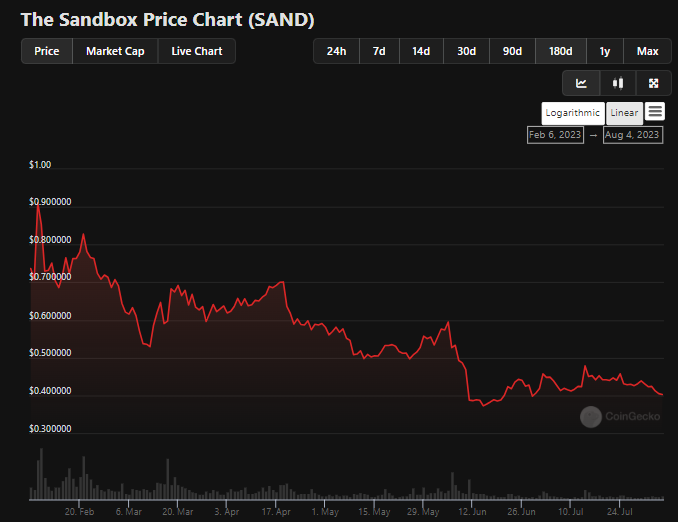
• $SAND - $133.14M on August 14
• $WLD - $7.26M daily
• $AVAX - $118.7M on August 26
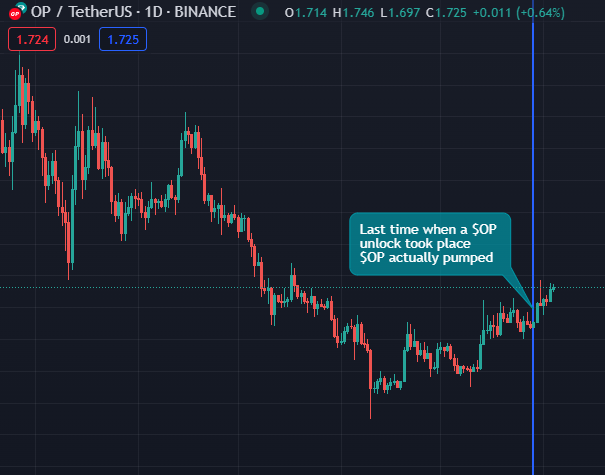
• $OP - $41.3M on August 30
• $INJ - $23.4M on August 21
Some thoughts and what you need to know about them:
> $SAND
$133.14M SAND is 16.16% of the circulating supply and will be unlocked on August 14.
This amount is pretty significant.
The unlocked tokens will mostly go to the team, advisors, and investors.
Investors & advisors are usually the ppl most likely to sell, so it would make sense to see the $SAND price dropping after the unlock.
Yet the token price is already close to its 2023 lows, so the unlock may be partially priced in.
> $WLD
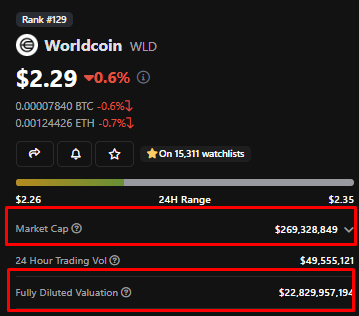
$WLD, the token of Worldcoin, is a ticking time bomb.
Its market cap is only $270M, while its fully diluted valuation is $22.8B!
However, most of the tokens that are now entering circulation are allocated to the community and governed by the team.
Even more, market makers control the majority of the current circulating supply.
> $AVAX
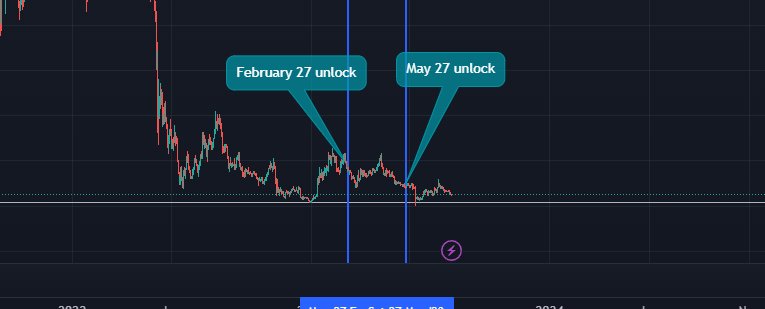
$118.7M worth of $AVAX is 2.76% of the circulating supply.
The unlocked tokens will go mainly to the team and strategic partners.
The last 2 times when new tokens entered circulation the price dropped, but only a few days after that.
> $OP
$41.3M worth of $OP is 3.37% of the circulating supply.
The unlocked tokens are allocated to investors & core contributors.
I think that the upcoming unlock is unlikely to cause a major decrease in $OP price.
This is because there's currently a lot of hype around the project. I'll personally not short it.
> $INJ
3.41% of the INJ circulating supply will enter circulation on August 21.
All of it is allocated to "ecosystem development", so it will probably be controlled by the team.
If the team plans to sell these tokens, they will likely sell them over a period of a few months.
There might be some selling pressure, but I don't expect it to nuke hard.
And that's it for August.
I hope you found this tweet useful🫡
One of the keys to Akash's success is a strong and growing community.
Check out this panel on the 'Secrets to Scaling Community' with @AdamDeanWozney, Head of Community at @ovrclk_, from the @She__Fi Summit — to learn the best ways to build community.
https://t.co/BzSpdB3om1
NVIDIA H100s remain in record-high demand, but distribution is still limited and inefficient.
The launch of the Akash GPU Mainnet is almost here, which will create the first open-source marketplace for high-density GPUs.
The world is ready for the #AISupercloud.
Overclock Labs has announced its acquisition of Cloudmos.
Cloudmos has been a phenomenal contributor to the Akash ecosystem, and as a key part of the acquisition— the entire Cloudmos codebase will become fully open-source.
@ovrclk_ 🤝 @cloudmosio
What’s the best way to invest in the inevitable fusion of crypto + AI?
Many are saying it’s infrastructure.
One notable infrastructure project is @akashnet.
They’re building a “decentralized cloud” for AI compute which could yield 100x returns for the $AKT token.
Let’s explore why:
🔶 What is the Cloud?
“Cloud computing” is just a fancy term for “using someone else’s computer”.
Instead of using your own computer to store data or perform complex calculations, you can use the internet to connect to a remote computer owned by Amazon, Microsoft, Google, etc…
These remote computers are often held in massive data centers.
Data centers are huge buildings (or complexes of buildings) that can each host millions of individual computers (called “servers”).
There are currently 8M+ data centers across the globe.
Cloud computing is one of the greatest advancements of the 21st century. It allows companies to access crucial computing resources without having to spend a bunch of money on hardware, maintenance or security.
As such, most businesses have transitioned to “the Cloud”.
🔶 The Problem with the Cloud
Unfortunately, the “Cloud” isn’t all it’s cracked up to be. Three players — Amazon AWS, Google Cloud Partners and Microsoft Azure — control over 60% of the market.
This creates several problems:
🔹 High costs: Amazon, Google and Microsoft use their dominant position to extract heavy taxes on their users. Andreessen Horowitz estimates that the top 50 publicly traded software companies spend in excess of $8B for cloud services (~50% of COGS)
🔹 Risks of censorship: Control also leads to censorship risks. The major cloud providers can ban anyone they want, at any time and for any reason. This may be an even bigger threat to #Web3, as over 2/3rds of Ethereum and Solana nodes are hosted by major cloud providers.
🔹 Underutilized resources: Finally, the Cloud is woefully inefficient. While there are over 8 million data centers in the world, most operate well below capacity. In fact, it is estimated that 30% to 85% of servers are underutilized.
🔶 The Solution: Akash Network
Akash is solving this problem with a decentralized marketplace for cloud computing.
Anyone can be a customer.
And anyone with sufficient hardware — including individuals or the 8.4M underutilized data centers — can join and sell their computing power for cash.
Often called the “AirBnB” for cloud computing, Akash is poised to break the stranglehold that “Big Tech” has on computing resources.
The network is cheaper, more reliable, more efficient and — most importantly — highly resistant to censorship.
Akash can be used for a variety of services such as:
· Middleware
· Validators
· DAO websites
· Gaming
· Mining
🔶 How does Akash Work?
Akash operates a two-sided marketplace with two key stakeholders:
🔹Tenants: Customers seeking computing resources
🔹Providers: Data centers (or any person with compute & storage capacity) that can provide computing resources
To utilize the network, customers specify their needs and submit a “request for bids” to the network.
Providers receive these requests and respond with a bid and the one with the lowest bid wins the contract.
🔶Market Overview
The global market for cloud compute is expected to rise from $380 billion in 2021 to $1.6 trillion in 2030.
Centralized storage and compute is currently dominated by the “Big 4” cloud providers — Amazon AWS, Google Cloud, Microsoft Azure and Alibaba.
🔶 Competitive Advantage
Akash offers several benefits compared to traditional cloud providers. It is:
🔹 Cheaper:Akash is significantly cheaper than AWS, Google Cloud Platform (GCP), or Microsoft’s Azure, with a cost savings of up to 80–90%.
🔹Censorship resistant: Unlike AWS, who can “deplatform” apps that violate their terms of service, Akash can’t censor or ban any user for any reason.
🔹 More reliable: Decentralized networks are more resilient to crashes and outages. If one data center goes down, Akash can simply switch to another.
🔹 Private:Tenants can choose to remain anonymous. This is important because if a deployment is hacked, critical information will be protected. Customers also aren’t forced to use a credit card, which is ideal for DAOs.
🔹 Flexible: Akash customers can select data centers based on their needs. For instance, a gaming dapp may want to use a cheaper, but less secure provider, while a DeFi protocol may opt for higher security.
🔶Traction
Akash currently has over 389 active leases.
Notable projects powered by Akash include Anonstake, Blockless, Praetor, HNS Search, Chia Network, Cosmos Directory, Third Web and Juno Network.
🔶 Team
Akash is a part of Overclock Labs, which is headquarted in San Francisco.
Notable team members include:
· CEO — Greg Osuri (@gregosuri)
· CTO — Adam Bozanich (@abozanich)
· COO — Boz Menzalji (@boz_menzalji)
· CFO — Cheng Wang
🔶 Tokenomics
$AKT is the native token of Akash. It has a circulating supply of 113.9M and total supply of 388.5M.
Its primary uses are:
• Fees: Transaction fees and block rewards are denominated in $AKT
• Governance: The token is used for governance
Tenants can also choose to settle leases with $AKT.
Akash distributed 100M tokens in its 2020 launch to the public, investors, team, foundation, ecosystem, testnet and select vendors.
$AKT is an inflationary token with a capped supply of 388.5M tokens. Inflation started at 4.5% per month and
gradually decreases over time.
🔶 Potential Valuation
If Akash achieves its ultimate goal of capturing 1% of the $1.6 trillion cloud computing industry, that would imply an FDV of $16 billion.
That’s a ~70x increase over the networks FDV value today.
But that’s just part of the long-term value proposition:
🔶 Long-Term Potential
Akash is currently building out its GPU network, which could have massive ramifications for the protocol.
Not only are GPUs the primary tool for AI (ML and DL), but they are also used in rendering, gaming, IOT, zero knowledge proofs, as well as in a variety of industrial applications.
This represents a massive opportunity for $AKT as many of these use cases have potential values in the tens of trillions! (e.g. AI alone is expected to be worth $80T).
A successful entrance into any one of these spaces could increase $AKTs value by orders of magnitude.
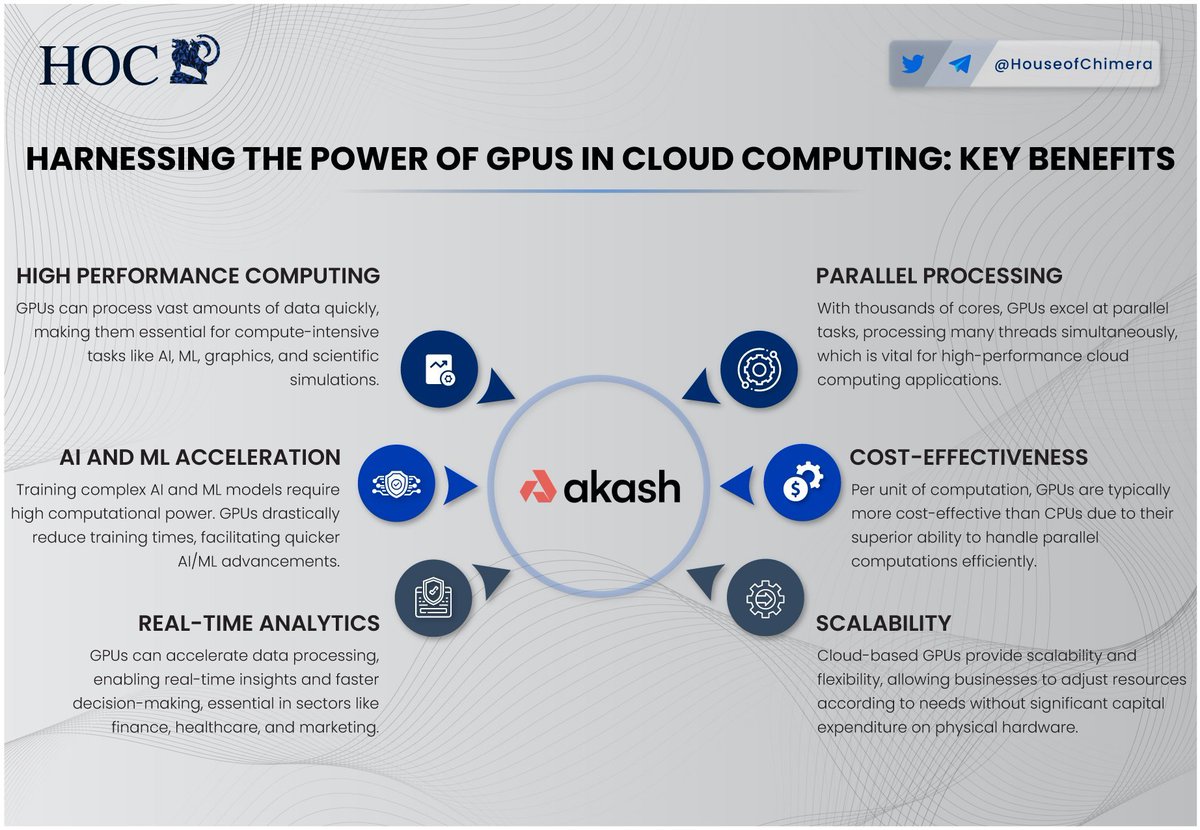
Harnessing the Power of GPUs in Cloud Computing by @akashnet: Key Benefits
🔹GPUs can quickly process vast amounts of data, making them essential for compute-intensive tasks. 🔸With thousands of cores, GPUs excel at parallel tasks, which is vital for high-performance cloud apps
📢Here is the $AKT monthly round-up.
🧬 Here we keep you up to date with the most important news from the @akashnet
team and community over the past month.
Let’s jump in👇
➡️ 1/ 💻
Akash GPU Testnet ended on July 19. During the campaign, over 1,300 participants signed up to stress-test the network across various AI deployments and benchmarks.
https://t.co/BdJEE10tJL
➡️ 2/ 🖼️
During the GPU Testnet, @zJu_u created AIQRArt. The app generated AI QR codes using Stable Diffusion. Members of our community gladly shared the results.
https://t.co/Oq3t8aociM
➡️ 3/ ✈️
In July, Akash had a full slate of events over the world. Akash's presence at the events shows commitment to innovation and solidifies its position in the crypto space.
https://t.co/eUost2yzXG
➡️ 4/
A proposal about Community Pool & Inflation was actively discussed and received big support from the community. This proposal is part of a big $AKT 2.0 update that will come in August.
https://t.co/eUost2yzXG