Bad decisions often come from our lack of insight into our own decision-making process, and our tendency to extract too much/too little information from our observations.
@MartinGTobias Same with Leonardo and the Santa Anna, probably his “best” painting. He kept working at it for 20 years and it was still unfinished when he died.
@harris Astonishing that Founders who are in a position to raise that much still ignore basic fundraising rules such as the one you shared.
Unless they’re also delusional / overconfident about the probability they can raise at all.
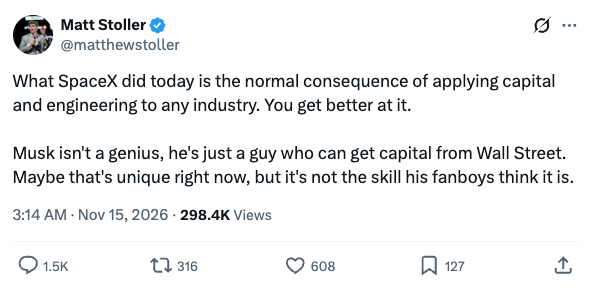
You work your ass off solving really hard problems day after day for decades, and this is what you get: anyone could have done it.
As an investor, I can tell you the limiting factor isn't investment. It's founder ability.
Great leaders today understand that their teams have limited bandwidth and that their decisions are not always consciously processed.
They design and encourage choice environments that take bounded rationality into account and optimize decision outcomes.
@HowardMarksBook (Oaktree): An 80% chance of being right is not certainty. Betting as though it is can get you into serious trouble.
Source: My First Million
@butshaunn@MartinGTobias and pattern-matching on hundreds of CEOs (including himself).
But more than anything, his promotion focus: focus on gains, willing to learn from mistakes, and scoring successes to discriminate skill vs luck.
such a fun time!
Martin Tobias (Incisive Ventures): Investing in 6 Unicorns, Raising A Fund II, And Selecting Founders At The Poker Table https://t.co/XZRljIQJvY via @@TheVCFactory
Thanks Steve. It’s not fast, it takes time because you want to understand how the GP makes decisions.
If I had to pick one, it’s understanding a promotion vs prevention focus: is the VC manager trying to win, or just not lose?
Detailed my approach, Mindset-Based Investing, here:
https://t.co/KxvkXGraPG
Good decisions happen when we pay attention and correct biases at each step of the process:
1️⃣ Judgment: how we predict outcomes from possible choices
2️⃣ Preference: how we weigh those outcomes
3️⃣ Choice: how we combine judgment and preferences to reach a decision
Decision-making skills can improve with practice, clear feedback, and appropriate training.
Correct.
The post cited shows ignorance of base rates and confusion of causality & correlation to a degree it’s frankly embarrassing to display publicly.
Let's not glorify childhood trauma. What people make of their circumstances, good or bad, is what makes someone go the distance, not the trauma itself.
We **should** be talking more about locus of control because I think all great founders have that and it can be manifest in different upbringings and experiences.
@saranormous (@conviction): An investment instinct is a starting point. Test it by looking for what you have missed and where you could be wrong.
Source: Invest Like The Best
@michael_jmoritz (@sequoia): A Webvan hat serves as a reminder of a $44 million investment mistake, and why the same error must not happen again.
Source: Giant Ideas