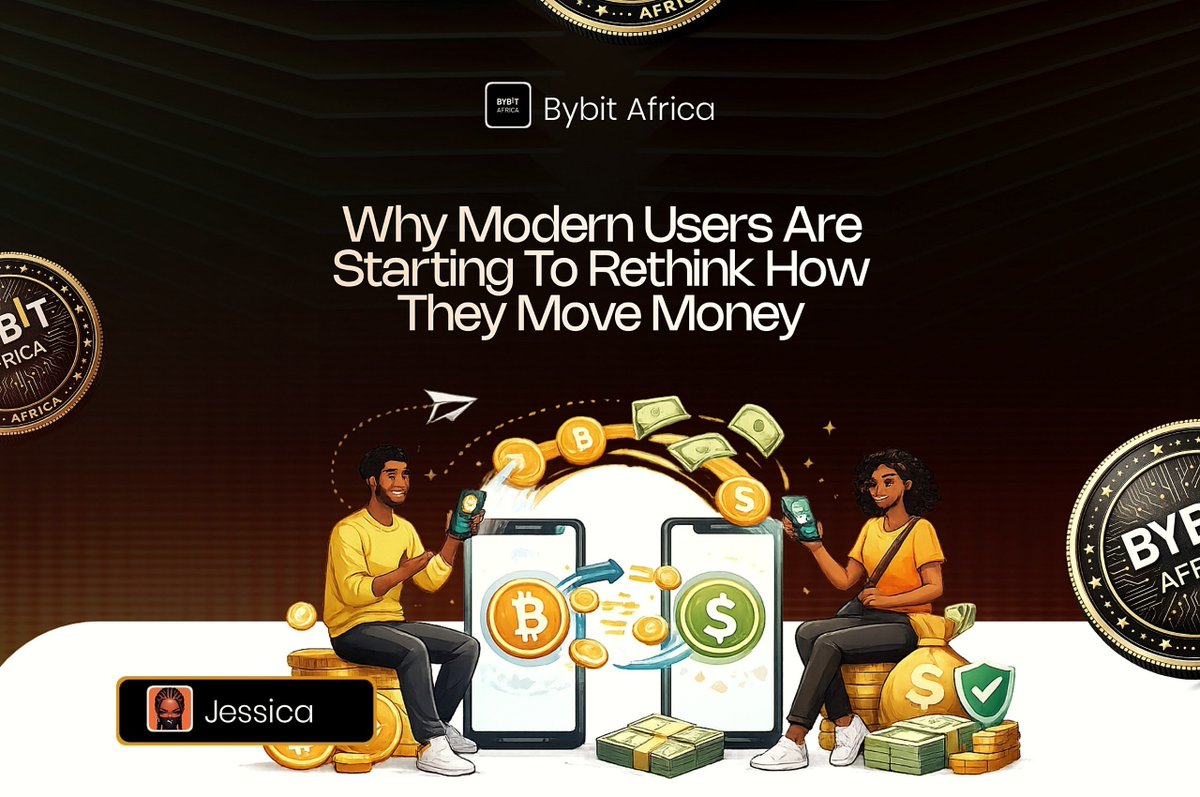
There was a time when bank cards only needed to do one thing well:
Work within your country.
Most financial activity happened locally anyway.
People earned in local currency, spent within local businesses, and rarely interacted with services outside their region often enough to notice the limitations of the system.
That is no longer how money moves today...
#MyBybitCardThread
Some people need to learn to respect boundaries even in buses, someone always wants to know what you are doing on your phone!
honestly, we deserve our privacy... we should not have to beg for it and that is why i love @gloamtrade .
Gloam let's you make transactions onchain without putting your entire business on display.
🚨 $600 up for grabs.
We’re running the Gloam Video Contest, and we want to see how you tell the story of private money on public chains.
On most chains, every payment you make is public. Gloam fixes that with privacy.
You move money privately on Robinhood Chain, Tempo, Base, and Ethereum, and only you decide who sees what.
Make a 1 to 3 minute video about it. Show a private payment, a cash out, a payroll run, or an AI agent paying privately. Or just explain why privacy on-chain matters to you.
Explainer, tutorial, short film, animation, or any style works.
Show the world what robinhood:0xdcd885f5c60b3ad49f6d58718696417314e8724d is building.
Prizes:
🥇 1st: $250
🥈 2nd: $150
🥉 3rd: $100
🏅 4th: $100
Winners are paid privately through Gloam.
How to enter:
Upload your video natively on X and quote this post.
Tag @gloamtrade
More contest details and submission details at https://t.co/sMsQZcF4fq
Entries close 16 November, and winners are announced by 18th November.
We are Moving Past Just the Community Building Part of things into the Building Partnership and collaboration Plus Brand Building Part of things ⚡
Evolution is a Must in a Sector Like Web3...
We are just growing not necessarily Leaving anything behind ⚡
Verifiable data infrastructure is coming to enterprise AI and finance with @spaceandtime.
Proud to be a launch partner as we continue building toward a future where data provenance, privacy, and verifiability are foundational to AI.
we spent a decade teaching people to never share their seed phrase. now the default way to let an ai agent pay for things is to hand it a private key.
that feels backwards to me.
an agent with a key can sign anything. the only thing between it and your money is its instructions, and instructions are the easiest thing to tamper with. a webpage can slip it new ones. so can a tool result. the key doesn't know who's asking, it just signs.
so the fix can't live in the prompt. it has to live somewhere the agent can't talk its way past.
that's the idea behind @spactvault, which i built at #NEARHackathon.
how it works
your money sits in a vault contract on @NEARProtocol. you set the rules. the agent never gets your key. it gets a NEAR function-call key that can do one kind of thing: ask the vault to pay.
then the contract decides, on chain:
- small payments go through on their own
- bigger ones wait until you approve that exact payment in your NEAR wallet
- anything over the cap, or to someone not on your allowlist, is refused, and no approval can push it through
the agent can't move tokens itself, can't change the rules and can't approve its own request. if it gets prompt-injected, the worst it can do is spend inside the limits you set, to people you already allowed.
NEAR makes this unusually clean. function-call keys are part of the account model, so "this key can only call these methods on this contract" is enforced by the protocol, not by my code promising to behave. and the vault has no access keys at all, so nobody can swap its code out, me included.
the part i didn't expect to matter
the hard part wasn't the contract. it was the approval screen.
when you approve a payment, you're trusting that what you see is what you sign. if the website, or whoever runs it, lies about the amount or the recipient, a normal approve button is useless.
so every request gets a fingerprint: a hash of its exact terms, stored by the vault. the approval page recomputes it in your browser, and the vault only accepts an approval that matches. change one character of the terms and it refuses. you're approving the terms, not the ui.
i learned this the practical way too. in my first real run i clicked through what i thought was the approval, and it was actually step one, registering a deposit address. the page now says "step 1 of 2" in plain words. small thing, but it feels like a lot of crypto losses happen at exactly this moment: a person clicking yes without knowing what yes means.
cross-chain
agents don't only want to pay people on NEAR, so the vault can also pay out on other chains through NEAR Intents. those payments always wait for you, whatever the amount, because once the tokens leave, the vault can't see what happens on the other side. i'd rather the contract be honest about where its guarantees end.
what actually happened on mainnet
real USDC, nothing staged:
- the agent asked for 1 USDC to my address on Base
- the vault held it and i got a review link
- i approved in my NEAR wallet
- 0.997398 USDC landed on Base in under 40 seconds
- then the agent asked for 5 USDC. over the cap, refused on chain (HARD_CAP_EXCEEDED), nothing moved
every transaction is linked in the repo.
how i tested it
i wrote down every attack i could think of (a lying backend, a prompt-injected agent, replayed approvals, parallel requests racing each other) and turned each one into a test. 18 cases run on every commit, 17 of them against a real NEAR node, and the results are public on the site.
it's still an unaudited prototype, so small amounts only. but the shape feels right to me: agents get budgets, humans keep keys, and the rules live where nobody can argue with them.
try it: https://t.co/03VXWQzcz1
code: https://t.co/mCQiQTZbzy
genuinely curious: if you ran an agent you didn't write yourself, what would its default limit be? and would you set it per payment, per day, or per recipient?
@NearLegion@NearBuilders
Every single day, my phone buzzed with the same question:
“What’s on the menu today?”
“Do you have jollof rice?”
“How much is egusi soup?”
“Please send pictures” 😩
And every single time, I’d send my food photos one by one, to every customer, over and over again.
I knew I needed a website. But a web designer was too expensive for a small kitchen like mine.
And without one, people didn’t really take my kitchen seriously.
So I tried @Base44 .
I added my food photos, described exactly what I wanted in plain words, and pressed send.
No code. No designer.
A few minutes later, C³ Kitchen had its own website:
➙ My full menu: rice, pasta & noodles, breakfast, soups & swallow
➙ My real food photos
➙ An “Order on WhatsApp” button on every dish
Now when someone asks “What’s on the menu?”, I don’t send 12 photos anymore.
I just send one link ↓
https://t.co/HQTUfnIFlG
If you’ve been putting off building something because you “don’t know tech”, this is your sign.
Every builder needs a base!🫡
I used to think crypto security was about building the strongest lock.
It's not. It's about how fast you can change the lock when someone builds a better key.
The world isn't waiting to find out:
⇾ In 2024, NIST published its first official post-quantum encryption standards
⇾ Governments and big tech are now planning their own migrations
For a blockchain, the hard part isn't picking new cryptography.
It's switching without breaking everything people already use.
That's where @Starknet's design stands out to me:
⇾ Its proof system is already hash-based, so the foundation doesn't need to be rebuilt
⇾ Accounts are programmable, so people can move to new signature methods one account at a time, with no big "switch day" for the whole network
⇾ StarkWare published a 3-phase roadmap (June 2026): secure all new activity, bring older contracts forward, then upgrade the parts that depend on Ethereum
Is it finished? No. Starknet isn't fully quantum-safe yet, and some pieces wait on Ethereum.
But you can't schedule a breakthrough. You can only be ready to adapt when it comes.
What would you rather have: the "strongest" lock today, or one you can change tomorrow?
https://t.co/Qcm83elxa6