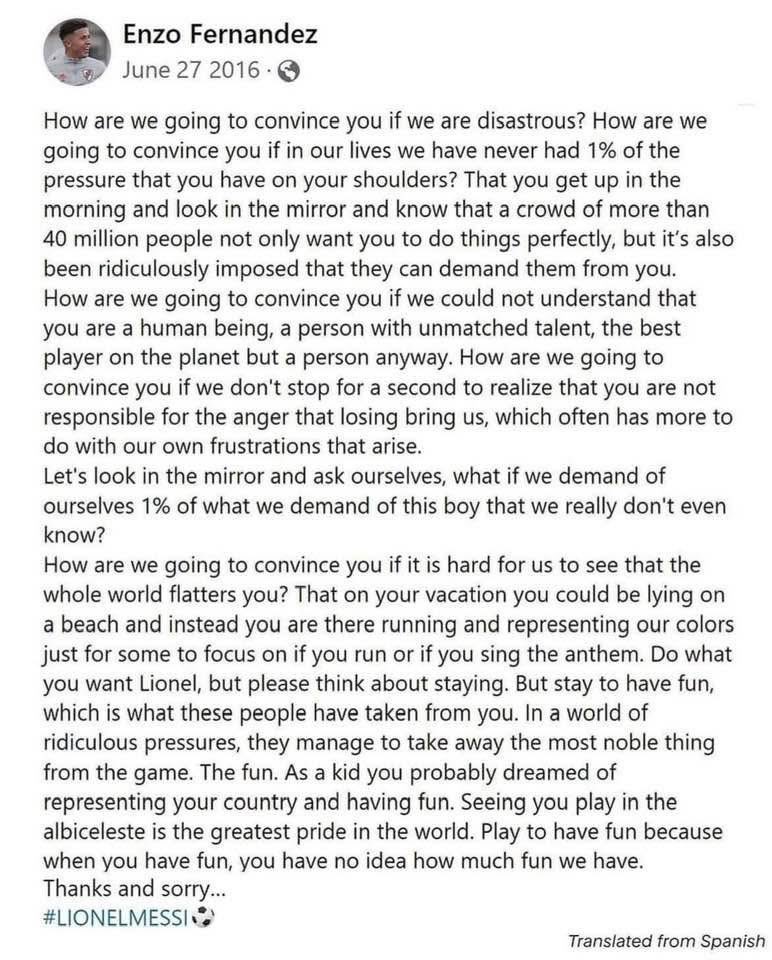
This was then 15-year-old Enzo Fernandez writing this on social media when Messi announced his retirement from the national team. These kids are now dying for him on the pitch. Its a fairytale ending to a perfect career. Not even in movies would this ever happen.
The U.S. soccer federation is a poor return on invested capital.
I played soccer for 20+ years.
Grassroots.
Academy.
D1 college.
Pursued professionally after.
And I’ll say the quiet part out loud:
The US soccer infrastructure is broken.
In America, we treat playing D1 soccer like it is the peak achievement.
For most families, clubs, coaches, and players, the entire youth soccer machine is built around one goal:
Get recruited.
Get a scholarship.
Play college soccer.
But if the objective is to produce world-class players, D1 soccer is a terrible development path.
From 18-22, some of the most important technical development years of your career, you are preparing for a 3-4 month season built largely around athleticism, direct play, set pieces, fitness, and survival.
Now compare that to an 18-year-old in Spain, Argentina, Morocco, Italy, England, or France.
That player has likely been in a professional environment for years.
Training daily.
Playing meaningful matches year-round.
Competing against grown professionals.
Getting thousands more touches.
Learning how to solve the game under pressure.
The gap is massive.
And it shows.
American players are usually athletic.
They are usually fit.
They usually compete hard.
But at the highest levels, that is not enough.
The biggest difference is technical comfort.
We do not move the ball like Spain.
We do not combine like Argentina.
We do not play with the same fluidity, rhythm, and confidence you see from countries where the game is embedded into the culture from childhood.
That comes down to volume.
Volume of touches.
Volume of street soccer.
Volume of futsal.
Volume of unstructured play.
Volume of high-level training environments.
Volume of meaningful games.
In the US, youth soccer is expensive, overly organized, overly coached, tournament-driven, and too often built around winning games at 13 instead of developing players for 23.
Parents spend thousands.
Clubs charge thousands.
Travel teams fly all over the country.
Showcases become the product.
Recruiting becomes the scoreboard.
But the return on invested capital is poor.
We probably spend more money on youth soccer than almost any country in the world, yet the technical output does not match the investment.
That is a broken operating model.
And like any business, if the output is weak, you do not blame the customer.
You inspect the system.
The US has talent.
The US has athletes.
The US has money.
The US has facilities.
But the foundation is wrong.
We built a pay-to-play, college-recruiting machine and confused it for a world-class player development system.
Those are not the same thing.
Until we fix the grassroots layer, increase meaningful touches, make development less dependent on family income, and stop treating college soccer as the top of the mountain, the US will keep underperforming relative to its resources.
I’m not saying this to trash US Soccer.
I’m saying it because I lived it.
And if we actually want to become a powerhouse, we have to be honest about the infrastructure first.
"AmERiCa HaS No FoOtBaLIInG Culture"
ok, where else can you watch Egypt vs New Zealand on 11 screens while ripping cigs and listening to Bone Thugz & Eazy-E, get f**ked.
🚨🎙️Zlatan Ibrahimović on Lionel Messi’s World Cup hat-trick masterclass as Argentina beat Algeria 3-0:
🗣️ “Let me tell you something… this is what happens when the greatest of all time plays football.”
“Messi didn’t just have a good opening game… he arrived at the World Cup like he still owns the damn thing.”
“People talk about age, about the end of an era, about pressure at 38 going on 39… but he doesn’t feel any of that. He creates pressure for every defender in the tournament instead.”
“Algeria tried to sit deep, they tried to frustrate, they tried to compete… but when Messi gets the ball anywhere near the box, the game is basically over.”
“A hat-trick on the opening night of the World Cup? That’s not normal… that’s a statement. That’s a warning to every team left in this tournament.”
“And this is why Argentina won so comfortably — because when you have a player like him, you don’t need ten chances. You need one moment of magic… and he gave them three.”
“Now people will start talking again… ‘Is he still the best player in the world?’ I don’t talk. I show. And tonight, Messi showed everyone.”
“This was not just three points for Argentina… this was a message to the entire World Cup. The king is still here.”
YOU THINK $XRP IS JUST A COIN… YOU’RE MISSING THE BIG PICTURE 😳
If you’ve watched this video of Ripple CTO David Schwartz, the bullish case for $XRP becomes existential
The next tech wave isn’t better UI or faster apps, it’s infrastructure that makes money move like information.
Nobody in the ‘90s could’ve imagined the scale of streaming. Today, we can’t fully imagine the consequences of value transfer dropping to near-zero cost.
But Schwartz isn’t guessing, he’s seen this pattern before.
This is about enabling new systems, new behaviors, and new use cases no one’s priced in yet.
True disruption doesn’t announce itself. But it always leaves a trail.
Can you connect the dots?
@_RadiantMind@beyond_broke I think he is. He mentioned in his last live that his 99.9999% confidence may have something to do with the timeline as well. When the year is 99.9999% complete?