Ever wondered why blockchain networks sometimes feel slow or congested even with powerful nodes?
The real bottleneck isn’t always computation; it’s data propagation.
Let’s break this down. 👇
@get_optimum@MurielMedard@blockchainjeff
Builders and node operators can start using mump2p today to see real latency improvements. DeRAM and DeROM are coming next, bringing fast low-latency reads and writes.
@get_optimum is the fastest decentralized internet protocol for web3
Web3 now sees infrastructure as real resources: compute, storage, liquidity... and now speed.
@get_optimum’s Flexnodes & Latency Marketplace treat latency as a monetizable asset... improving block propagation, coordination & network efficiency.
Speed becomes infrastructure.
I once thought data storage was Web3’s main challenge. Turns out retrieval is harder.
Blockchains preserve data well, but instant access is the gap.
That’s why @get_optimum stands out: mump2p & RLNC for faster movement, then DeRAM for instant usability.
Every blockchain "Send" starts a journey across continents and thousands of nodes.
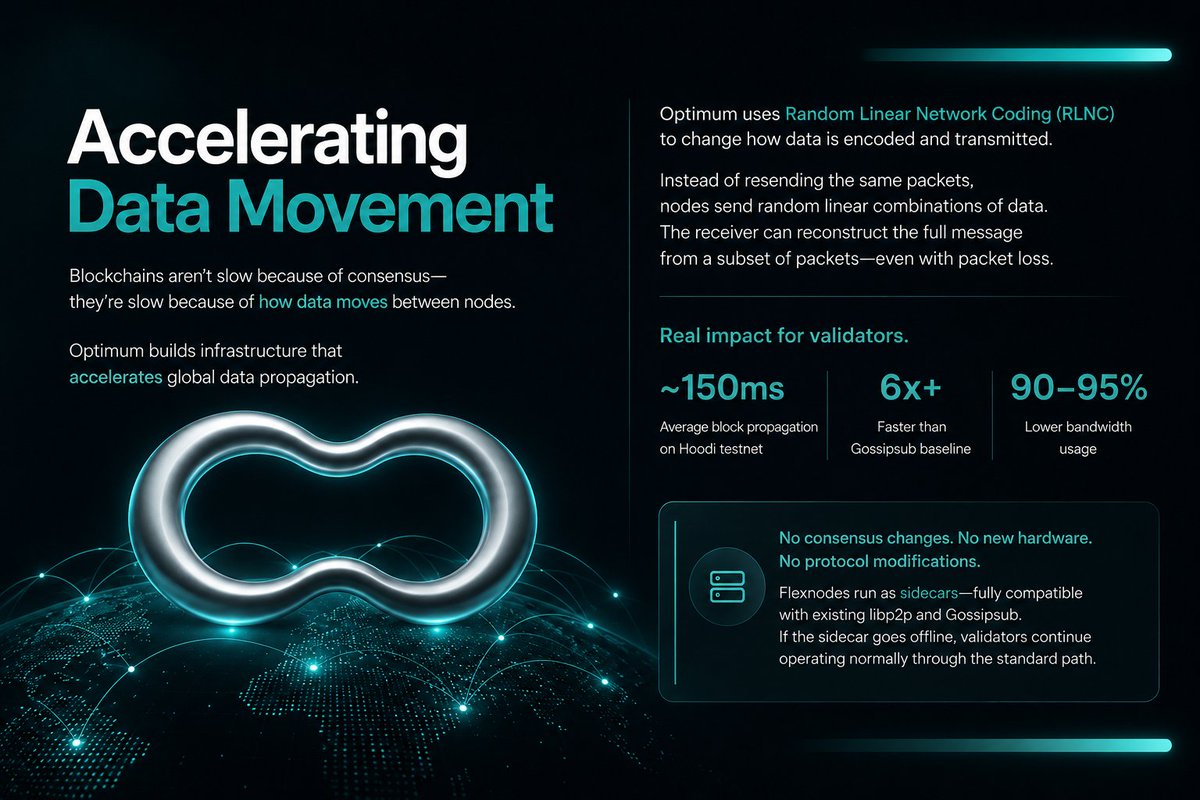
While TPS gets all the hype, data propagation is the hidden bottleneck. @get_optimum uses RLNC for smarter, faster network flow.
Xeffy's Community MiniApp has launched! 🚀
Join us: https://t.co/hmAJIkcSfD
Access the Xeffy app, become an early contributor, and contribute to RWA mass adoption!
Early participants and contributors will be provided with our ecosystem token $Xef 🎁
Mark June 2026 on your calendars!👀🪂
Invite your friends and earn points by using the app!
Optimum is not a blockchain, but a side network that works alongside existing chains. It handles no consensus or transactions, needs no protocol changes, and only boosts data propagation during heavy network load.
Diving into mump2p by @get_optimum: Blockchains need faster node comms, not just execution. It splits data into coded pieces for quick rebuild vs gossip. Handled 10MB blocks in 1s on testnet....key for scaling DeFi, DePIN & AI.
Most scaling discussions focus on adding capacity.
What interests me about @get_optimum and Flexnodes is the focus on unlocking unused bandwidth and making existing connectivity more valuable, not raising barriers to participation.
Infrastructure determines blockchain scalability.
Boosting throughput & fees isn't enough if data can't propagate efficiently across the network.
@get_optimum is tackling this key communication layer for stronger coordination & decentralization at scale.
Blockchain bottlenecks are shifting from consensus to data propagation speed.
@get_optimum’s Flexnodes use RLNC coding to accelerate global block spread. On Hoodi testnet: ~150ms propagation (6x faster) with 90-95% less bandwidth. Runs as compatible sidecar, no protocol changes.
People only discuss blockchain scalability after slowdowns hit. But comms issues build quietly: more users = more data, straining global validator sync across latencies.
@get_optimum tackles this with RLNC-powered data acceleration for efficient, low-latency propagation.
The next gen of software is AI-driven. But most legacy infrastructure wasn't built for today's heavy AI demands.
@get_optimum is building AI-native systems for seamless coordination & scalable compute, so devs can focus on innovation as AI adoption accelerates globally.
The biggest challenge in blockchain isn’t always raw computation....often, it’s communication.
@get_optimum is creating a decentralized memory layer to radically improve how data travels across networks, cutting latency and enabling much faster coordination.